
Resources
Underwriting resources
Practical perspectives on document review, financial analysis, fraud signals, policy evaluation, and explainable decisions.
Book a walkthrough
The library, by stage
Every guide, shelved over the stage of underwriting it explains.
Each spine is one guide, standing over its workflow stage, and its height is how long it takes to read. Two stages have no guide of their own yet, and the shelf leaves them empty.
- 23
- Guides on a single stage
- 04
- Guides across the whole workflow
- 07
- Stages with guides of their own
- 01
- Stages without one yet
Across the whole workflow · 37 min
- What Is Decision Intelligence in Underwriting? A Practical Guide12 min
- From Documents to Decision-Ready Underwriting: Building a Connected Review Workflow11 min
- Human-in-the-Loop AI Underwriting: Why Lenders Shouldn't Automate Away the Underwriter8 min
- Underwriting Turnaround Time: How Fragmented Review Slows Down MCA and SMB Lenders6 min
01Intake1 · 5 min
- Document Intelligence for Lenders: Turning Messy Borrower Files into Structured Underwriting Data7 min
- The Hidden Cost of Manual Document Review in MCA Underwriting7 min
- Source-Linked Extraction: Why Underwriters Need Evidence, Not Just Answers6 min
02Documents3 · 20 min
- Bank Statement Analysis for Underwriting: The Complete Guide for Alternative Lenders7 min
- Cash Flow Underwriting for SMB Loans: What Underwriters Should Actually Look For7 min
- NSF Patterns and Overdrafts: What They Really Tell Underwriters About Risk8 min
- Average Daily Balance, DSCR, and Deposit Consistency: Core Metrics for MCA Underwriting10 min
- Bank Statement Analysis Software vs. an Underwriting Platform: What MCA Funders Actually Need4 min
03Financials5 · 36 min
- KYB for Lenders: A Practical Guide to Business Verification in Underwriting9 min
- KYB vs. KYC: What Alternative Lenders Need to Know7 min
- Shell Companies and Synthetic Business Identities: A Growing Risk in SMB Lending7 min
04Verification3 · 23 min
- Detecting Stacking in Merchant Cash Advance Underwriting9 min
- Fraud Signals in Small Business Lending: What Underwriters Should Watch For8 min
- Bust-Out Fraud in MCA Lending: How It Works and How to Catch It Early7 min
- Document Fraud Detection in Underwriting: Beyond the Naked Eye7 min
05Fraud4 · 31 min
- What Is a Loan Policy Engine? A Guide for Alternative Lending Teams7 min
- Decision Engine vs. Underwriting Engine: What's the Difference?6 min
- Why Policy Exceptions and Overrides Need an Audit Trail7 min
06Policy3 · 20 min
- Underwriting Audit Trails: Why Evidence-Linked Decisions Matter for Alternative Lenders6 min
- Evidence-Backed Underwriting Reports: What Good Documentation Looks Like7 min
- Explainable AI in Underwriting: Meeting Compliance Expectations Without Slowing Down Decisions7 min
- AI Credit Memos for Small-Business Lending: What a Decision-Ready Memo Must Contain5 min
07Report4 · 25 min
- No guide yet
08Human DecisionCovered above
Spine height is reading time
Point at a spine, or tab to it, to read what the guide covers, how long it takes and which part of Cevrynt it relates to. Every spine is a link straight to the article.
Why the library is shelved by stage
An underwriting team rarely goes looking for "fraud content". It goes looking for help with the part of the file it is stuck on — the statements, the verification, the rule a deal keeps missing. So the guides stand over the stage they help with, in the same order as the workflow the rest of this site describes.
The empty shelves are left empty on purpose. Intake and the human decision have no guide of their own yet; what covers them today are the four guides that span the whole workflow, drawn as a bracket over every stage rather than squeezed onto a shelf they do not belong to.
How the shelf is built
- Where a guide standsIts own stage tag
- Spine heightReading time
- Order on a shelfOldest first
- Audience guidesRoutes, in 02
Nothing on the shelf is placed by hand. Each guide's stage, category and reading time come from the article itself, so a new guide appears over its stage the moment it is published.
Six stages with guides of their own, two covered by the guides that span them all, and every spine a link. The shelf shows where the writing is deep, where it is thin, and exactly how long each part takes to read.
Reading routes
Start from the work you do, and follow four guides to the page that describes it.
One line for each kind of reader, stops in reading order, and the guides two routes share drawn as interchanges.
- 05
- Reading routes
- 17
- Guides they stop at
- 03
- Interchanges between routes
- 00
- Forms before a guide
Route 01You fund merchant cash advances4 guides · 33 min
Route 02You lend on revenue or cash flow4 guides · 29 min
Route 03You lend to online sellers4 guides · 30 min
Route 04You submit deals as a broker or ISO4 guides · 29 min
Route 05You are choosing underwriting software4 guides · 28 min
A guideOn more than one routeThe page for that work
Why a route ends at a page, not a sign-up form
Four guides in order is about half an hour's reading, and it is enough to know whether the way Cevrynt thinks about underwriting fits the way your team works. The natural next step after that is the page describing your own workflow — not a form asking for your email first.
The interchanges are worth noticing. The bank-statement guide is where an MCA funder and a cash-flow lender start to share a problem; stacking is where a funder and a broker do. Pointing at one lights it on every route it belongs to.
What a route is
- Reading orderSuggested
- Where it endsA page on this site
- Email needed to readNo
- LengthSummed reading time
Routes are a starting order, not a curriculum. Every guide stands on its own, and the full library — including everything not on a route — is on the shelf above and in the blog.
Five kinds of reader, four guides each, and three places where their routes cross. Start with the line that sounds like your work, and it ends at the page that describes it.
Read it, then see it
Three guides, each pinned to the screen that shows what it describes.
Every pin is one of the guide’s own section headings, placed on the part of the product view it is about. Choose a guide, then follow the numbers.
- 03
- Guides paired with a product view
- 09
- Guide sections marked on the views
- 00
- Real borrower files shown
Read
Where each section shows
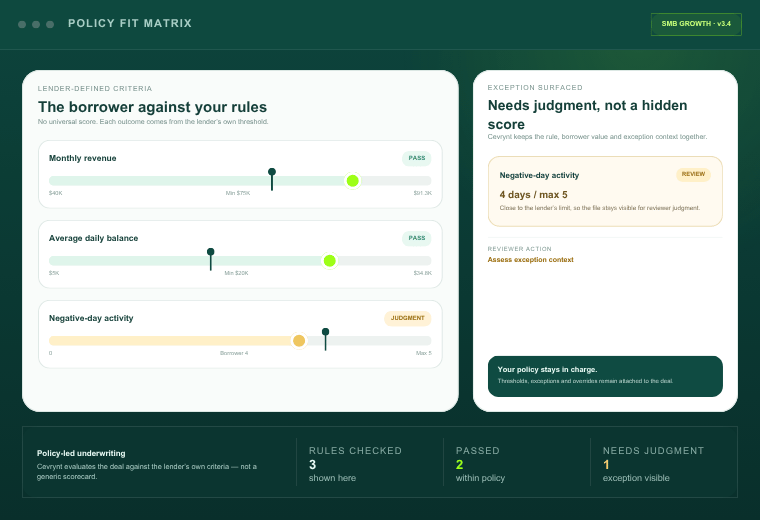
- Why lender-specific configuration mattersThe policy name and version the whole view is evaluated against.
- What good policy evaluation output looks likeEach rule shows the lender's threshold, the borrower's value and the outcome on one line.
- Policy engine vs. a black-box scoring modelThe item near its limit is surfaced for judgment instead of folded into a score.
Why the view sits beside the guide
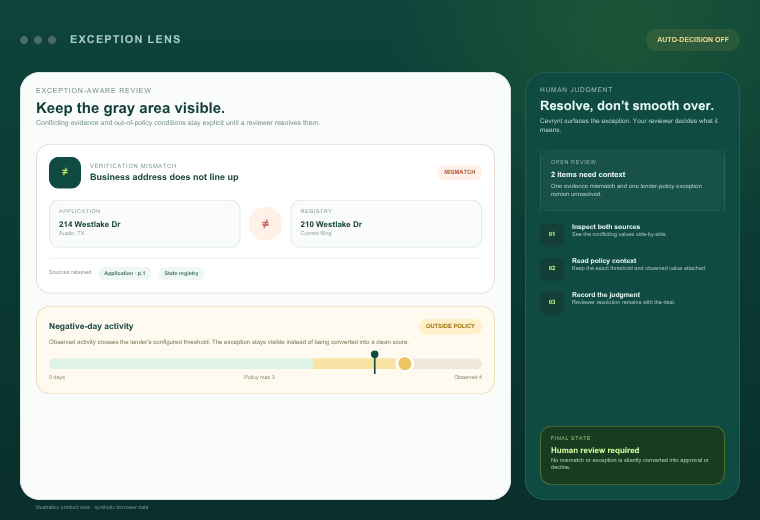
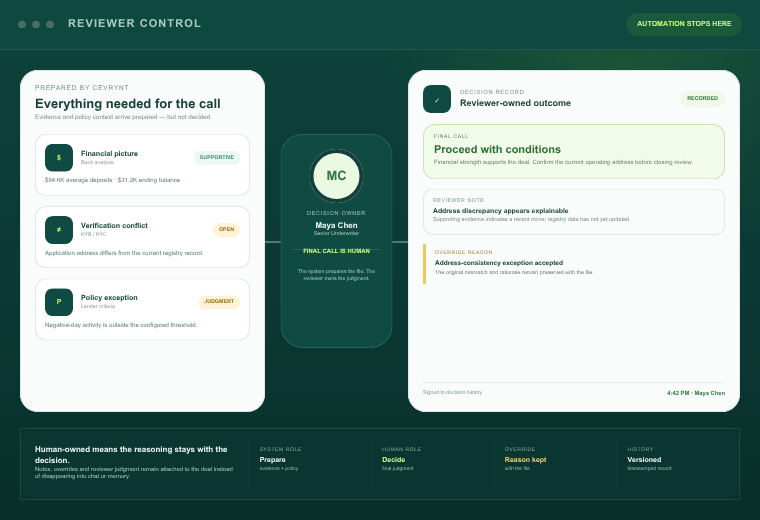
"Keep exceptions visible" is easy to agree with in a paragraph and hard to picture. Set beside a screen where the exception is visibly still open, the idea stops being abstract — so each guide here is paired with the one view that shows what it argues.
The pins are the guide's own section headings, word for word, and each links straight to that section. Nothing on the screen is a real borrower: these are illustrative views on synthetic data, and every caption says so.
How to read a plate
- A numbered pinA section of the guide
- Its headingLinks to that section
- The viewIllustrative, synthetic
- In contextThe product page
Three guides have a view that matches them closely enough to pin. The rest are on the shelf and routes above; a pairing is added only where the screen genuinely shows what the guide describes.
Read the section, then find it on the screen. Nine headings, three views, and every pin a link back to the paragraph that explains it.
Question index
Every question the guides already answer, searchable as you type.
Gathered from the FAQ at the end of every guide. The bars show where in the workflow the matching answers live; each row opens the guide that answers it.
- 215
- Questions the guides answer
- 32
- Guides they come from
- 215
- Showing now
215 questions
- Is decision intelligence the same as automated underwriting?What Is Decision Intelligence in UnderwritingWhole workflow
- Does decision intelligence replace a lender's credit policy?What Is Decision Intelligence in UnderwritingWhole workflow
- What is the biggest risk of adopting decision intelligence tools poorly?What Is Decision Intelligence in UnderwritingWhole workflow
- Who uses decision intelligence platforms in lending?What Is Decision Intelligence in UnderwritingWhole workflow
- How do I know if my current underwriting stack is disconnected or genuinely connected?What Is Decision Intelligence in UnderwritingWhole workflow
- Is it realistic for a smaller lending operation to adopt decision intelligence, or is this only for larger funders?What Is Decision Intelligence in UnderwritingWhole workflow
- Does moving to a connected workflow require replacing every existing tool at once?What Is Decision Intelligence in UnderwritingWhole workflow
- Does a connected underwriting workflow replace the underwriter?From Documents to Decision-Ready UnderwritingWhole workflow
- How is this different from a loan origination system (LOS)?From Documents to Decision-Ready UnderwritingWhole workflow
- Can this fit an existing credit policy, or does it require adopting a new one?From Documents to Decision-Ready UnderwritingWhole workflow
- What is the illustrative Cedar & Stone LLC deal referenced in Cevrynt's materials?From Documents to Decision-Ready UnderwritingWhole workflow
- Does a connected workflow require underwriters to change how they make decisions?From Documents to Decision-Ready UnderwritingWhole workflow
Why the answers stay in the guides
Every guide ends with the questions readers most often ask about its subject. Spread across the library they are hard to find, so this index gathers all of them and lets you search as you type. The bars above the list redraw with each keystroke to show which part of the workflow the matches come from.
The answers are deliberately not repeated here. A two-line answer lifted out of a guide loses the reasoning around it, so each row takes you to the guide's own FAQ, where the answer sits next to the explanation it depends on.
What the index is
- Where questions come fromEach guide's FAQ
- Where answers liveIn the guide
- SearchAs you type
- Nothing matchesAsk the founder
Questions are taken word for word from the guides' FAQ sections and update whenever a guide does. They are general answers about underwriting practice, not advice about a particular file or lender.
Every question the library answers, in one place, and one keystroke from the guide that answers it. If yours is not on the list, that is worth telling us.
Glossary
The terms the guides lean on, each defined once and linked to where it is explained.
From ADB to stacking: a sentence or two for each, tagged by the part of the workflow it belongs to, and a link to the guide section that works it through.
- 20
- Terms defined
- 14
- Guides they point into
- 06
- Parts of the workflow
- Audit trailReport
- The evidence, policy outcome, notes and overrides behind a decision, kept so the decision can be reconstructed later.
- The components of a reconstructable decision recordUnderwriting Audit Trails
- Average daily balanceADBFinancials
- The average of an account's end-of-day balances across a period — a steadier read of liquidity than any one statement's closing balance.
- Average daily balance (ADB)Average Daily Balance, DSCR, and Deposit Consistency
- Beneficial ownerVerification
- A person who ultimately owns or controls the business, whether or not they appear on the application. Where KYB and KYC meet.
- Beneficial ownership verification sits at the intersectionKYB vs. KYC
- Bust-outFraud
- A scheme that builds a normal-looking history, then draws as much credit as possible in a short window with no intention of repaying.
- How a bust-out scheme typically unfoldsBust-Out Fraud in MCA Lending
- Cap and termFinancials
- In revenue-based financing, the total to be repaid and the period over which a share of revenue is expected to repay it.
- How cap and term work in RBF and why they matter for underwritingRevenue-Based Financing Underwriting
- Composite documentFraud
- A document stitched together from parts of genuine ones, so each piece looks authentic on its own.
- Composite documentsDocument Fraud Detection in Underwriting
- Debt service coverage ratioDSCRFinancials
- Cash available for debt payments divided by the payments due. Below 1.0, the obligations are larger than the cash flow meant to cover them.
- Debt service coverage (DSCR)Average Daily Balance, DSCR, and Deposit Consistency
- Decision enginePolicy
- The logic layer that renders a result from rules — narrower than an underwriting engine, which covers the whole review.
- Decision engine: the specific logic layer that renders a resultDecision Engine vs. Underwriting Engine
- Decision intelligenceWhole workflow
- Connecting data, analysis and human judgment in one underwriting workflow. A property of the workflow, not a model.
- Decision intelligence is a workflow property, not a modelWhat Is Decision Intelligence in Underwriting
- Deposit consistencyFinancials
- How evenly deposits arrive from month to month. A steady business and a volatile one can share the same average.
- Deposit consistencyAverage Daily Balance, DSCR, and Deposit Consistency
- Human-in-the-loopWhole workflow
- A design where software prepares the file and a named person makes — and owns — the decision.
- What genuine human-in-the-loop design requiresHuman-in-the-Loop AI Underwriting
- Know your businessKYBVerification
- Confirming that a business exists, is in good standing, and is the entity the application says it is.
- KYB: know your businessKYB vs. KYC
- Know your customerKYCVerification
- Confirming the identity of the people behind the business — owners, officers and whoever signs.
- KYC: know your customerKYB vs. KYC
- Lookback periodFinancials
- The span of statement history an analysis covers. Every other metric moves when it changes, so it belongs next to every figure.
- How the lookback period choice affects every metricAverage Daily Balance, DSCR, and Deposit Consistency
- Non-sufficient funds eventNSFFinancials
- A payment presented when the account cannot cover it, either returned or paid into overdraft. The pattern matters far more than the count.
- What an NSF event actually indicatesNSF Patterns and Overdrafts
- OverridePolicy
- A reviewer's documented decision to proceed differently from what the policy outcome indicated, with the reason recorded.
- What a good override record should includeWhy Policy Exceptions and Overrides Need an Audit Trail
- Policy exceptionPolicy
- A file where an observed value falls outside one of the lender's policy thresholds. It is a finding, not a decision.
- The difference between an exception and an overrideWhy Policy Exceptions and Overrides Need an Audit Trail
- Source-linked extractionReport
- Pulling a value from a document while keeping a pointer to the exact page and line it came from.
- What good source-linking looks like in practiceSource-Linked Extraction
- StackingFraud
- Taking further advances from other funders while existing positions are still being repaid.
- Why stacking happens and why it's difficult to catchDetecting Stacking in Merchant Cash Advance Underwriting
- Synthetic business identityVerification
- A business assembled from real-looking records to borrow against, rather than one that genuinely trades.
- Synthetic business identities: a more sophisticated variantShell Companies and Synthetic Business Identities
Why each definition is only a sentence or two
A glossary that tried to explain DSCR or stacking in full would be a worse version of the guide that already does. So each entry gives just enough to keep reading — the meaning as the guides use it — and hands off to the exact section where the term is worked through, with its caveats.
The terms are the ones the library actually leans on, not a dictionary of lending. Each is tagged with the part of the workflow it belongs to, and each link lands on a section heading, not just the top of an article.
How an entry is built
- The definitionPlain language
- The linkA guide section
- Link targetsChecked at build
- OrderA to Z
Definitions describe how these terms are generally used in underwriting and in the guides. They are not regulatory definitions and are not advice on any particular file.
Twenty terms the library leans on, a sentence each, and a link from every one to the section that explains it properly.
Founder-led
Bring the question your underwriting team keeps coming back to.
If a guide raised something your team handles differently, we will walk through how Cevrynt shows the evidence for it — against your own criteria, with your underwriters making every decision.