
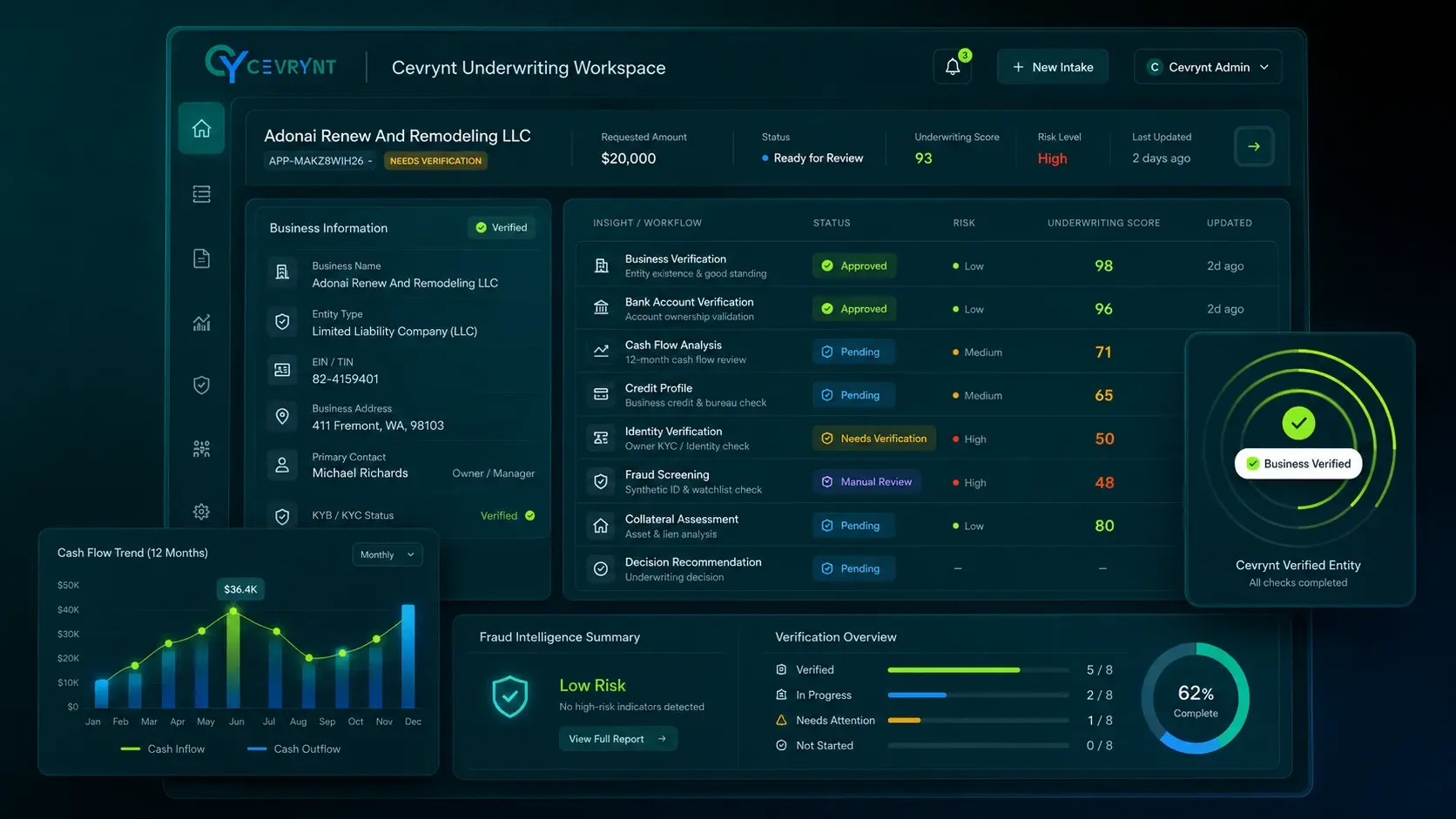
"Human in the loop" has become one of the more overused phrases in lending technology, often appearing as a footnote in a pitch deck rather than a real design principle. For alternative lenders evaluating AI-assisted underwriting tools, it is worth understanding what the phrase should actually guarantee — because the difference between genuine human-in-the-loop design and a rubber-stamp workflow has real consequences for risk, compliance, and borrower outcomes.
This is not an argument against automation. Automating document classification, financial extraction, and initial policy checks genuinely saves underwriters time. The argument is narrower and more specific: the decision to approve, decline, or counter-offer on a loan or advance should remain with a trained person, and the system supporting that person should make their judgment easier to exercise well, not harder to exercise at all.
Why full automation is the wrong goal for underwriting
It is tempting to frame underwriting automation as a spectrum with "fully manual" on one end and "fully automated" on the other, with the implicit assumption that more automation is always better. That framing breaks down for a few structural reasons specific to underwriting.
First, underwriting decisions in alternative lending — particularly merchant cash advance underwriting — routinely involve judgment calls that do not reduce cleanly to a rule. A seasonal business with an unusual deposit pattern might be a red flag or might be completely normal for that industry; distinguishing between the two often requires context a model was not trained to weigh. Second, the cost of a wrong decision is asymmetric and consequential — both for the lender's capital and for the borrower's business — in a way that rewards caution over throughput. Third, regulatory and investor scrutiny of automated credit decisions has intensified, and a fully automated decision is harder to defend after the fact than one a trained underwriter can explain.
What genuine human-in-the-loop design requires
A workflow that claims to be human-in-the-loop should meet a few concrete criteria. If it does not, the term is likely being used as marketing rather than as an accurate description of how decisions actually get made.
The underwriter sees evidence, not just conclusions
A system that tells an underwriter "this file scored 72 out of 100" without showing which specific transactions, documents, or verification results drove that score is not meaningfully keeping a human in the loop — it is asking the human to trust a number. Genuine human-in-the-loop design surfaces the underlying evidence alongside any summary finding.
Override is a first-class action, not a workaround
In many underwriting operations, disagreeing with an automated finding requires stepping outside the tool entirely — a note in a separate spreadsheet, an email to a manager. That friction quietly discourages underwriters from exercising judgment, even when they should. A well-designed workflow makes override a supported, documented action within the same system, not an exception that has to be handled manually.
The system adapts to lender-specific policy, not the reverse
If adopting a tool means underwriters have to start following the tool's implicit policy rather than the lender's own, the human has effectively been moved out of the loop, even if they are technically still clicking "approve." Policy evaluation should reflect the lender's actual credit criteria, described further in our guide to loan policy engines.
Escalation paths exist for ambiguous files
Not every file is equally clear-cut. A genuine human-in-the-loop workflow should make it easy to route an ambiguous file to a senior underwriter or a second reviewer, rather than forcing a binary decision under time pressure.
Where automation earns its place
None of this is an argument against automating the parts of underwriting that genuinely benefit from it. Automation is well suited to structurally repetitive tasks: classifying documents, extracting transaction data, computing standard financial metrics, checking business registration status, and applying explicit policy rules consistently across every file. These tasks do not require judgment so much as consistency, and they are exactly where manual review introduces the most variance and the most wasted time.
The dividing line is not "which tasks are hard" but "which tasks require weighing context that is specific to this borrower, this industry, or this moment." Automation should handle the former reliably and hand the latter to a trained person with full context.
Why this distinction has gotten more important, not less
It would be reasonable to assume that as AI models improve, the case for keeping a human in the loop weakens. In practice, the opposite pressures have grown stronger. Regulatory attention on automated credit decisions has intensified across jurisdictions, with growing expectation that lenders can explain individual decisions rather than pointing to aggregate model performance. Investors conducting diligence on alternative lending portfolios increasingly ask not just about approval rates, but about how decisions are made and who is accountable for them. And borrowers themselves — small business owners whose livelihoods depend on financing decisions — are a population where getting individual cases wrong carries real human cost, not just a statistical error rate that looks acceptable in aggregate.
None of this means AI has no place in underwriting. It means the role AI plays needs to be structured deliberately, with human judgment positioned at the point where the actual credit decision gets made, rather than treated as a formality that can be minimized as models improve.
A worked example: where automation stops and judgment begins
Consider a borrower whose bank statements show three months of strong, consistent deposits, but with one unusual $40,000 deposit in the second month that doesn't match the business's typical transaction pattern. In a well-designed human-in-the-loop workflow, automation handles the mechanical parts of this: it classifies the documents, extracts the transaction data, calculates the standard cash flow metrics, and flags the unusual deposit as an outlier worth a closer look, with a direct link back to the specific statement line.
What automation should not do is decide, on its own, whether that $40,000 deposit is a red flag or a benign explanation — a one-time equipment sale, a insurance payout, a large client prepayment. That distinction requires context a system wasn't necessarily trained to weigh: knowledge of the specific industry, a conversation with the borrower, or a judgment call about how much weight one anomaly should carry against an otherwise strong three-month history. This is exactly the kind of decision that should land with a trained underwriter, informed by the automated flag rather than overridden by it.
Questions to ask a vendor about human-in-the-loop claims
- Can an underwriter see the source document or transaction behind every automated finding, in one click?
- How is a manual override captured, and is it visible to a second reviewer or auditor later?
- What happens when an underwriter disagrees with a fraud or policy flag — is there a documented path, or does it require going outside the tool?
- Does the platform ever issue a final approval or decline without a human review step?
- Can the platform be configured to reflect our specific credit policy, including our existing exceptions?
From here, this article is about Cevrynt
How Cevrynt keeps the underwriter in control
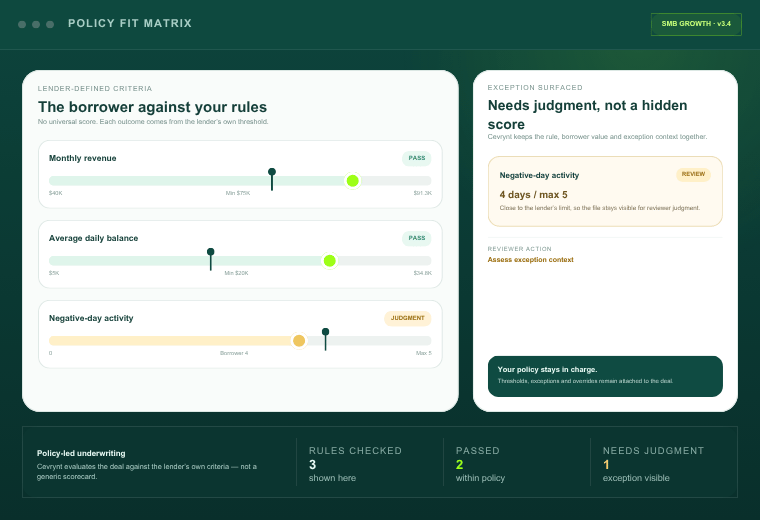
Cevrynt is built around the premise that AI should structure evidence for an underwriter, not replace their judgment. Every finding across document intelligence, financial analysis, verification, and fraud signals stays linked to its source, and every stage feeds into a policy engine that supports documented overrides rather than treating them as exceptions to route around.
Cevrynt is not a lender, does not issue funding decisions, and does not guarantee outcomes. It exists to give the underwriting team a more complete, evidence-linked picture — while leaving the actual approval, decline, or counter-offer decision exactly where it belongs, with the lender's own underwriting team.
For teams evaluating how this balance works in practice, a qualified walkthrough against a representative file is the most useful way to see it firsthand.