
Keep your stack. Connect Cevrynt around it.
Cevrynt is designed to fit around the systems already moving your deals — intake, LOS or CRM, document sources, verification providers, and downstream reporting.
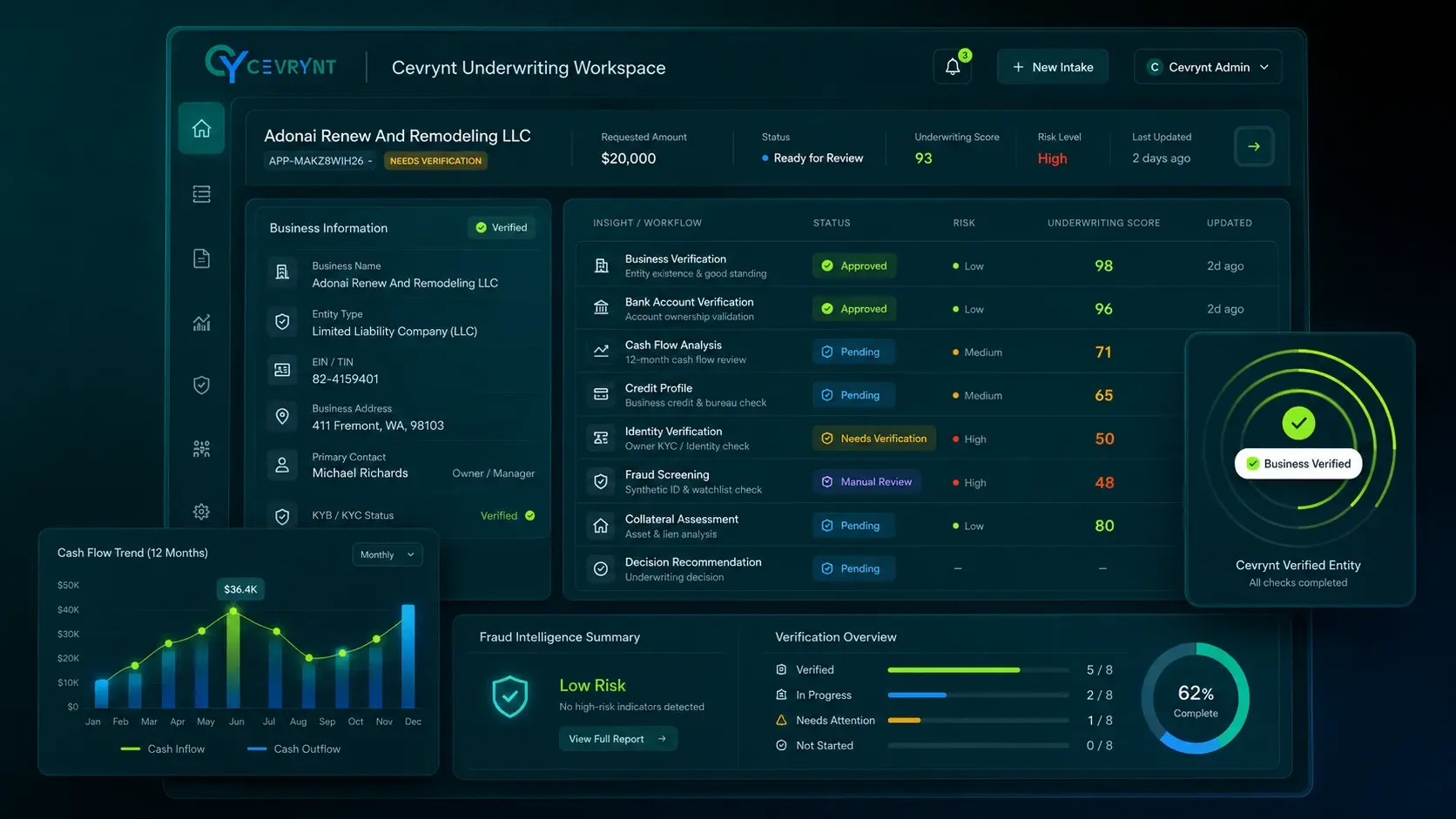
START WITH THE FILE
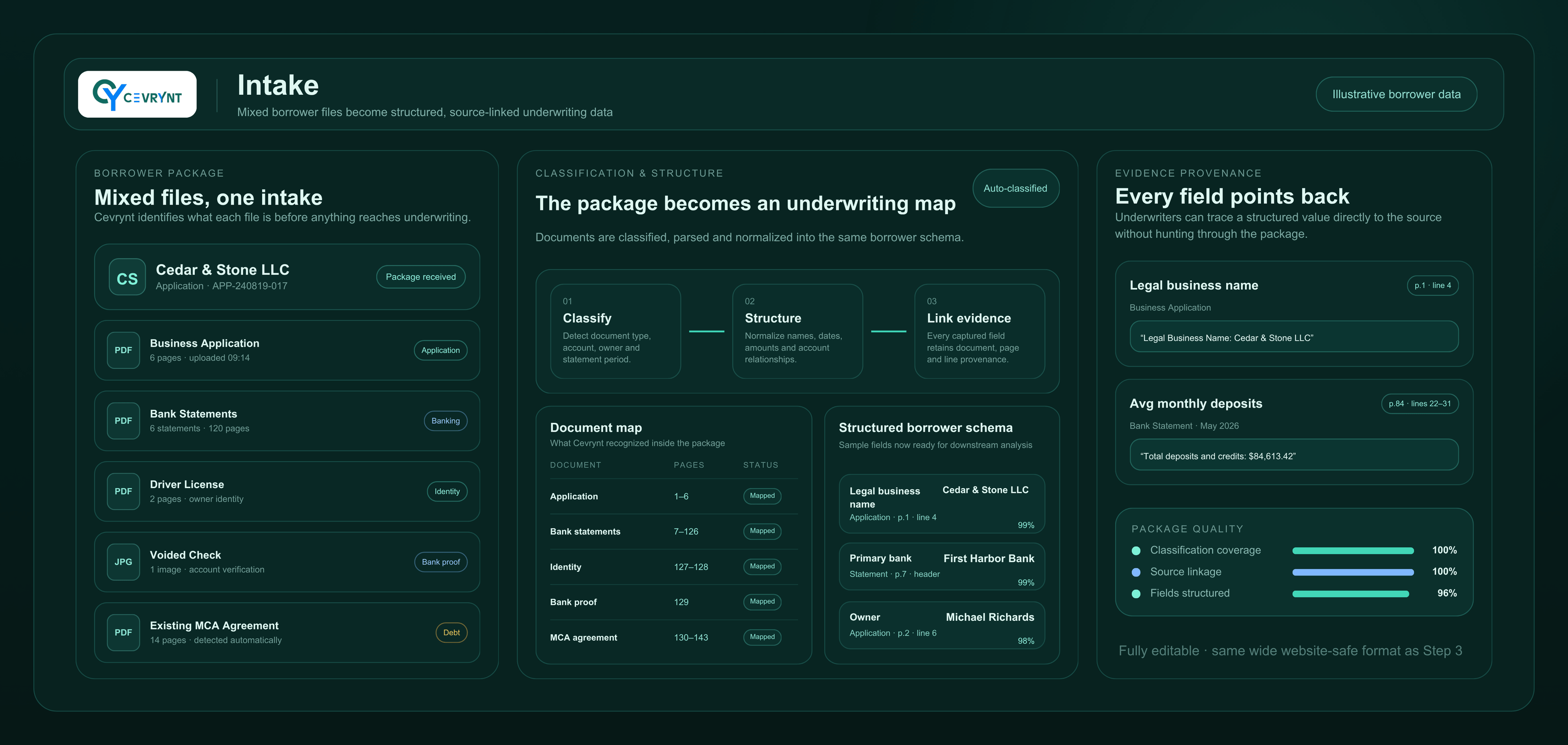
Start with the borrower package you already receive.
Cevrynt can begin from the files already entering your underwriting process. Applications, bank statements, identity documents, bank proof, and existing MCA agreements are grouped into one deal and structured before any deeper system integration is required.
pp. 1–6
of 143 pages4%
Business application: 6 of 143 pages, 4 per cent of the package.Business application
The starting point for the deal. Cevrynt captures the borrower’s stated business details here, then carries those fields forward so later documents and verification checks can confirm or challenge them.
- Legal name
- EIN
- Entity type
- Ownership split
- Amount requested
Bank statements
The core financial evidence. Cevrynt structures six months of statement activity so underwriters can review deposits, liquidity, NSF activity, negative days, transfers, and recurring obligations without rebuilding the file manually.
- Deposits
- Average daily balance
- NSF activity
- Negative days
- Inter-account transfers
Owner identity
Identity evidence is checked against the borrower application so mismatches in names, dates, or document details can be surfaced before the file moves deeper into underwriting.
- Legal name
- Date of birth
- Document expiry
- Match to application
Bank proof
Cevrynt uses bank proof to connect the submitted statements to the business and account being underwritten, while keeping the account details available for reviewer verification.
- Account number
- Routing number
- Account holder
- Match to statements
Existing MCA agreement
Existing funding obligations are brought into the same deal record so the underwriter can compare stated positions with recurring bank activity and understand the repayment load already on the business.
- Funder
- Outstanding balance
- Remittance amount
- Remittance frequency
WHERE CONNECTIONS HELP
Connect the handoffs. Keep the underwriting judgment.
Cevrynt can sit between the systems that receive a deal and the system your team uses to manage it. A scoped connection can remove file moving, duplicate entry, and result re-keying — while review, exceptions, and the final decision stay with your underwriters.
Illustrative workflow. The exact connection depends on your existing systems and implementation scope.
9steps4by hand
- IntakeA broker submission arrives through the existing inbox, form, CRM, or portal.
- OperationsDownloads the borrower package and adds the files to Cevrynt.by hand
- CevryntClassifies the files, structures the underwriting data, and keeps material findings linked to their source.
- OperationsCreates or locates the matching deal in the CRM or LOS.by hand
- OperationsMatches borrower details, deal references, and workflow status between the two systems.by hand
- CevryntRuns bank analysis, KYB/KYC, fraud review, and lender-defined policy checks against the same deal.
- UnderwriterReviews the findings, source evidence, policy exceptions, and anything that still requires judgment.
- OperationsEnters key findings, memo details, and status back into the system of record.by hand
- Credit teamApproves, declines, counters, requests more information, or escalates the file.
Connections remove the clerical handoffs. Review, judgment, notes, exceptions, and final approval stay with your team.
ACCESS & CONTROL
Connect only what the underwriting workflow needs.
A Cevrynt connection is scoped around a defined job — receive the deal, read the approved evidence, return agreed underwriting outputs, and nothing broader than the workflow requires.
| CEVRYNT MAY NEED | Would never |
|---|---|
| Deal-scoped access to borrower data and submitted files | Broad access to your entire customer or loan book |
| A stable deal or borrower identifier | Administrative control of your CRM or LOS |
| An approved destination for underwriting outputs | Authority over credit policy or funding decisions |
| Agreed access, retention, and deletion rules | Indefinite access to data after the agreed purpose ends |
HOW CEVRYNT CONNECTS
We don’t start with the API. We start with the workflow.
Before anything is integrated, Cevrynt maps where the deal enters, what underwriting data is actually needed, where the reviewed output belongs, and which system remains the source of truth.
- Map the workflow
Follow one deal through the systems it already touches
Identify where the package arrives, where the deal record lives, which files and fields move between systems, and where underwriters review and record the outcome.
- Prove the underwriting
Test Cevrynt before turning the pilot into an integration project
Run representative files through the agreed workflow and validate extraction, bank analysis, verification, policy results, exceptions, and review outputs before automating the handoffs.
- Connect what matters
Build the smallest connection that removes a real handoff
Once the workflow is proven, connect only the approved inputs and outputs through the appropriate API, webhook, CRM, LOS, inbox, or file-source path.
If a connection does not remove a real handoff, preserve the source of truth, or improve the review, there is no reason to build it.
WHAT COMES BACK
Return the underwriting record to the system your team already uses.
Cevrynt can send structured findings, policy exceptions, evidence references, memo fields, and review status back to the approved CRM, LOS, or system of record. The underwriting context moves with the result — the credit decision does not.
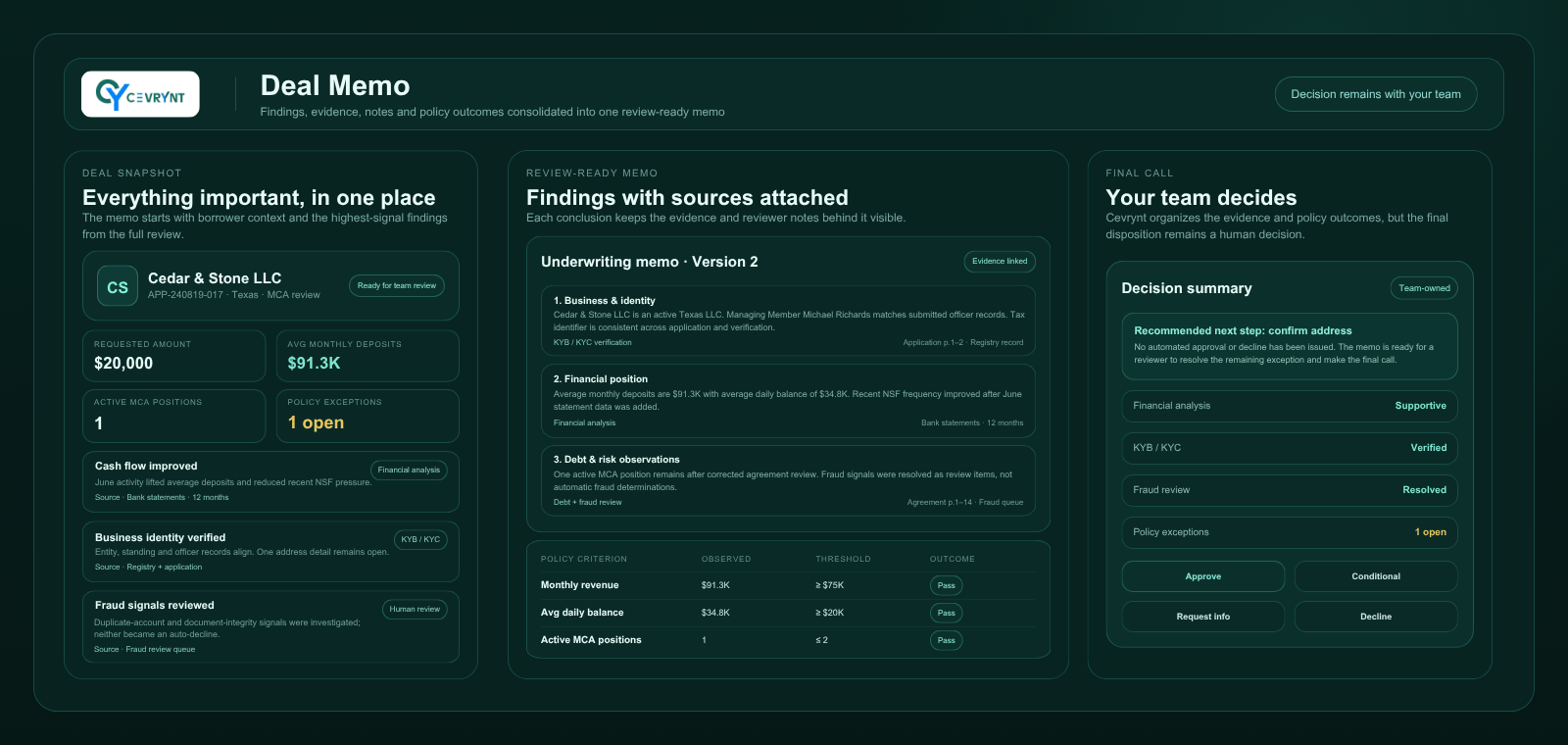
- Requested
- $20,000
- Avg monthly deposits
- $91.3K
- Avg daily balance
- $34.8K
- Active MCA positions
- 1
Business & identity
Entity is active and the legal business name matches the application. A registered-address discrepancy remains open for reviewer confirmation.
Traced toApplication pp. 1–2 · Business verification
Cash flow & liquidity
Average monthly deposits are $91.3K with an average daily balance of $34.8K. NSF activity improved to 4 events in the last 90 days after reanalysis.
Traced toBank statements · 6-month review
Existing obligations & policy
One active MCA position remains. Updated evidence cleared one previous exception, while one lender-defined policy exception still requires underwriter judgment.
Traced toMCA agreement pp. 1–14 · Policy v3.4
Your team decides
- Approve
- Conditional
- Request info
- Decline
Cevrynt returns the underwriting record and supporting evidence. Final pricing, structure, approval, decline, and funding authority stay with your team.
Founder-led integration walkthrough
Bring your underwriting stack. We’ll map where Cevrynt fits.
Show us how a deal moves through your intake, CRM or LOS, review process, and system of record. We’ll identify what Cevrynt should receive, what can be returned, and which handoffs are worth connecting.