
Who are we actually funding?
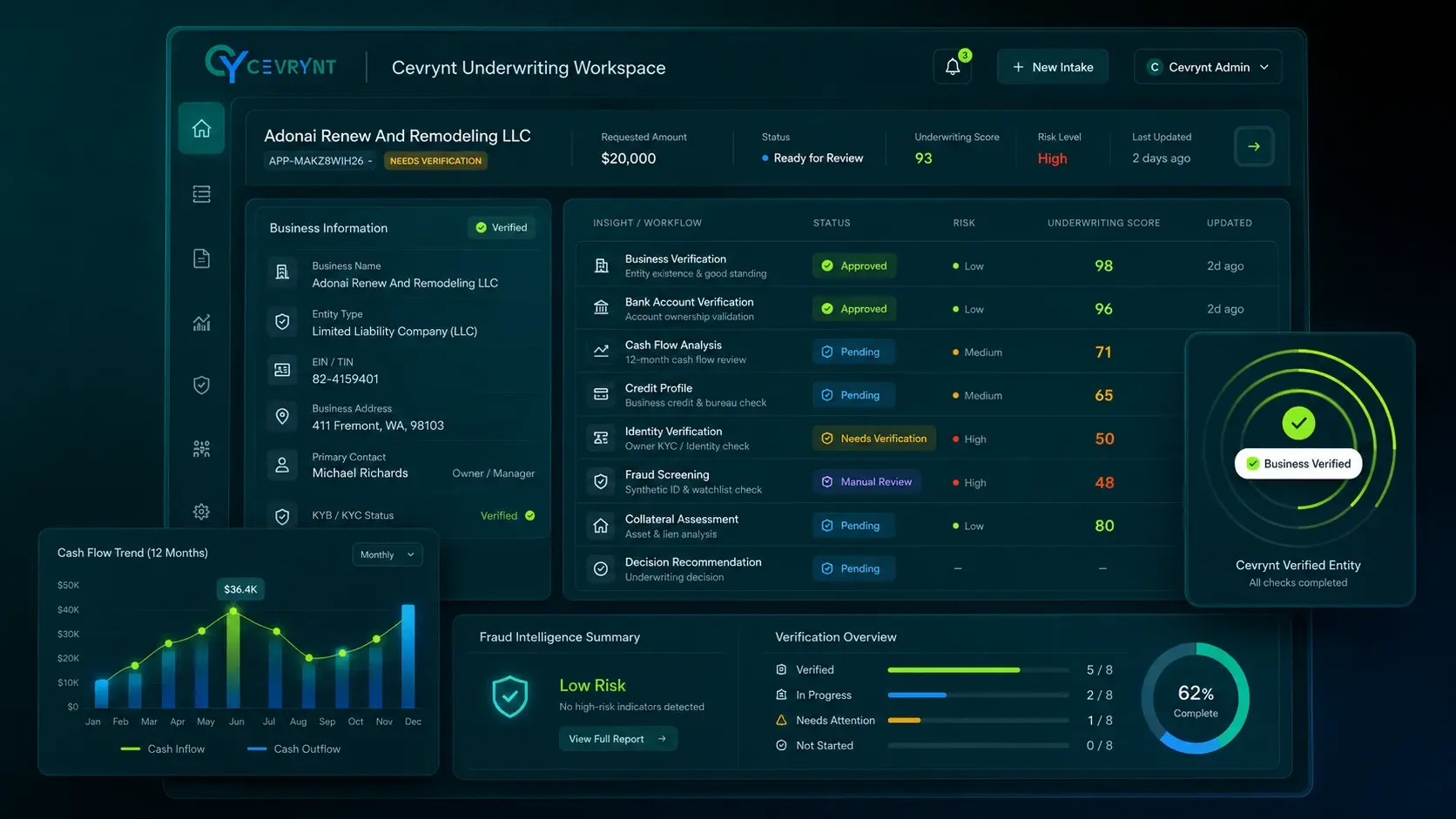
Compare the legal entity, business details, ownership, address and application claims against verification evidence before treating the rest of the file as fact.
What verification produces
Five facts against four documents. Nine of the twenty cells are empty.
Verification is a grid before it is anything else, and the interesting thing about the grid is how much of it nobody filled in. Read any cell to see exactly what that document says.
- 20
- Cells in the grid
- 11
- Where a document speaks
- 09
- Where nothing does
| Fact · document | Application | Articles of organisation | Bank account | Processing statement |
|---|---|---|---|---|
| Legal name | Stated | Stated | Stated | Stated |
| Entity type | Stated | Stated | Not stated by this document | Not stated by this document |
| Principal address | Stated twice, differently | Stated twice, differently | Not stated by this document | Not stated by this document |
| Registered agent | Not stated by this document | Stated | Not stated by this document | Not stated by this document |
| Entity on the signature block | Stated twice, differently | Not stated by this document | Not stated by this document | Stated twice, differently |
Read any cell to see exactly what that document says.
StatedTwo valuesSilent
What an empty cell is
- A document with no opinionMost of them
- A failed checkNot the same thing
- Filled in from elsewhereNever
- Whether it mattersA person
Nine empty cells is the ordinary shape of a submission, not a shortfall. A bank statement has no view on entity type and a processing statement has none on a registered agent, and inventing one would be worse than leaving the cell blank.
11 cells with a document behind them and 9 with nothing at all. The empty ones are not the gaps in the work — they are most of what a submission actually is, and a grid that quietly filled them would be inventing a business rather than verifying one.
What a conflict means
Twelve readings, four conflicts, and one column that is empty all the way down.
Every conflict has several readings and none of them can be separated by processing. The column you are looking for is on the grid, labelled, and blank in every row.
- 04
- Conflicts this grid produced
- 12
- Ways to read them
- 00
- Conclusions issued
- 02
- Still open after review
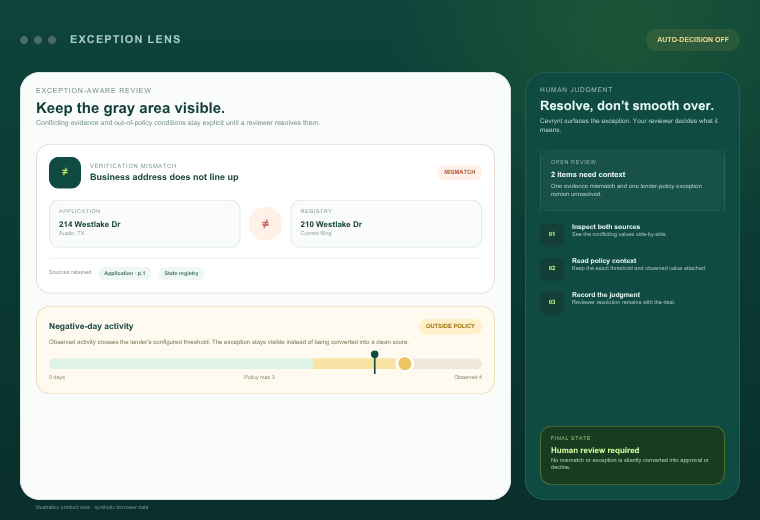
01The address on the application is not the address on the filing.Open · with a person
The business moved and the filing has not caught up yet.
The application gave a mailing address rather than a premises.
The application describes a location the business does not operate from.
02The registered agent changed weeks before the application.Settled in review · The broker confirmed a change of service provider
A routine change of service provider on renewal.
A change of counsel ahead of a transaction.
A deliberate move of where legal notice is served.
03The signature block names an entity that appears nowhere else in the file.Settled in review · A template error; page 2 was re-signed as Cedar & Stone LLC
A holding company that owns the applicant.
A typing error carried over from another document.
The wrong entity is the one applying.
04The filing lists a holder the application does not.Open · with a person
A passive investor nobody thought to list.
A holder added after the application was drafted.
A holder the applicant chose not to disclose.
Why the fourth column is emptyThere is no most-likely, no ranking, no score and no recommended reading. A conflict with two dull explanations and one that is not cannot be separated by processing — it is separated by a phone call. Printing something in that column would make this page easier to sell and the file harder to defend.
What the platform will not do with any of them
- Rank the readingsNever
- Select oneNever
- Score the conflictNever
- Put it to a personAlways
Cevrynt makes no identity finding, no sanctions or watchlist determination and no credit opinion. A conflict is surfaced with its sources attached and its readings intact, and the lender's reviewer decides which one is true.
Four conflicts and 12 ways to read them. Software that picks one is guessing with a straight face; software that hands you three is doing the only honest thing it can with a question that needs somebody to pick up the phone.
When it changed
Fourteen months on one axis, and two changes in the last eight weeks.
Six events placed by when they actually happened, on an axis ruled by year. The long gap on the left and the cluster on the right are the whole of what this chart has to say.
- 06
- Events on the entity record
- 02
- Inside the lookback window
- 00
- Findings on their own
Placed by date, on a ruled axis — not spaced evenly
- 14 months beforeEntity formed
- 11 months beforeOfficer added
- 6 months beforeAnnual report filed
- 61 days beforeRegistered agent changed
- 45 days beforePrincipal address changed
- Day 0Application submitted
Ninety days back from the application, because that is what this lender configured. A different lender sets a different window and the same six events produce a different count — the window is theirs, not ours.
- 01Entity formed14 months beforeFourteen months of standing behind the file — the same time in business the Policy Engine page evaluates. A young entity, which is exactly why every later change sits close to its start and why the dates matter more than the list.
- 02Officer added11 months beforeThree months after formation, and unremarkable at that distance.
- 03Annual report filed6 months beforeRoutine, on schedule, and outside the window.
- 04Registered agent changed61 days beforeInside the window. A change of service provider and a change of where legal notice is served look identical from here.
- 05Principal address changed45 days beforeInside the window, and the reason the address on the application no longer matches the filing in section one.
- 06Application submittedDay 0The date everything else is measured back from.
What a recent change is
- A change near the applicationNoted
- Why it changedNot inferred
- Whether it mattersA person
- A finding on its ownNever
Recency is a property of a date, not a judgement about a business. Nothing on this axis is scored, weighted or converted into a signal, and no event here is treated as adverse.
A registered agent and a principal address that both moved in the eight weeks before an application is not evidence of anything. It is a coincidence worth exactly one question — and the distance between those two sentences is the whole discipline of this stage.
Who owns it
Two holdings over the line, and one of them is not on the application.
The line is the threshold this lender drew, not a rule we brought. What sits above it has to be identified — and one of the two that does was never mentioned by the borrower.
- 03
- Holdings on the record
- 02
- Above the lender threshold
- 01
- The application does not list
Each holding on a ruled scale, against the line this lender drew
The line is configuration — not law, not a recommendation and not our opinion. Cevrynt holds no view on where a threshold belongs and gives no guidance on setting one.
- 01Managing memberApplication · filingSignatory and majority holder, and the only person on the file who is both. Worth stating rather than assuming.
- 02Second holderFiling onlyOver the line, named in the filing, and absent from the application. This is the fourth conflict from section two with a number attached to it.
- 03Third holderApplication · filingUnder the line, so not required to be identified. Still on the file, still on this chart, and still at full strength.
Where a holding is read from
- The filingWhere it lists holders
- The applicationWhat it claims
- Where they disagreeBoth kept
- Undocumented ownershipNamed as undocumented
Where the documents do not establish ownership, the gap is reported as a gap. No holding is estimated, apportioned or inferred from anything other than a document that states it, and Cevrynt makes no beneficial-ownership determination.
Two holdings over the line, one under it, and one of the two that nobody put on the application. The chart is not the finding — the finding is that a thirty per cent holder reached this stage without the borrower mentioning them, and that is a question for a person.
Where there is nothing to check
Absence of a record is not evidence of anything.
Four situations where the documents run out early, and how far each one actually reaches. None of them is a failed check, and none of them is a finding about the borrower.
- 04
- Situations with less to check
- 05
- Stages the chain can reach
- 00
- Reported as a failure
How far the documents actually reach — ruled by stage, not by score
- A sole proprietor with no filingNo entity record
- An entity formed weeks agoThin history
- Registered in one state, operating in anotherTwo records
- A name held through a holding companyChain incomplete
No coverage percentage appears anywhere on this page. A coverage figure would read as an accuracy claim about the product, and there is no documented figure behind one.
- 01A sole proprietor with no filingThere is no entity record because there is no entity. That is the correct output, not an empty result, and it is reported in those words rather than as a check that did not pass.
- 02An entity formed weeks agoA filing exists and has almost nothing behind it. Thin is reported as thin rather than padded out with whatever else happens to be in the submission.
- 03Registered in one state, operating in anotherBoth are stated and neither is promoted to being the real one. Which of them governs is a question about the lender's policy, not about the business — and not one this stage gets to answer.
- 04A name held through a holding companyThe chain is followed as far as the documents go and stops being reported where they stop. An unfinished chain is shown unfinished rather than closed off at the last name anybody could find.
What absence means here
- No record foundReported as such
- A failed verificationNot the same thing
- A reason to declineNever ours
- What happens nextA person
A short span is a fact about the documents in front of us, never a finding about the borrower. Nothing on this chart is scored, and nothing about a thin record is passed downstream as a signal.
Absence of a record is not evidence of anything. The most expensive mistake this stage can make is to report a gap in its own coverage as a finding about the borrower — and it is the mistake that looks most like diligence.
Founder-led
Bring the entity that never quite matches.
The interesting file is the one where the name on the filing, the name on the account and the name on the signature block are three different things, and somebody has to decide whether that is housekeeping or something else. Describe one of those and we will run it against the real thing rather than a tidy demo.