Small-business lending moves fast. Underwriting still does not.

Cevrynt, Inc. turns a messy borrower package into an evidence-backed, policy-aware underwriting review a lender can inspect and act on. We are raising a $250K pre-seed round to take the working MVP to a lender-ready launch.
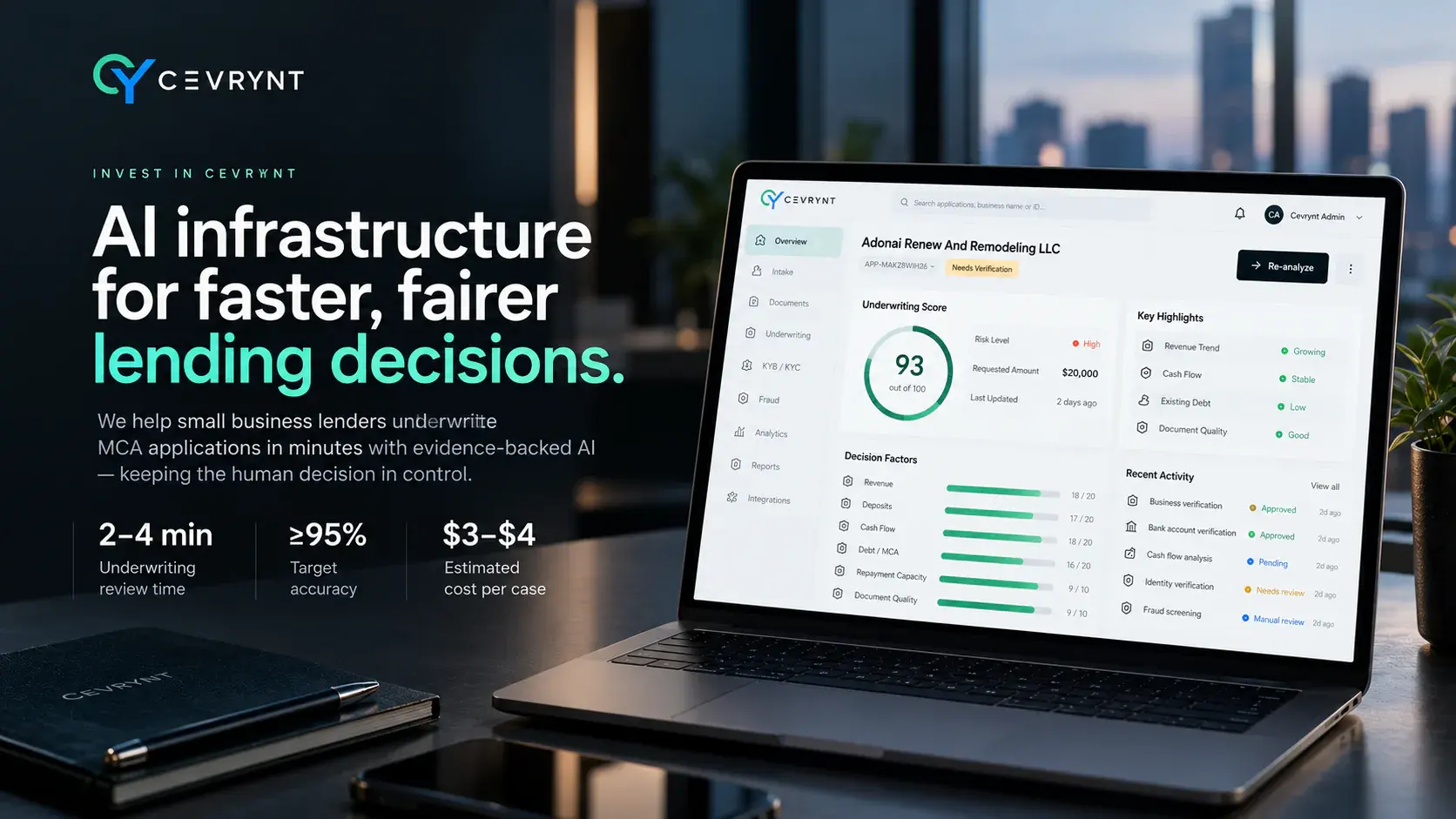
Invest in Cevrynt: AI infrastructure for faster, fairer lending decisions. Cevrynt helps small business lenders underwrite MCA applications in minutes with evidence-backed AI, keeping the human decision in control. 2–4 min underwriting review time, ≥95% target accuracy, $3–$4 estimated cost per case. Shown beside an illustrative Cevrynt underwriting dashboard on a laptop.
01

THE BOTTLENECK

Collecting files is easy. Turning them into a defensible decision is not.

A reviewer still connects seven things by hand. Every handoff adds time. Every manual interpretation adds variance.

Seven sources · one review

  1. 01Borrower applicationIntake details and attestations.
  2. 02Bank statements & ACHCash-flow truth: deposits, balances, returns.
  3. 03Existing debt & MCA positionsStacking risk and repayment load.
  4. 04KYB, KYC & recordsIs the business, and the owner, who they say?
  5. 05Address & web evidenceIs this a real, operating business?
  6. 06Fraud & inconsistencyAltered documents and figures that do not reconcile.
  7. 07The lender's own policyRisk appetite, thresholds and exceptions.

In alternative lending, slower review means lost merchants, higher operating cost, and decisions that are harder to explain later.

Cevrynt is not another point OCR tool. It is the decision layer across the whole review: every source above feeds one evidence-linked record, and the lender still makes the call.
02

WORKING PRODUCT TODAY

A working workspace from intake to decision.

Intake, extraction, analysis, verification and a policy-aware memo, connected end to end. Cevrynt recommends. The lender still decides.

Built · intake to decision, working today

  1. 01Intake & extractionManual upload, bulk packages or a borrower form, then OCR plus structured document intelligence with source references kept attached.
  2. 02Financial analysisBank, ACH, existing debt, cash-flow and risk signals structured from the statements themselves.
  3. 03VerificationKYB and KYC checks, registry records, web and address evidence, with conflicts kept visible.
  4. 04Fraud & review signalsDocument issues, inconsistencies and unusual activity surfaced with the evidence behind them.
  5. 05Lender policyThe lender's own rules, versioned, applied to the same evidence rather than a generic AI verdict.
  6. 06Explainable memoA decision-ready review with every finding traceable. Cevrynt recommends; the lender decides.

900+

real-world underwriting files evaluated on the working MVP
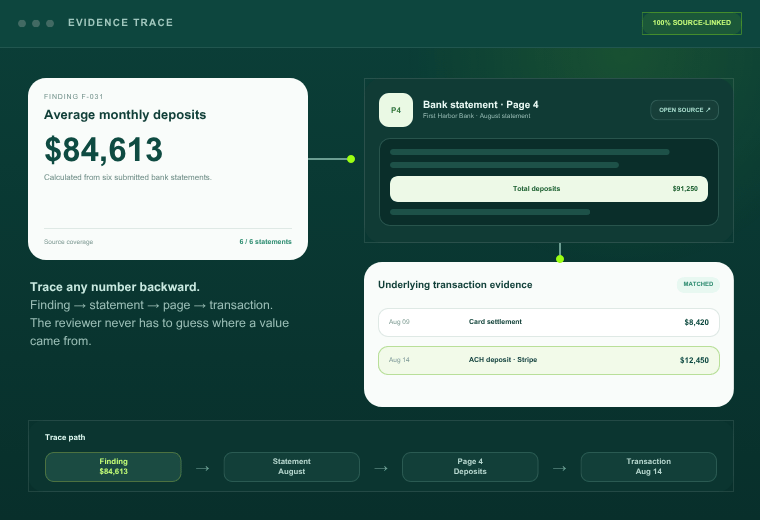
Illustrative Cevrynt evidence-trace view showing an $84,613 financial finding linked back to the supporting bank statement page, source lines, and underlying transaction evidence.
01A financial finding traced back to the statement page and supporting transactions.
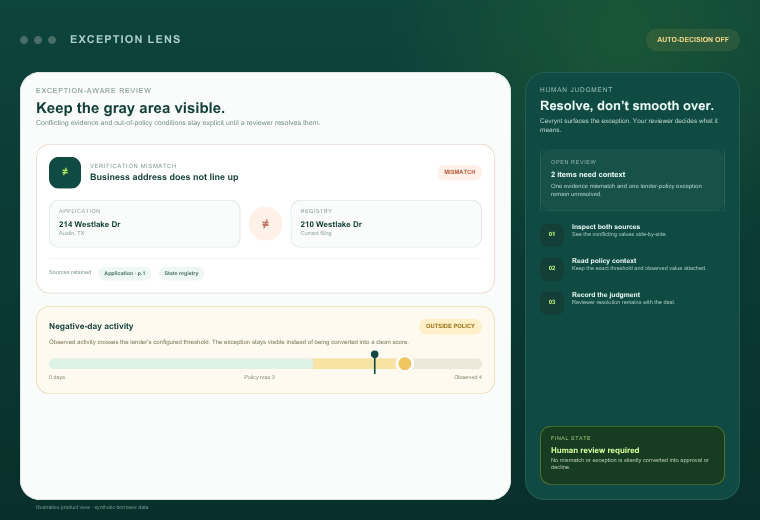
Illustrative Cevrynt verification view showing conflicting business information side by side, both source values preserved, and the mismatch held open for human review.
03A verification conflict kept open with both values and their evidence preserved.
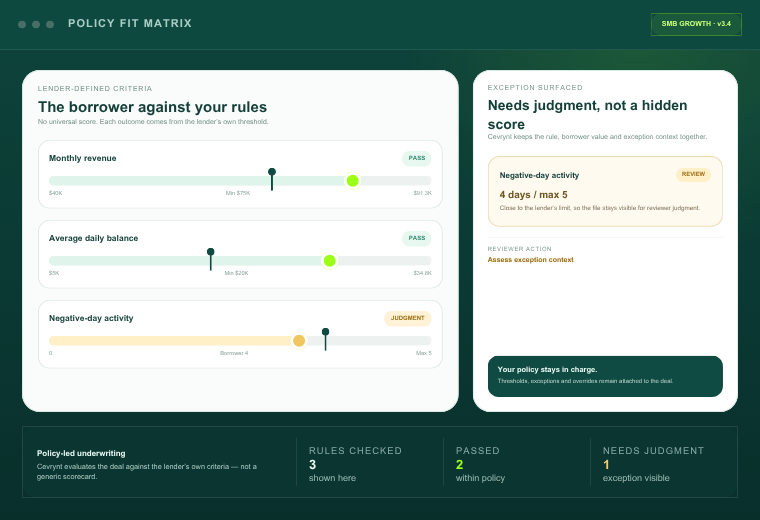
Illustrative Cevrynt policy view showing lender-configured criteria, observed values, thresholds, passing checks, and one exception kept open for reviewer judgment.
05Lender-defined criteria applied with the exception left visible for judgment.
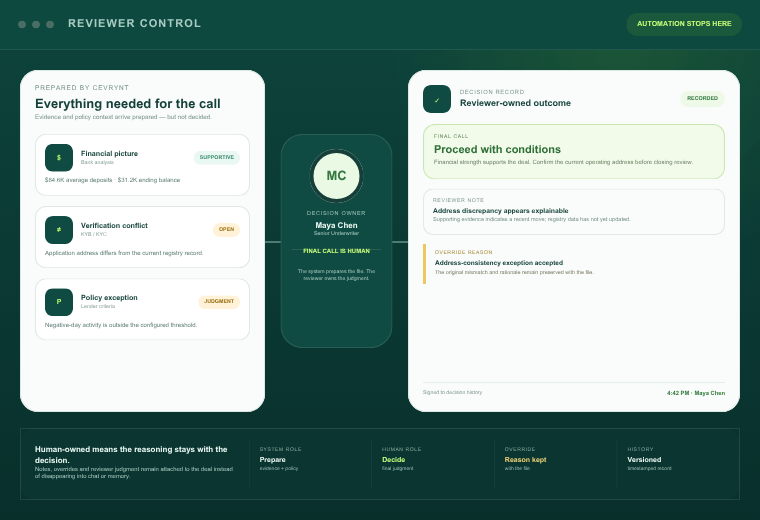
Illustrative Cevrynt underwriting-record view bringing financial findings, verification issues, policy exceptions, source-linked evidence, and reviewer context into one reviewable case.
06A decision-ready review assembled with the evidence, policy context, and reviewer record intact.

A working workspace from intake to decision — not a slide-deck promise. API, LOS and CRM integrations are on the roadmap, not claimed as production today.

Product views shown here use illustrative synthetic borrower data. Real-world files have been used for internal development and evaluation; they are not customer deployments, funded transactions, or independently validated accuracy results.
03

TRACTION ON REAL FILES

Working MVP. Real files. Real evidence.

Not a prototype. The MVP has processed more than 900 real-world borrower files across MCA and alternative-lending workflows, and more than 132 deals have been verified with senior underwriters.

Internal evaluation · working MVP

Real-world files evaluated
900+
Across MCA, working-capital and alternative-lending workflows.
Deals verified with senior underwriters
132+
Real deals where senior underwriters verified the MVP's output during internal evaluation.
Fastest end-to-end memo
4m 17s
From uploaded package to review-ready memo, in one internal run.
Evidence sources connected
7
The seven sources a reviewer otherwise connects by hand.
Signed partner agreement
1
Development and Referral Agreement with SHOPLINE.

Files evaluated per month · 2026

  1. 12Mar
  2. 20Apr
  3. 34May
  4. 47Jun
  5. 63Jul
  6. 80+Aug

Monthly counts shown for March to August 2026. Cumulative 900+ files across MCA, working-capital and alternative-lending deal flows.

Next milestone: design-partner pilots and the first paying customers.

Figures are internal evaluation counts on the working MVP for 2026, including deals verified with senior underwriters. They are not customers, pilots, contracts or revenue, and the memo time is from a single run rather than an average.
04

WHY IT BECOMES STICKY

Lender policy is part of the decision, not a note after the fact.

Cevrynt applies each lender's policy to the same underlying evidence and preserves policy versions over time. That is the switching cost.

A generic AI answer is not enough.Each lender has its own risk appetite.Cevrynt encodes it — and keeps every version.

A generic AI answer4
  1. Same answer for every lender.One model's view, whatever the lender's appetite.
  2. Policy applied after the fact.A reviewer still reconciles the output with the credit rules by hand.
  3. No record of policy changes.Nothing shows which rules a past decision was made under.
  4. A verdict, not a workflow.Switching cost is close to zero.

Easy to try, and just as easy to replace.

Cevrynt4
  1. Consistent decisions inside each lender.The same evidence, evaluated against that lender's own rules.
  2. An audit trail around policy changes.Versions are kept, so past decisions stay explainable.
  3. More embedded workflows over time.Intake, review and memo live in one place.
  4. A dataset of evidence, policy and reviewed outcomes.Switching cost rises as policy is encoded.

Every policy-encoded lender adds switching cost, and the dataset compounds with every reviewed deal.

Lender policy is part of the decision, not a note after the fact. That is what makes Cevrynt harder to replace than a model call.

Describes the product's design and the intended source of defensibility. It is not a claim about current customer retention or switching behavior.
05

THE MARKET WEDGE

Start in MCA. Expand across SMB finance.

Small-business and alternative lending is large, document-heavy, and still underwritten by hand. The category is moving from extraction tools to decision infrastructure, and lenders still need policy control, explainability, audit trails and human final authority.

Start in MCA. The same infrastructure serves the rest.

Market entry paths01MCA funders02Alternative lenders03Brokers & ISOs04E-commerce underwritingThe fileMCA fundersApplications, bank statements, existing positions, and business evidence.Alternative lendersBorrower documents, financials, verification, and supporting records.Brokers & ISOsA submission package prepared for one or more downstream funders.E-commerce underwritingBank evidence alongside approved commerce activity, payouts, and operating history.Who decidesMCA fundersThe funder's underwriting team.Alternative lendersThe lender's credit or risk team.Brokers & ISOsThe downstream funder, not the broker.E-commerce underwritingThe financing provider reviewing the merchant.What variesMCA fundersRepayment tolerance, stacking rules, thresholds, and risk appetite.Alternative lendersProduct criteria, eligibility rules, exceptions, and policy version.Brokers & ISOsRequired documents, lender appetite, stipulations, and submission requirements.E-commerce underwritingAvailable commerce evidence, lender criteria, and how platform activity is weighed.

MCA comes first: the fastest decision cycles, the most document pain, and the clearest wedge. The underwriting work underneath every segment repeats — assemble the evidence, understand the financials, verify the business, apply lender policy, and prepare the case for human review.

One evidence and policy layer, not four separate products. Market sizing and its sources are covered in the investor meeting.

These are Cevrynt's market-entry paths, not customer counts, market share, or active deployments.
06

TEAM & COMPANY

Nine-plus people, inside a clean Delaware company.

A founder, six-plus engineers and product builders, and two marketers — with the entity, security work and financing structure already in place.

Team today · Cevrynt, Inc.

  • 1FounderArin leads product, lender conversations, partnerships and the raise.
  • 6+Engineering & productBuilding the workspace, document pipeline, verification and policy engine.
  • 2MarketingContent, SEO, partnerships and go-to-market support.

Investment readiness

Delaware C-Corp
Cevrynt, Inc. is registered in Delaware at 8 The Green, Ste R, Dover, Kent County, DE 19901, USA, with clean records, IP assignment, cap table and banking in place.
SOC 2 readiness
Controls, policies, evidence collection and audit prep, funded by this round. Not claimed until an independent auditor issues the report.
Security work
Access controls, logging, penetration testing, vendor review and data-handling discipline.
Provider-flexible architecture
No single-model dependency: reasoning, OCR, verification and search providers can be swapped per workflow stage without re-architecting.

Lenders buy accuracy, but also security, process and clean structure. The company is set up for that from the start.

Team figures describe current headcount across employees and contractors. They are not a committed hiring plan.
07

DISTRIBUTION & MODEL

Demos, then pilots, then paying customers.

Direct lender demos today, a signed SHOPLINE referral agreement for merchant-side reach, and a SaaS model that expands with usage.

Go-to-market · four steps, in order

01

Direct demos

Walk lenders through a file their team already knows, using their own policy, so the output is judged against a case they understand.

Where we are now

02

Design-partner pilots

Scoped pilots on representative files and lender-specific criteria, with human approval authority explicit throughout.

Funded by this round

03

Paying customers

A SaaS platform fee, with usage-based processing, integrations and premium modules — verification, automation, white-label — as expansion.

Subscription + usage

04

Case studies, then repeatable acquisition

Documented outcomes feed SEO, content and partner channels, so acquisition stops depending on one conversation at a time.

Next-round evidence

Start with the workflow. Expand through usage, integrations and automation.

SHOPLINE · signed Development and Referral AgreementCevrynt has signed a Development and Referral Agreement to operate as a technology and referral partner on the SHOPLINE platform, around e-commerce merchant-underwriting workflows. SHOPLINE merchants need working capital; Cevrynt structures documents, evidence and fraud signals; funding partners receive organized opportunities. The lender keeps final decision authority. It is not a live integration, an investment, or a promise of merchant eligibility or funding.

Revenue paths: subscription, usage, integrations and referral. Pricing is scoped per lender and is not published.

Describes the planned go-to-market sequence, not completed deployments or scaled distribution.
08

WHY NOW

The product is built. The round is small. The next raise comes after the evidence.

Pre-seed is the one round that comes before paying customers. Here is what is already true going into it.

  1. 01

    Built

    Built before the raise

    A working MVP with a built-in MCA CRM, 900+ real-world files evaluated, 132+ deals verified with senior underwriters and a signed SHOPLINE agreement. This round funds the launch, not version one.

  2. 02

    6×+

    Momentum you can see

    Files evaluated per month went from 12 in March to 80+ in August, and the total passed 900 by October.

  3. 03

    $250K

    A deliberately small round

    The whole pre-seed is $250K, so there is limited room in it. It is sized to reach the milestones below, not to sit in the bank.

  4. 04

    First

    The earliest entry point

    The next raise is planned after paying customers, SOC 2 readiness and recurring revenue. This round comes before that evidence exists.

Internal evaluation · working MVP · 2026
12files in March
80+files in August
900+files in total, October
132+deals verified with senior underwriters

Internal evaluation counts, not customers, pilots, contracts or revenue. Past momentum is not a promise of future results.

Meet the team, see the product on real files, and get the deck after the call.

Book an investor meeting
09

THE ASK

$250K pre-seed to reach a lender-ready launch.

The round funds product reliability, test volume, paid pilots, SOC 2 readiness and the first recurring revenue.

Use of funds · $250K

Pre-seed round · 2026

$250K

To take the working MVP to a lender-ready launch: product reliability, test volume, paid pilots, SOC 2 readiness and credible recurring revenue.

Instrument
Standard SAFE or an agreed instrument
Entity
Cevrynt, Inc. · Delaware C-Corp
Registered address
8 The Green, Ste R, Dover, DE 19901, USA
Deck
Shared after a meeting or by email
  1. 40%Product & engineeringCore team, product maturity, QA, SaaS hardening, automation, API foundation and integrations.
  2. 25%AI, cloud, data & testingModel calls, OCR, verification APIs, infrastructure, storage and regression testing.
  3. 15%Go-to-marketDesign partners, direct sales, SEO, content, partnerships and onboarding.
  4. 10%Operations & runway reserveEssential operating costs and a buffer for longer lender sales cycles.
  5. 10%Security, SOC 2 & contingencyControls, penetration testing, audit prep and a compliance buffer.

The next raise is built on evidence: paying customers, usage data, SOC 2 readiness and credible recurring revenue.

This page is for information only and is not an offer to sell, or a solicitation of an offer to buy, any security. Any investment will be made only through definitive documents and only with investors who qualify under applicable securities laws.
10

ROADMAP

Four milestones, each with a measurable exit.

A 12–18 month plan built for investor accountability. Each stage ends on a criterion anyone can check.

12–18 month plan · four milestones, each with an exit criterion

  1. 01

    0–3 months · Make it dependable

    Accuracy benchmarks, automated testing, exception handling, multi-tenant SaaS and a security baseline.

    Exit criterion

    Accuracy of 95% or better on the regression set.

  2. 02

    3–6 months · Make it launchable

    Billing, onboarding, monitoring, SOC 2 readiness, commercial packaging and design partners.

    Exit criterion

    SOC 2 Type I audit kicked off.

  3. 03

    6–12 months · Make it connected

    API foundation, LOS and CRM readiness, email reading, event-based workflows and paid pilots.

    Exit criterion

    First paid pilot live.

  4. 04

    12–18 months · Make it repeatable

    SEO, partnerships, expansion revenue, portfolio intelligence and next-round metrics.

    Exit criterion

    $25K+ MRR, or next-round metrics.

Target: lender-ready SaaS, design-partner pilots, first paying customers and a data-backed next raise.

From dependable, to launchable, to connected, to repeatable.

Milestones and exit criteria are targets set for investor accountability, not results already achieved or guaranteed.
11

REQUEST THE PITCH DECK

See the full deck in a 20-minute meeting.

The pitch deck is not published. Book a private 20-minute product walkthrough and investor conversation, or email and the deck will be shared directly.