
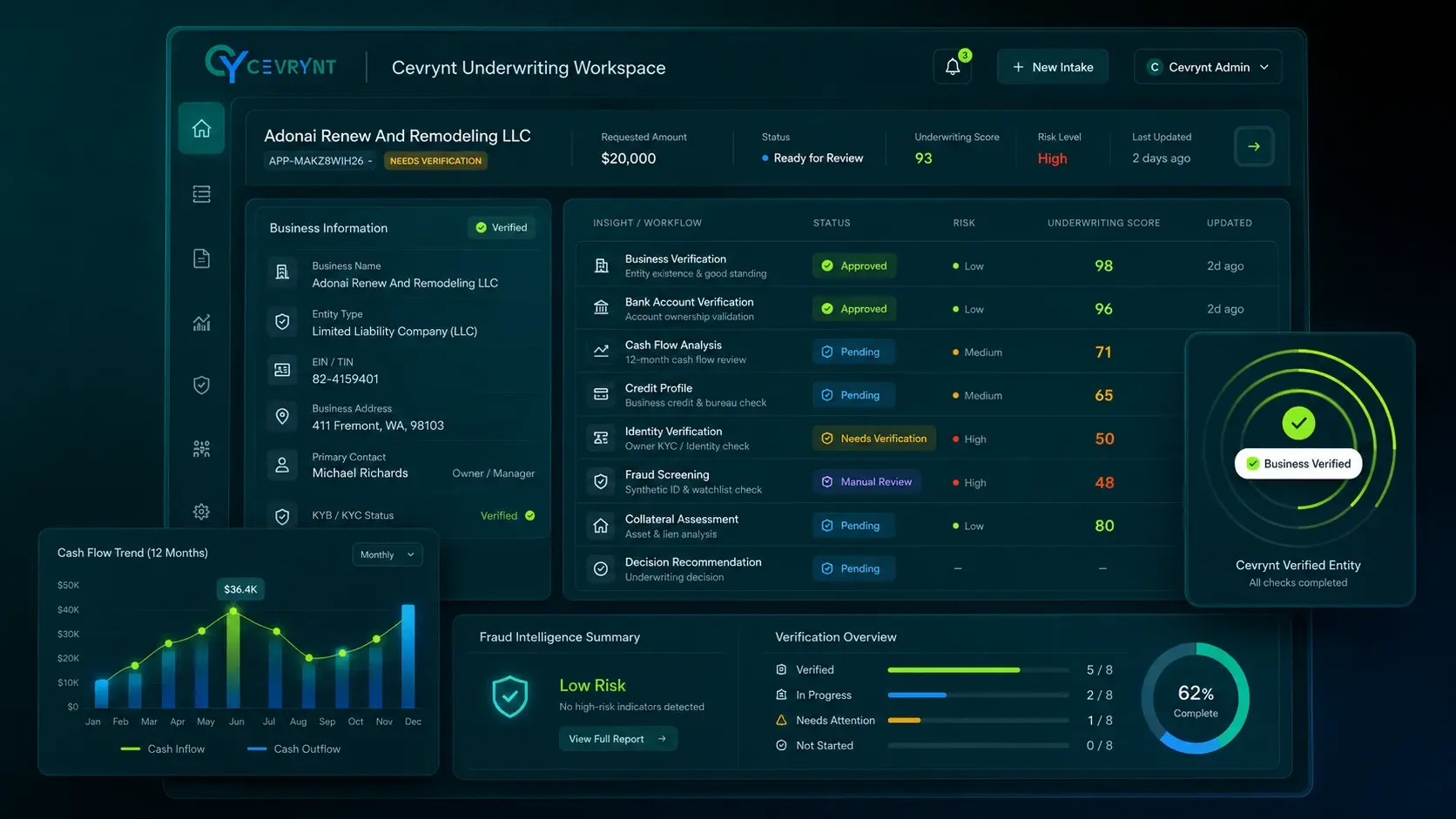
Underwrite the SMB file without losing the story behind it.
Cevrynt brings borrower documents, bank activity, business verification, fraud signals, and your credit policy into one evidence-linked review — with exceptions left visible for your underwriters.
POLICY & EXCEPTIONS
Ten rules settle. Two need an underwriter.
Cevrynt applies your credit policy criterion by criterion. Clear checks resolve against the evidence; exceptions stay open with the observed value, threshold, source, and reason attached for human review.
- 10 / 12
- policy checks resolved
- 02
- exceptions routed for review
- No
- automatic decline from an exception alone
- 01Average monthly deposits$84.6K≥ $75KPass
- 02Average daily balance$31.2K≥ $20KPass
- 03NSF activity · 90 days6 events≤ 5ExceptionThe file exceeds policy by one event. Cevrynt keeps the underlying statement activity available so the reviewer can see when the events occurred and how recent cash flow compares with policy.Reviewer action required · exception remains open
- 04Existing repayment obligations$1,550 / dayWithin lender-defined limitPass
- 05Time in business14 months≥ 12 monthsPass
- 06Address consistency214 vs 210 Westlake DrApplication and verification records alignExceptionThe application lists 214 Westlake Dr while the verification source lists 210 Westlake Dr. Cevrynt keeps both values and their sources visible rather than silently selecting one.Reviewer action required · discrepancy remains open
What stays with every policy result
- Policy versionv3.4 retained
- Observed value + thresholdVisible
- Exception reasonRequired when outside policy
- Source evidenceLinked to the finding
- Reviewer actionRecorded when resolved
Six of the twelve policy checks are shown in this example. Routine passes stay compact; exceptions expand to show the observed value, applicable rule, supporting evidence, and reviewer action still required.
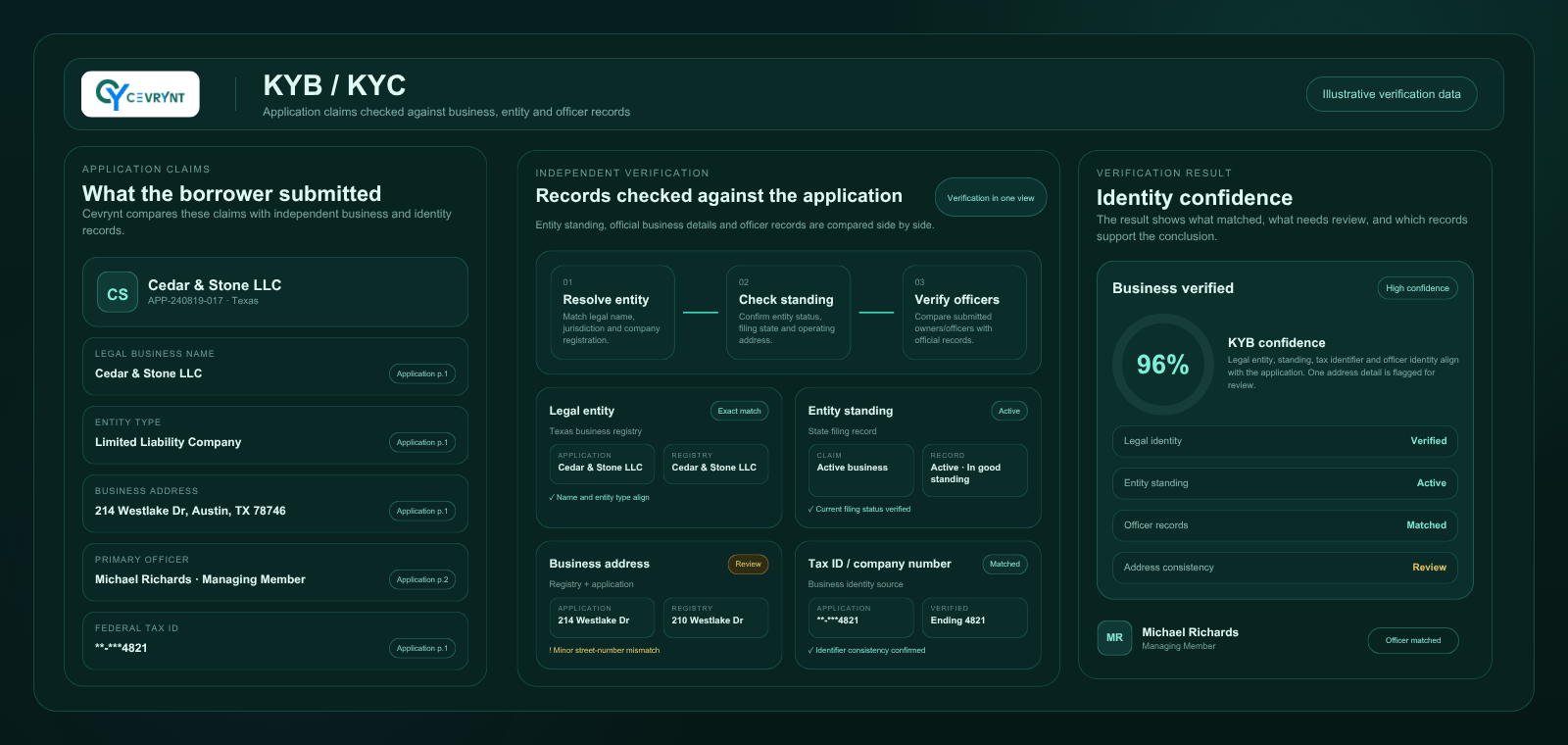
BUSINESS VERIFICATION
Verify the business claim by claim — not with one green check.
Cevrynt compares what the borrower submitted with business verification sources. Fields that align can close; anything that conflicts stays visible with both values and its source for an underwriter to resolve.
- 04
- business fields compared
- 01
- review item still open
Legal business name
Match
Cedar & Stone LLC
Cedar & Stone LLC
Business application · p.1
Business verification source
Entity status
Match
Active business
Active · in good standing
Business application · p.1
State filing record
Tax identifier
Match
**-***4821
Ending 4821
Business application · p.1
Business identity source
Business address
Review
214 Westlake Dr
210 Westlake Dr
Business application · p.1
Business verification source
Three fields align across the application and verification sources. The business address does not. Cevrynt keeps both values and their sources visible, then leaves the discrepancy open for reviewer resolution instead of silently choosing one.
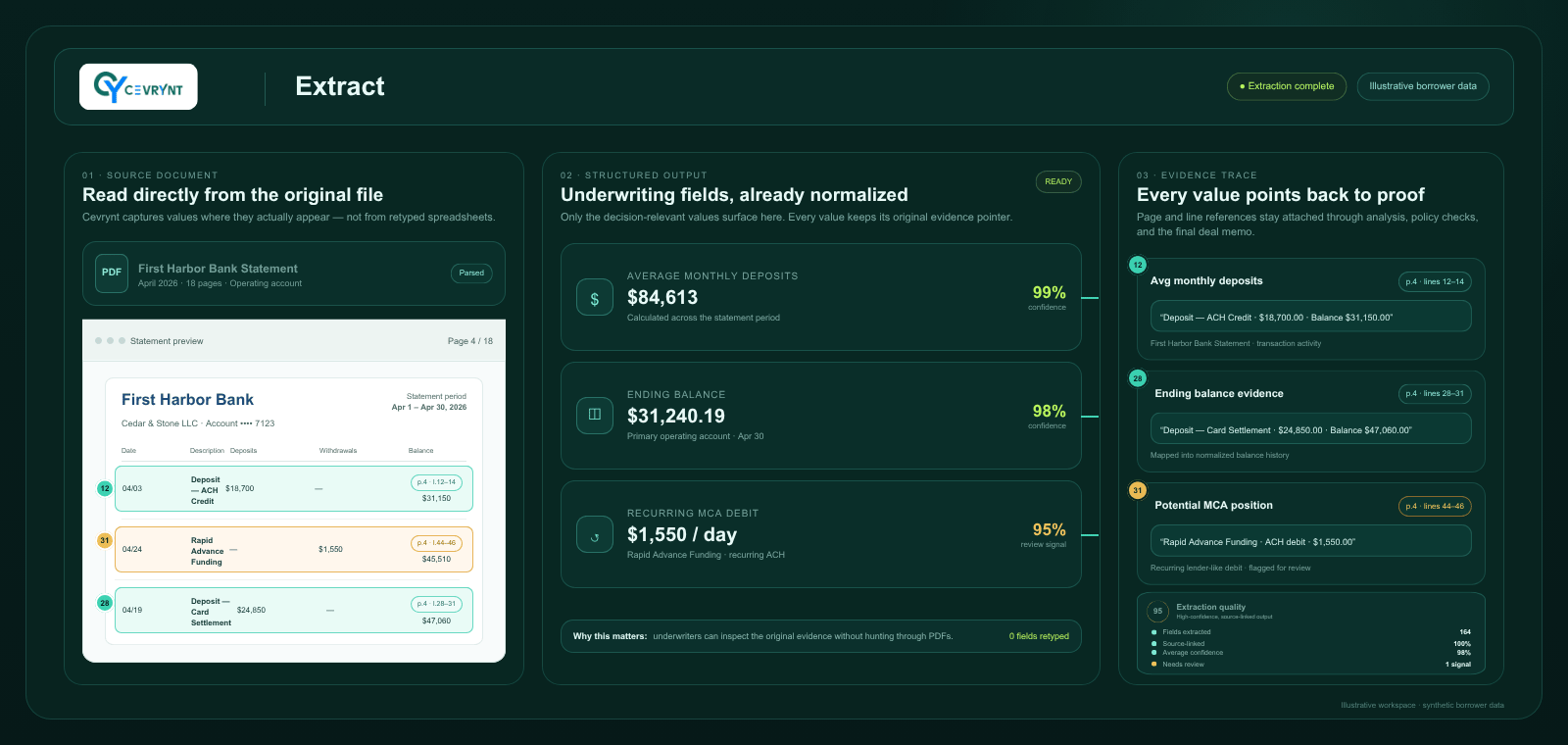
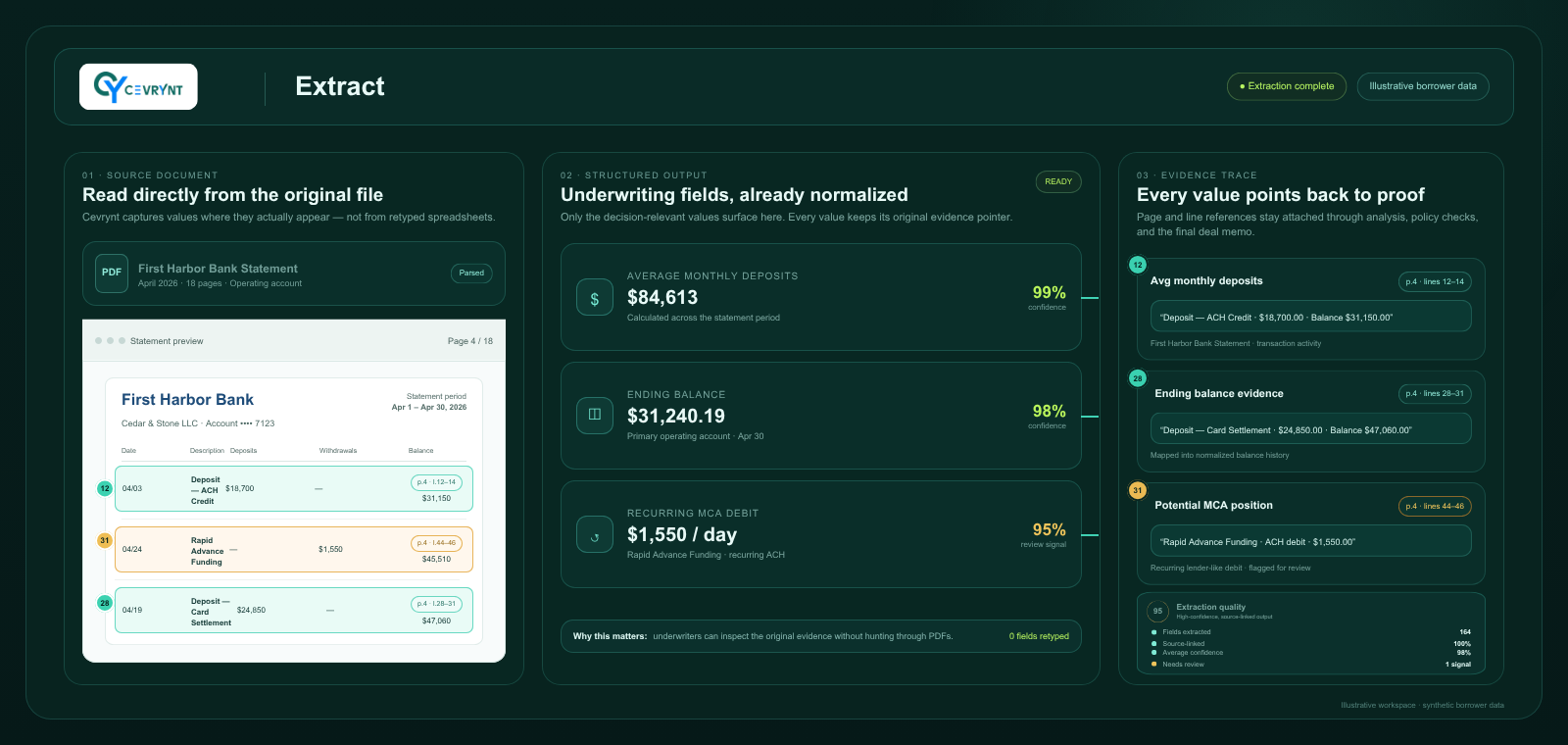
DOCUMENT INTELLIGENCE
Turn the borrower package into underwriting data — without losing the source.
Cevrynt classifies the submitted files, structures the fields your underwriting workflow needs, and keeps material values connected to the document, page, transaction, or verification result they came from.
143pages mapped to one deal
01structured underwriting record
- Monthly deposits · April$84,613Bank statement · p.84 · lines 21–31“Total deposits and credits · $84,613.42 · Statement period 04/01–04/30”
- Average daily balance · April$31,240Bank statement · p.84 · lines 32–39“Average daily balance · $31,240.19 · Lowest daily balance $18,904.42”
- Recurring repayment$1,550 / dayBank statement · p.46 · lines 41–46“Rapid Advance Funding · ACH debit · $1,550.00 · observed business-daily”
CASH-FLOW CONTEXT
Six statements become one view of how the business actually moves.
Cevrynt normalizes the statement period into one continuous underwriting view, so deposits, liquidity, recurring obligations, and cash-flow stress can be read across time instead of reconstructed month by month.
- 6 → 1
- bank statements connected
- 06
- months normalized
- 05 / 06
- months with positive net cash flow
- 18ppJan–Feb
- 21ppMar–Apr
- 20ppMay–Jun
- 19ppJul–Aug
- 22ppSep–Oct
- not availableNov–Dec
Each block represents one statement period · height reflects the source-page volume behind it
What the six-month view shows
- Deposit consistencyConsistentMonthly inflows remain broadly stable across the six-statement review period.
- LiquidityStableAverage balances remain positive with no sustained deterioration across the period.
- Existing repayment obligationsWatchRecurring debt payments remain a meaningful draw on operating cash flow and warrant underwriter review.
- Cash-flow stressLimitedNSF and negative-balance activity appears intermittently rather than as a persistent deterioration pattern.
What the six-month view showsCash flow is broadly stable. The main watch item is the recurring repayment burden already drawing from operating cash flow — not deposit volatility.
DECISION MEMO
The review comes together. The decision stays with your team.
Cevrynt assembles the borrower facts, financial analysis, business verification, policy results, open exceptions, and supporting evidence into one review-ready underwriting memo. Your team resolves what is still open and makes the final credit call.
04available lender dispositions
00issued by Cevrynt
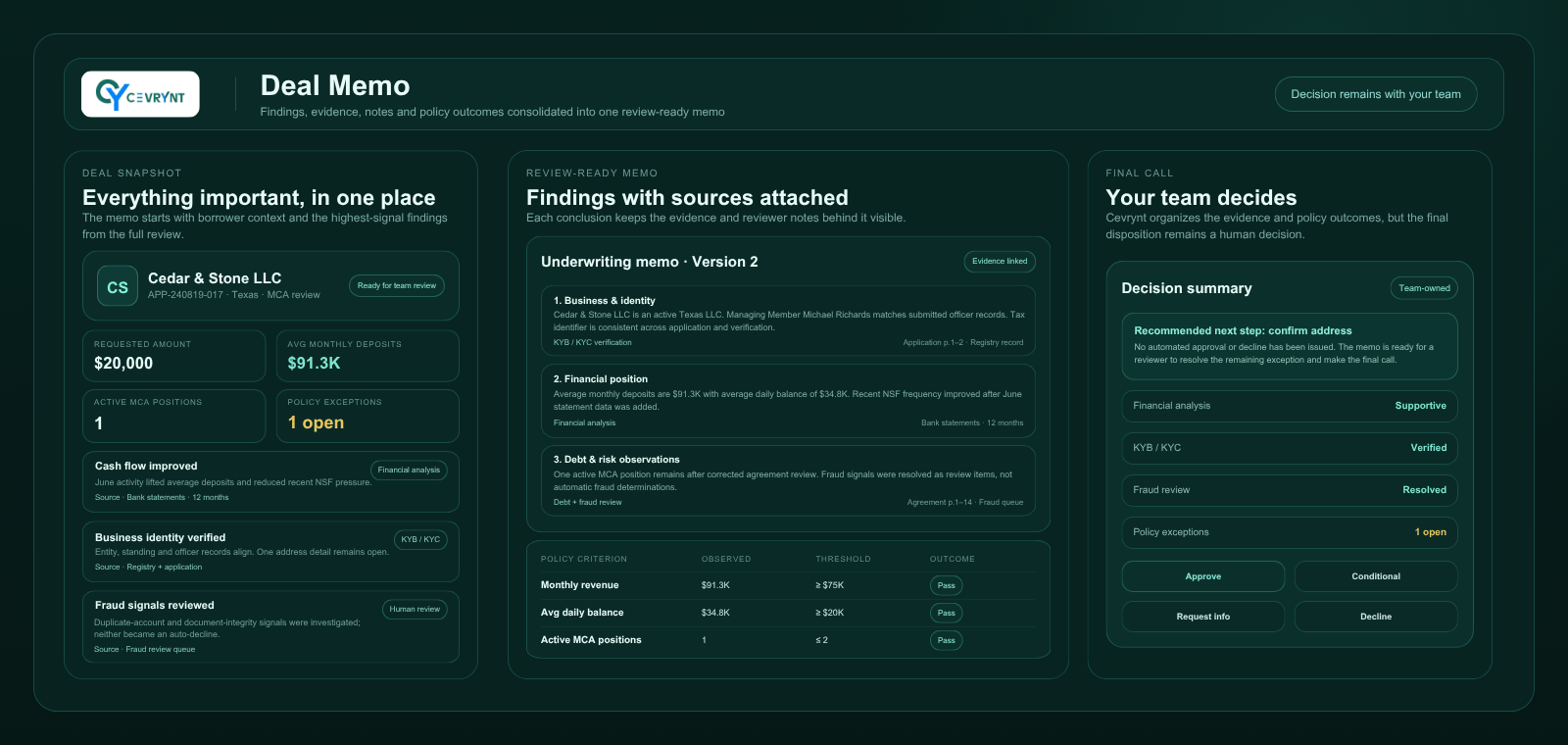
Decision summary · lender-owned
- Financial analysisSupportive
- Business verification1 review item
- Fraud reviewNo unresolved material finding
- Policy exceptions1 open
- Evidence traceAttached
Your team makes the final credit decision
These are lender actions, not Cevrynt recommendations. Cevrynt assembles the review, keeps the evidence and policy context attached, and leaves approval, decline, conditions, and information requests with your team.
FOUNDER-LED SMB UNDERWRITING REVIEW
Bring one SMB file your team already knows.
Walk through the borrower package, cash-flow evidence, business verification, lender policy, and open exceptions with Cevrynt. Compare what the platform surfaces with the underwriting work your team already trusts.