
Frequently asked questions
Straightforward answers about what Cevrynt does, who it is for, and how lender control is preserved.
The short answer first
Sixteen questions, each answered in a few words before the full reasoning.
Read down the short answers to get the whole picture in a minute. Open any row for the full answer and the page that goes further.
- 16
- Questions answered
- 04
- Groups
- 05
- Answered with a plain no
- 00
- Answers quoting a performance number
Choose a question to open its full answer
01About Cevrynt4 questions
Cevrynt is an AI-assisted underwriting infrastructure platform for alternative lenders and SMB finance teams. It structures borrower documents and business signals into evidence-linked analysis that human underwriters use to make faster, more consistent decisions.
No. Cevrynt is not a lender and does not make or guarantee funding offers. Cevrynt supports the underwriting process; lenders retain final approval authority in every case.
Cevrynt is built primarily for merchant cash advance funders, alternative lenders, and revenue-based finance companies, along with the underwriting, credit, risk, and operations teams inside those organizations. Brokers, ISOs, and commerce platforms are also part of the audience Cevrynt supports.
No. Cevrynt is designed to give underwriters a more complete, evidence-linked picture of a deal faster — not to replace their judgment. Every workflow keeps a human decision-maker in the loop for the final approve, decline, or counter-offer call.
02The underwriting workflow4 questions
Cevrynt connects intake, document structuring, bank-statement and financial analysis, business verification, fraud and risk signals, lender-specific policy evaluation, and evidence-linked reporting into one workflow that ends with a human decision.
Cevrynt is designed to evaluate deals against a lender's own policy, including specific exceptions and override rules, rather than imposing a generic scoring model. Policy configuration is discussed directly during a walkthrough or pilot.
Underwriters can apply a documented override at the policy stage. Reviewer notes, overrides, and audit history are part of the workflow rather than something handled outside the system.
No. Cevrynt does not publish approval rates, accuracy percentages, or performance guarantees, and does not guarantee universal borrower eligibility. Fit and expected value are best assessed against your own file mix during a walkthrough or pilot.
03Security, data, and integrations3 questions
Access controls, data handling, audit requirements, and deployment requirements are reviewed directly with the Cevrynt team before a pilot. See the security page for what to bring to that conversation.
Integration needs are mapped on a case-by-case basis during a qualified walkthrough. Cevrynt does not claim live integrations that have not been documented and verified for a specific lender's stack. See integrations for how this is scoped.
No. It is a documented development and referral partnership exploring e-commerce merchant-underwriting workflows. It does not imply a generally available live integration, automatic data sharing, universal merchant eligibility, or guaranteed funding. See the partnership page for details.
04Getting started5 questions
No. Cevrynt does not publish public pricing. The website is built around qualified walkthroughs and pilot conversations rather than self-serve signup, so pricing and scope are discussed directly with your team.
A pilot starts with a focused, bounded workflow: representative files, lender-specific review criteria, and clear evaluation goals defined directly with the founder. Human approval authority stays explicit throughout. See pilot for more detail.
You can book a walkthrough directly on Calendly, reach founder-led sales at arin@cevrynt.com, or contact sales@cevrynt.com for other enquiries.
It is a single, persistent illustrative deal used across Cevrynt's product storytelling to demonstrate how the workflow behaves on a representative file. It is clearly labeled as illustrative and does not represent a real borrower, customer, or completed transaction.
Sign In links to the separate Cevrynt application for existing users. Booking a demo or walkthrough is for prospective lenders evaluating the platform for the first time.
About underwriting itself, not Cevrynt?Search the 215 questions answered in the guides
Why the short answer comes first
Most people arrive at an FAQ with one question and want to know straight away whether the answer is yes or no. So each question sits on one line with its short answer beside it, and the full reasoning opens underneath only if you want it.
The plain noes are set apart in amber because they are the boundaries — not a lender, not a replacement for the underwriter, no published approval rates, no live SHOPLINE integration, no public pricing. The short answers never say more than the full ones; they only say it first.
How to read a row
- AmberA plain no
- GreenA plain yes
- InkNeeds a phrase
- Full answerOpens beneath
Every question has its own link. Share the address of a row and it opens on arrival — which is also how the citations in the next section work.
Sixteen questions, each with its answer in a few words first. Five of them are a plain no, and none of them quotes a number Cevrynt could not stand behind.
Where the line is
What Cevrynt does on one side of the line, and what it never claims on the other.
Eight pairs taken straight from the answers above, each crossing the same line and each linking back to the question that states it.
- 08
- Things Cevrynt does
- 08
- Things it does not do
- 08
- Answers they are taken from
DoesSupports the underwriting process with evidence-linked analysis
Does notLend, or make or guarantee funding offers
Stated inIs Cevrynt a lender?DoesGives underwriters a fuller, evidence-linked picture of each deal
Does notReplace the underwriter's judgment on the final call
Stated inDoes Cevrynt replace human underwriters?DoesEvaluates deals against the lender's own policy
Does notImpose a generic scoring model
Stated inCan Cevrynt work with our existing credit policy?DoesKeeps overrides, reviewer notes and audit history in the workflow
Does notLeave disagreements to be handled outside the system
Stated inWhat happens when an underwriter disagrees with a finding?DoesAssesses fit against your own file mix in a walkthrough or pilot
Does notPublish approval rates, accuracy percentages or guarantees
Stated inDoes Cevrynt provide approval rates, accuracy metrics, or performance guarantees?DoesMaps integration needs case by case
Does notClaim live integrations not documented for your stack
Stated inDoes Cevrynt integrate with our existing loan origination system?DoesHolds a documented development and referral partnership with SHOPLINE
Does notShare data automatically, or promise eligibility or funding
Stated inIs the Cevrynt × SHOPLINE partnership a live integration?DoesDiscusses pricing and scope directly with your team
Does notPublish public pricing
Stated inDoes Cevrynt publish pricing?
Why the boundaries get a section of their own
Read one at a time, the answers above are separate replies. Read together, half of them draw the same line: what Cevrynt does on one side, and what it pointedly does not do on the other. For a lender deciding whether to take a walkthrough, that line is often the most useful thing on the page.
Nothing here is new. Every pair restates an answer already given above and links back to it, so the two sections can never drift apart — and the right-hand column is exactly what you should expect Cevrynt never to claim.
What stays with the lender
- Final approvalThe lender
- Credit policyThe lender's own
- OverridesDocumented
- Funding offersNever Cevrynt's
Cevrynt supports the underwriting process. The approval, the decline, the counter-offer and the policy they are measured against all remain the lender's.
Eight things Cevrynt does, eight it does not, and one line between them that every answer on this page respects.
Answered here, or answered with you
Ten answers are finished on this page. Six need your files, your stack or your team.
Each question runs as far as the step where its answer is complete, and quotes the sentence that puts it there.
- 10
- Answered in full on this page
- 04
- Finished in a walkthrough
- 02
- Finished in a pilot
- What is Cevrynt?
- Is Cevrynt a lender?
- Who is Cevrynt built for?
- Does Cevrynt replace human underwriters?
- What does Cevrynt's underwriting workflow actually cover?
- What happens when an underwriter disagrees with a finding?
- Is the Cevrynt × SHOPLINE partnership a live integration?
- How do I book a walkthrough?
- What is the 'Cedar & Stone LLC' deal referenced across the site?
- How is Sign In different from booking a demo?
- Can Cevrynt work with our existing credit policy?
- Does Cevrynt provide approval rates, accuracy metrics, or performance guarantees?
- Does Cevrynt integrate with our existing loan origination system?
- Does Cevrynt publish pricing?
- How does Cevrynt handle access and data security?
- What happens during a pilot?
How far each answer has to travel
Each line runs to the step where its answer is finished. Point at a row to read the sentence in that answer that puts it there, and what is left open until then; choose it to jump to the answer.
Why the page shows where it stops
Ten of these questions are answered completely right here. Six are not, and pretending otherwise would be the one dishonest thing an FAQ can do: policy configuration, integration, fit, pricing, security review and the pilot itself all depend on your files, your stack and your criteria.
So instead of blurring the difference, the chart draws it. A short line means the page has done its job; a long one means the answer genuinely needs your team in the room — and says exactly which part.
What decides a line's length
- Where it stopsIts own answer
- The reason shownQuoted word for word
- QuotesChecked at build
- Choosing a rowOpens the answer
Security requirements are reviewed before a pilot begins, so that line stops at the pilot. A walkthrough is where the remaining questions about your policy, stack, fit and pricing are worked through.
Ten answers finished here, four in a walkthrough, two in a pilot. The page says which is which, and quotes itself to prove it.
The final call, followed through
From a prepared file to a recorded reason, with a person making the call.
Four sentences from the answers on who decides, each spotlighting the part of an illustrative reviewer view where it becomes visible.
- 04
- Steps from finding to decision
- 02
- Answers they are quoted from
- 00
- Steps decided by software
Follow the call
On the reviewer view
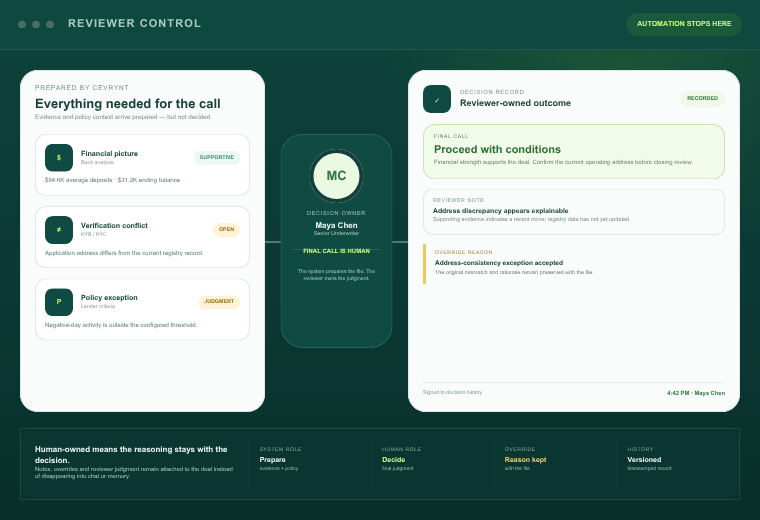
Illustrative product view · synthetic data
Why the answer is walked through on a screen
"Cevrynt does not replace underwriters" is the kind of sentence every vendor writes. What makes it true or not is what the screen does when an underwriter disagrees — so this section follows one call from the prepared file to the recorded reason, on an illustrative view.
Each step is a sentence from one of the two answers that make the claim, quoted word for word. The spotlight only shows where on the screen that sentence becomes something you can see.
Who does what in the call
- Prepares the evidenceCevrynt
- Makes the callThe underwriter
- Records the reasonThe underwriter
- Owns the policyThe lender
The reviewer, the outcome and the figures in the view are illustrative, on synthetic data. In every real file, final approval authority stays with the lender.
Four steps from a prepared file to a recorded reason, and not one of them decided by software. That is what "the underwriter stays in charge" looks like when you can see it.
Founder-led
Ask the question that is not on this page.
If your team's question is about your own files, policy or stack, the quickest answer is a walkthrough with the founder — against your criteria, with your underwriters making every decision.