
Does the borrower package actually hold together?
Catch missing or duplicate documents, conflicting names and numbers, suspicious document signals and inconsistencies between what was submitted and what the evidence shows.
Duplicate documents
July arrived twice. Nobody gets to assume the two are the same.
Two exports of one statement, side by side, one row per line. Every date, description, amount and running balance is held against its counterpart before either copy is allowed to count.
- 02
- Exports of the same month
- 138
- Lines compared, field by field
- 00
- Lines that differ
Export oneStatement_July.pdf
Export twoJuly statement (1).pdf
July · page 1 · lines 1–12 of 138
Pages 1–6 compared · 138 of 138 lines identical · 2 file properties differ, neither of them content
Two files for one month
Choose a line to see its fields held against each other. Every date, description, amount and running balance is compared across both exports — the gutter is the result of that comparison, not a decoration. The only differences sit in the file properties above: a name and an export time.
Why compare what looks like a copy
Two exports of one month are only interchangeable if they are the same, and that is exactly what cannot be assumed. A statement exported twice is ordinary — somebody downloaded it again, or a broker forwarded an older copy. A statement exported twice with one line changed between the two is the oldest trick in a document package.
So neither is quietly dropped. Both stay in the file, as Document Intelligence recorded, and they are compared line by line before either is allowed to feed anything else. These two are identical in every line, which closes the finding — and the closure is recorded with the same detail it would have been raised with.
What the comparison covers
- Every date, amount and balanceCompared
- Both copiesKept
- One dropped without comparingNever
- An identical pairClosed, recorded
A difference between two exports would be raised for a reviewer with both lines side by side, not labelled as tampering. There are ordinary reasons for a statement to change between exports — a pending item that posted — and deciding which applies is a person's call.
Two files, one month, one hundred and thirty-eight lines each, and not a single field different between them. That is the least dramatic result a fraud check can produce, and it is still written down in full — because a check that only leaves a trace when it finds something cannot show anybody that it ran.
Signals, not verdicts
Four different things leave exactly this trace on a statement.
The one open fraud-stage finding on this file, with every reading that fits it — and, past the edge of the file, the single thing that would tell each one apart.
- 01
- Open fraud-stage finding on this file
- 04
- Readings that fit it
- 00
- The statements can rule out
The observation
$610 every Tuesday for nine weeks, and no funding credit anywhere on these statements.
ACH DEBIT · ORIG CO ID 91-7730 · PPD
Would tell it apartThe agreement, and the date it was funded
Would tell it apartThe ··4471 statements, which were never submitted
Would tell it apartThe name behind originator ID 91-7730
Would tell it apartThe agreement, held against what the application disclosed
Four readings, one trace
Choose a reading to see it held against every feature the statements show. Each one passes every test, which is precisely the problem: the statements cannot separate them. What would is drawn past the edge of the file, and none of it is here.
Why the engine stops at the edge
A platform that wanted to look decisive would name this. The difficulty is that four very different things — two of them entirely routine — leave exactly the same trace on a bank statement, and a label chosen from that trace would be a guess wearing a verdict's clothes.
So the signal goes to a person with the question already attached: here is the pattern, here is what fits it, and here is the one document that would separate them. That is a shorter phone call to the broker than a red badge would produce, and it does not accuse anybody of anything.
What a signal carries
- The pattern and its datesAttached
- What would tell readings apartNamed
- A fraud labelNever
- A risk scoreNone
A signal is raised for a named reviewer and closed by one. The readings shown here illustrate what a reviewer weighs; Cevrynt reports the pattern and what would resolve it, and the lender retains final authority over what happens next.
Nine Tuesdays, one amount, no funding credit. Four readings fit that exactly, and the statements cannot tell any of them apart — which is not a gap in the analysis. It is the analysis, stated honestly, with the one document that would settle it named on the way out.
Document signals
Every line checked against the line above it.
Each running balance is the one above it plus or minus that line’s amount, so the statement can be checked against itself. The file as submitted, and two labelled illustrations of what an edit would look like.
- 12
- Lines recomputed
- 00
- Where the arithmetic breaks
- 00
- Where the other export differs
Twelve lines, twelve agreements
Every printed running balance equals the one above it plus or minus that line's amount, and every line matches the other July export. Choose a line to see its printed and recomputed balance side by side, or switch to an illustration to see what an edit would do.
Why a statement can be checked against itself
A bank statement carries its own proof. Each running balance is the one above it plus or minus that line's amount, so recomputing the column turns every line into a check on every line before it. An amount that was changed without the balances following it cannot hide: the gap opens at that line and stays open all the way down.
A careful edit rewrites the balances too, and then the arithmetic has nothing to say. That is not a flaw in the check; it is the reason checks are layered. The same careful edit is now a line-by-line disagreement with the other July export — and a change made consistently across every copy is not something arithmetic can find at all, which is exactly why these checks support a reviewer rather than replace one.
What the recompute covers
- Every printed running balanceRecomputed
- Where a gap first opensPinned to the line
- An edit made consistently everywhereNot findable
- A gap called tamperingNever
A break in the running balance is raised for a reviewer with the line where it opens, not labelled as fraud. There are ordinary causes — a statement page missing from the middle, a bank's own pending-item adjustment — and deciding which applies is a person's call.
The file as submitted agrees with itself on every line. The two illustrations show why that result is worth something: an edit that leaves the balances alone breaks exactly where it was made, and an edit careful enough to fix them walks straight into the other export.
Every check, recorded
Five checks ran on this file. Four came back clean, and clean gets written down too.
What each check compared, what it found, and where it went — including the four that found nothing, because those are most of what a reviewer can rely on.
- 05
- Checks run on this file
- 04
- Came back clean, and recorded
- 01
- Open, and with a person
Clean is still a resultChoose a check to read the record it left. Four of the five came back clean, and each clean result is written down with the same detail an open finding gets — because a check that only leaves a trace when it finds something cannot show anybody that it ran.
Why the clean ones are on the page
A fraud page that only shows what was caught quietly implies that everything else was never looked at. On this file, four checks found nothing, and those four are most of what a reviewer can rely on: the duplicate is identical, the arithmetic holds, the statements are continuous, and nobody is carrying the account alone.
The fifth is open, and it is with a person. Not because the engine suspects anything in particular, but because the statements cannot tell four readings apart — and a platform that picked one would be making an accusation it cannot support.
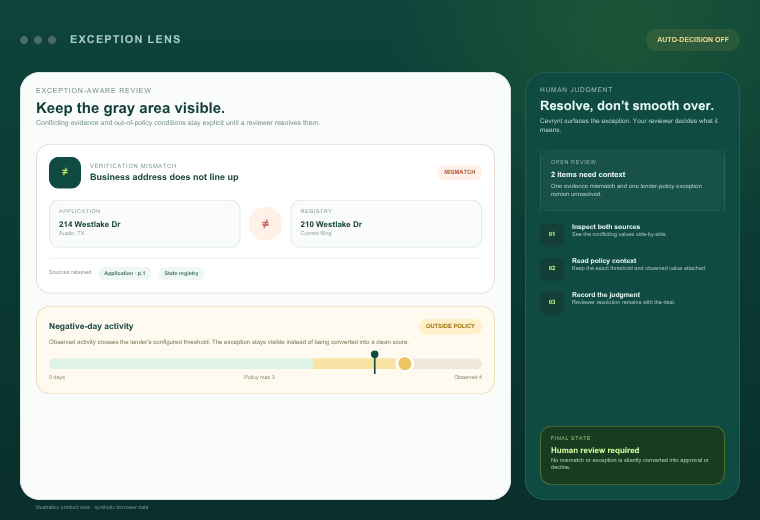
What every check leaves behind
- What was comparedNamed
- What it found, clean or notRecorded
- An open item's reviewerNamed
- A fraud score for the fileNone
Open items wait for a person in a view like the one above — both sides of a conflict kept visible, and nothing converted into an approval, decline or score. The lender retains final authority over every file.
Five checks, four clean, one open. That is the whole fraud-stage account of this file — not a percentage, not a badge, but five records a reviewer can open, and one question that still needs somebody to pick up the phone.
Submitted against evidence
What the application says, held against what the statements show.
The borrower’s own figures — card sales, revenue, accounts, existing advances — each joined to the evidence submitted with them. Names and addresses are compared on Business Verification.
- 05
- Figures the application states
- 02
- The statements agree with
- 02
- Reported or noted, not raised
- 01
- Open, and already counted
Names are elsewhere. These are the numbers.Choose a claim to read how it was held against the statements. Each hinge is shut where the two agree, slightly apart where the difference is a question of definition, and open where the statements show something the application does not mention.
Why the numbers get their own view
A borrower states figures about their own business — what it sells, what it banks, what it already owes — and the statements submitted with the application either bear those figures out or they do not. That comparison is the plainest meaning of what was submitted against what the evidence shows, and it is where a package most often stops holding together.
On this file it mostly holds. Two figures agree, one differs only in how revenue is defined, one points at an account the file does not include, and one — the weekly debit — is the open signal from section 02 seen from the application's side. Nothing here is a new finding; it is the same file, read against the borrower's own words.
What a claim is held against
- The borrower's own figureQuoted
- The documents behind the evidenceNamed
- A definitional differenceReported
- A borrower called dishonestNever
A stated figure that differs from the statements is surfaced with both sides quoted, not labelled as misrepresentation. Borrowers estimate, round and describe their business in their own terms; deciding whether a difference matters is the lender's call.
Five figures from the application, held against the statements sent with it. Two agree, two differ for reasons the page can name, and one is the question already on its way to the broker — which is what a package that mostly holds together looks like.
Founder-led
Bring the package that looked fine until it did not.
The file where something was off and it took a week to say what — two statements that did not quite agree, a debit nobody could explain, a document that was clean on its own and wrong next to the others. Walk us through it, and we will show you where it would have surfaced and what it would have been attached to.