MCA underwriting software helps a merchant cash advance funder turn a submission into a reviewable underwriting file: it classifies the documents, reads the bank statements, separates true revenue from transfers and loan proceeds, finds existing MCA positions, checks the business, surfaces fraud signals and applies the funder's own credit policy. A good system shows its evidence for every figure and leaves the approval, pricing and structure to the underwriter.
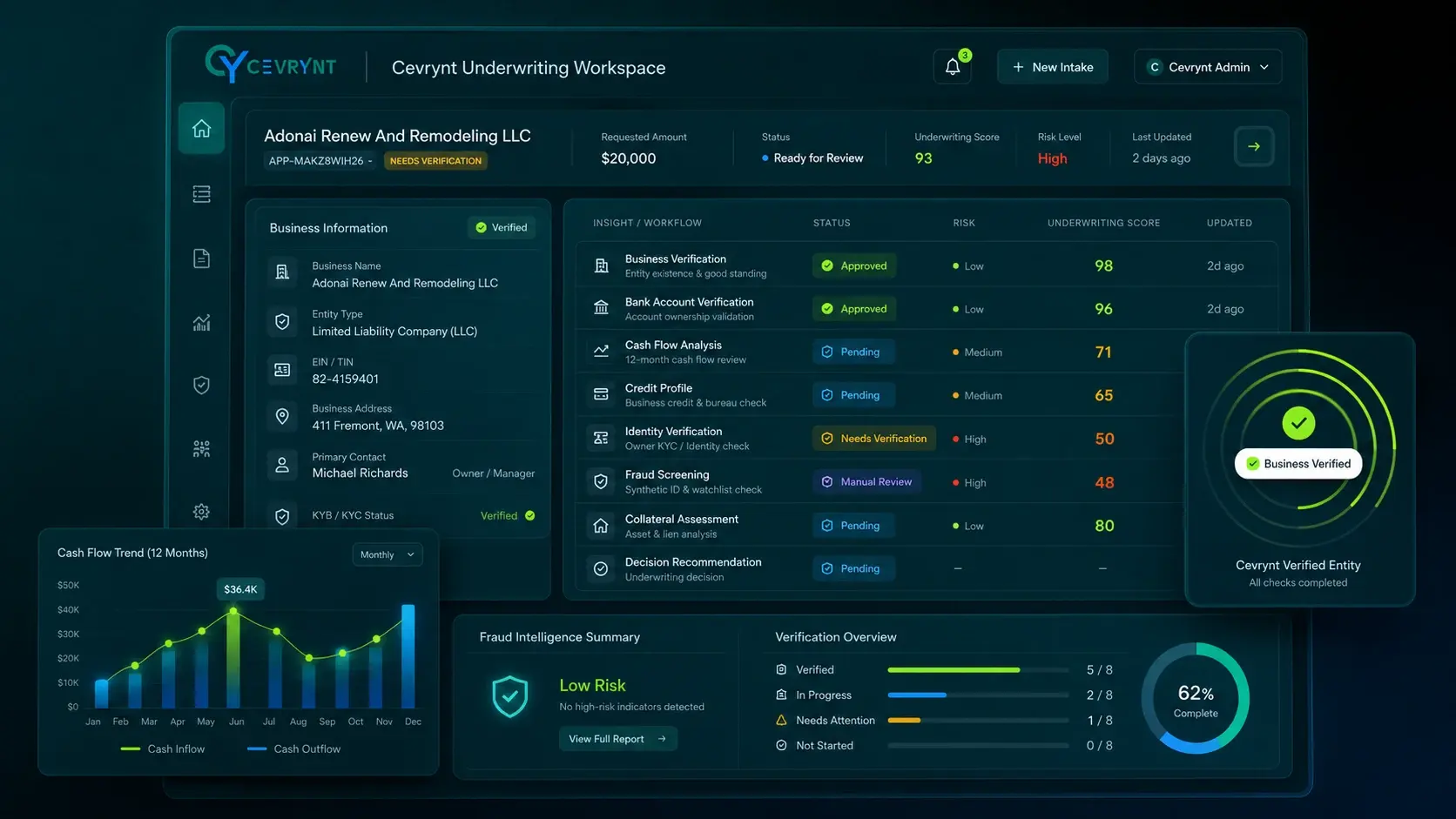
Cevrynt is AI-assisted MCA underwriting software with a built-in MCA CRM, built for U.S. merchant cash advance funders and alternative lenders. The underwriting follows one file from intake to a human decision: Intake, Documents, Financials, Verification, Fraud, Policy, the underwriting memo and the underwriter's decision. The CRM carries the same deal from submission through offer, contract, funding and servicing. Cevrynt scores each deal and recommends a decision and amount, with the reasons and evidence behind them, and the funder's underwriter makes the final decision. Cevrynt is not a lender and does not fund deals.
What does MCA underwriting software do?
- Document intake and classification. Applications, bank statements, IDs, voided checks and agreements are sorted and filed against one deal. See Document Intelligence.
- Bank statement analysis. Deposits, true revenue, average daily balance, negative days, NSFs and transfers across the full statement period, not month by month. See Bank Statement Analysis.
- Existing positions and stacking. Recurring MCA debits are surfaced from bank activity so the underwriter sees what the merchant already carries before adding another position.
- Business verification (KYB). The legal entity, ownership, address and application claims are compared against verification evidence. See Business Verification.
- Fraud and risk signals. Document tampering signs, conflicting details and duplicate files are flagged for a person, never turned into an automatic decline. See Fraud Signals.
- Your credit policy, criterion by criterion. Each rule in your buy box shows the observed value, your threshold, the margin and any exception. See Policy Engine.
- An evidence-linked underwriting report. Every material number opens back to the statement page and line it came from, with reviewer notes, overrides and audit history. See Underwriting Report.
- A built-in MCA CRM. The deal pipeline from submission to decision; ISO and broker records with their submissions; offers from your own pricing and terms, contracts and e-signature; then funding, daily remittances, collections and renewals.
Do you need separate bank statement software and an MCA CRM?
Bank statement software converts statements into data. An MCA CRM runs the pipeline, ISOs, contracts, funding and servicing. Most funders have stitched the two together with spreadsheets, and underwriting happens in the gap between them. Cevrynt puts the CRM and the underwriting in one place: the deal you work in the pipeline is the same deal whose statements, positions, verification, fraud signals and policy results the underwriter reviews. If you prefer to keep an existing CRM, integration is scoped before a pilot. Our MCA tech stack guide maps every layer, and bank statement software vs an underwriting platform covers the most common confusion.
How does Cevrynt compare with other MCA underwriting tools?
We publish one honest comparison per vendor, built from each vendor's own public site, with a feature table and a section on when the other product is the better fit: Cevrynt vs Kaaj, Heron Data, Ocrolus, MoneyThumb, Inscribe, Provenir, Prism Data, Carrington Labs, LendSaaS and Nova Credit Cash Atlas. The comparison overview sorts the whole market by the job each tool does.
How should a funder evaluate MCA underwriting software?
- Test it on your own past files, including declines and edge cases, not on a vendor's demo deal.
- Click any figure and check that it opens the exact statement page and line behind it.
- Check that revenue is separated from transfers, loan proceeds and existing MCA funding, and that you can see how.
- Confirm the software applies your policy and shows which rule produced each result.
- See what happens to exceptions: held open for a person, or decided automatically.
- Ask what data leaves your environment, where it is stored and for how long. See Security.
For the full process, read the MCA underwriting process step by step, the buyer's guide to MCA underwriting software, how to set hard stops for NSFs, negative days and restricted industries and how to pilot underwriting software in 30-60-90 days.