
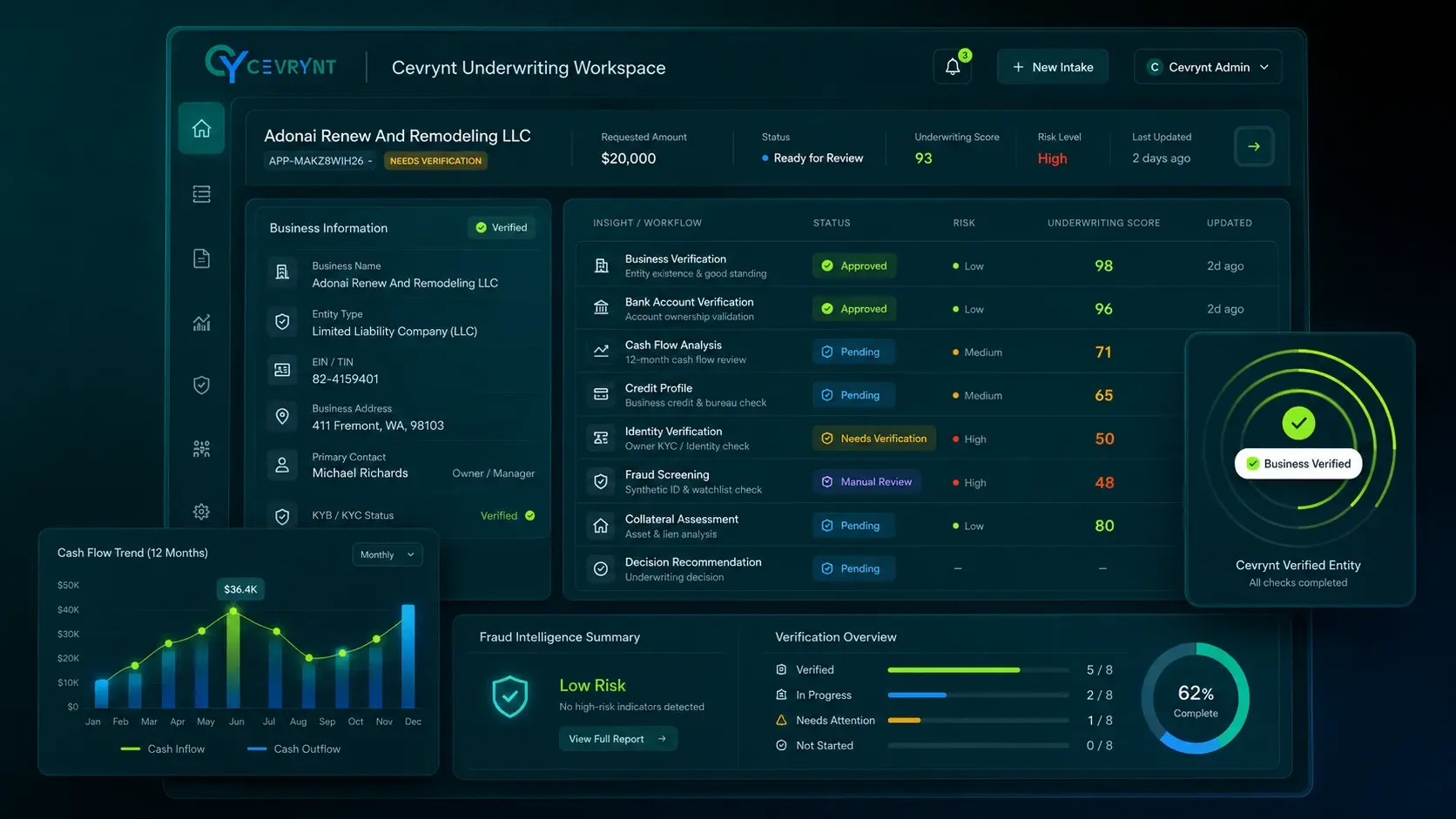
Bank statements are the center of merchant cash advance underwriting, so it is no surprise that bank statement analysis software is often the first tool a funder buys. These tools are good at what they do: they read PDF statements, extract every transaction and calculate the metrics underwriters rely on. Well-known examples, such as Ocrolus and MoneyThumb, serve many kinds of lenders.
What surprises many funders is how much work remains after the data is extracted. A clean transaction table is not an underwriting decision. This guide explains where bank statement analysis ends, where underwriting begins, and how to tell which one your team is short of.
What bank statement analysis software does
- Reads PDF, scanned or downloaded statements and extracts every transaction.
- Normalizes formats across banks and categorizes transactions.
- Calculates metrics: total and average deposits, average daily balance, ending balances, negative days, NSF and overdraft counts.
- Flags some document-integrity issues, such as edited PDFs or balances that do not reconcile.
- Delivers results by dashboard, spreadsheet export or API into your own systems.
For the fundamentals of the analysis itself, see our bank statement analysis guide and the explainer on DSCR and average daily balance.
What it leaves for the underwriter
Extraction answers "what happened in this account?" Underwriting answers "what does that mean for this deal, under our policy?" The gap between the two is where most review time actually goes:
- True revenue. Deposits include transfers from the owner's other accounts, loan and MCA proceeds, refunds and reversals. Deciding what counts as revenue needs context from the rest of the file.
- Existing positions. Recurring debits have to be recognized as MCA or loan payments, grouped by funder, and weighed against revenue — the core of stacking detection.
- The rest of the file. Does the business on the statements match the application and the registry? Do the documents hold together? Statement data alone cannot answer either.
- Your policy. Minimum revenue, maximum positions, negative-day limits, industry rules — the numbers only matter once they are held against the funder's own thresholds.
- The record. Someone still has to write down what was found, what was decided and why.
What an underwriting platform adds
An underwriting platform — sometimes called underwriting intelligence — uses statement analysis as one input and brings it together with business verification, fraud signals and the lender's credit policy. The output is not a table but a reviewable file: cash flow and obligations interpreted in context, conflicts surfaced, each policy rule shown as passed, failed or needing judgment, and a report or memo the decision can be made from. Our overview of the four types of AI underwriting software places both categories in the wider market.
Which do you need?
A bank statement analyzer is enough when you have an in-house team or system that already turns clean data into decisions consistently, and the only bottleneck is getting the data out of PDFs. Engineering-led lenders that have built their own decisioning often fall into this group.
An underwriting platform makes sense when extraction is no longer the slow part — analysts have the numbers but still spend hours reconciling them with the application, finding positions, checking the business and writing up the file, and different underwriters reach different conclusions on the same deal.
Many funders use both: an analyzer or open-banking feed for the data, and an underwriting layer that turns it into a decision-ready file. The questions that matter when choosing either are the same — can every figure be traced to its source, and does the output separate what is known from what still needs judgment? See our AI underwriting software comparison for how specific vendors approach this.
From here, this article is about Cevrynt
How Cevrynt approaches bank statement analysis
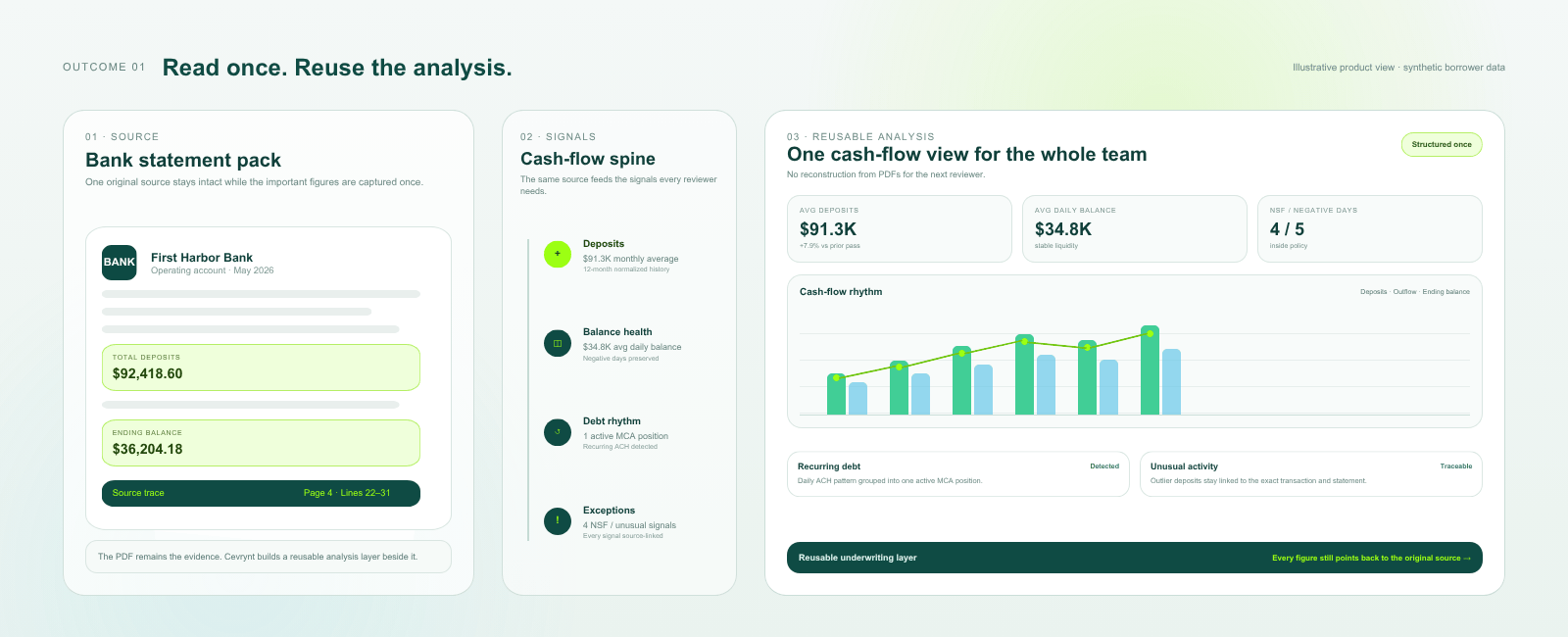
Cevrynt's bank statement analysis is one stage of a connected underwriting review rather than a standalone export. Deposits, balances, negative days, NSFs and existing positions are analyzed across the full statement period, each figure keeps the page and line it came from, and the results flow straight into business verification, fraud signals and your own policy. The file that reaches your underwriter shows what was found and what still needs judgment — the decision remains theirs.
Bring a recent statement pack to a walkthrough and compare it with how your team reviews it today.