
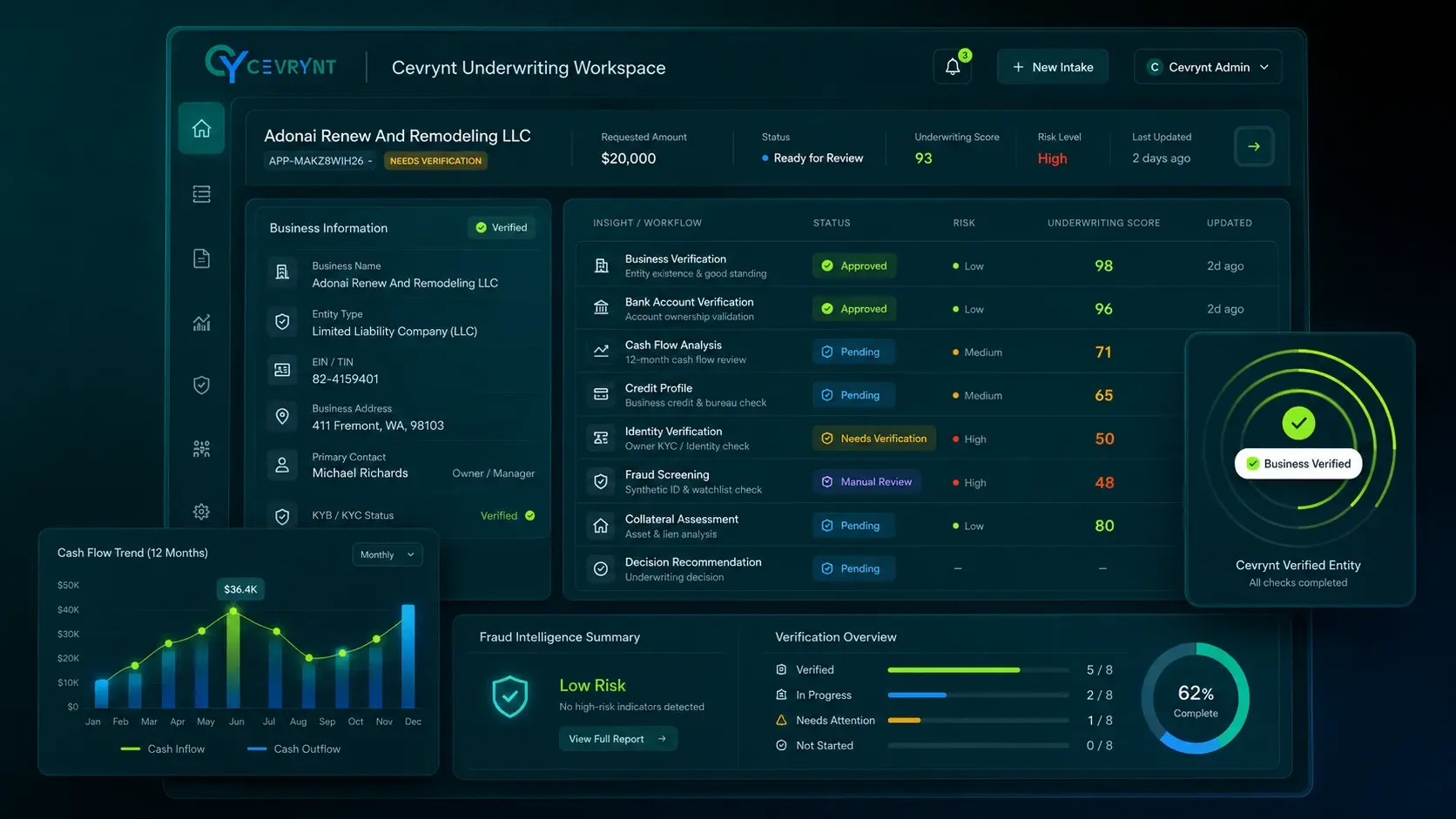
Search for "AI underwriting software" as an MCA funder or small-business lender and you will find dozens of vendors using nearly identical language: faster decisions, automated analysis, decision-ready files. Underneath that language they do very different jobs. Some turn PDFs into data. Some automate what happens when a submission lands in your inbox. Some run your entire lending operation. And some prepare the underwriting file itself for a credit decision.
Buying the wrong category is the most expensive mistake in an evaluation, because no amount of feature comparison fixes it. This guide sorts the market into four types by the job each one does, so you can decide which job you actually need done next — and only then compare vendors.
1. Extraction and bank statement conversion
These tools read financial documents — above all bank statements — and return structured data: transactions, balances, deposits, and derived metrics such as average daily balance or NSF counts. They are typically delivered by API or a simple dashboard and are used across many kinds of lending, from mortgage to consumer to small business.
Choose this type when your team or your platform already knows what to do with clean data and simply needs to stop keying it in. Engineering-led lenders often build their own underwriting logic on top of an extraction API. It will not, on its own, verify the business, weigh existing positions against your policy, or tell an underwriter what still needs judgment — that assembly remains your job. For a closer look at this boundary, see bank statement analysis software vs. an underwriting platform.
2. Intake and submission automation
High-volume MCA funders receive hundreds of submissions from ISOs by email, each with an application and several months of statements. Intake automation handles that front door: parsing the application, scrubbing statements, running background and fraud checks, sometimes matching deals to funding partners or applying first-pass rules, and pushing the results into your CRM.
Choose this type when the bottleneck is volume — deals waiting in an inbox before anyone looks at them, or analysts spending their day on files that were never going to fund. Watch for how much of the credit decision the automation takes on. Screening out obvious declines quickly is valuable; silently deciding borderline files is a different thing. Our guide to automating MCA submission intake covers where that line should sit.
3. Lending platforms and MCA CRMs
These are systems of record. A lending platform or MCA-specific CRM manages the whole lifecycle: leads and ISO relationships, submissions, underwriting workflow and approvals, contracts, syndication, payment servicing, renewals and collections. Many now include AI document parsing as one feature among many.
Choose this type when your operation runs on spreadsheets and email and needs one place for every deal and every dollar. It is usually not the deepest tool for the analysis itself; platforms tend to be broad rather than deep at the underwriting step, which is why many funders pair one with a specialist tool.
4. Underwriting intelligence
The newest category sits between the data and the decision. Underwriting intelligence tools take the complete borrower package — application, statements, IDs, business records — and produce an analysis an underwriter can act on: cash flow and existing obligations, business verification, fraud signals, results against the lender's credit policy, and a memo or report that brings it together.
Within this category, the important differences are philosophical as much as technical. How much does the tool decide on its own? Can every figure be traced to its source? Whose policy is applied, and can you see which rule produced each result? Those questions matter more than the length of the feature list, and they are covered in depth in our piece on decision engines vs. underwriting engines.
Most lenders need more than one type
These categories are layers, not rivals. A common stack for a growing MCA funder is a CRM as the system of record, an open-banking or extraction provider for data, and an underwriting layer that turns that data plus verification and policy into a reviewable file. The right question is not "which vendor is best?" but "which layer is our current bottleneck?"
- Deals sit unopened for hours → intake automation.
- Analysts retype statements into spreadsheets → extraction.
- Nobody can see the pipeline or reconcile payments → a lending platform.
- Files are opened quickly but reviewed inconsistently, exceptions get lost, and decisions are hard to explain later → underwriting intelligence.
Five questions that separate vendors inside any category
- Can an underwriter open any number and see the exact document, page and line it came from?
- Does it distinguish revenue from transfers, loan proceeds and existing MCA payments — and show its reasoning?
- Is your credit policy applied as written, with each result tied to a named rule and version?
- What happens to exceptions — are they decided automatically or held open for a person?
- Which performance claims can the vendor evidence on files like yours, not on a curated demo?
For a side-by-side view of named vendors in each category, including Kaaj, Heron, Ocrolus and MoneyThumb, see our AI underwriting software comparison. For a full evaluation plan, read the buyer's guide to MCA underwriting software.
From here, this article is about Cevrynt
Where Cevrynt fits
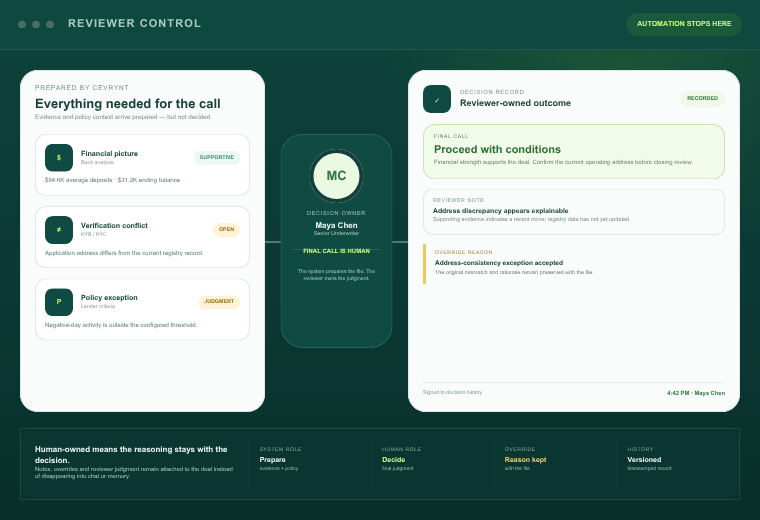
Cevrynt is underwriting intelligence built first for merchant cash advance and alternative lenders. It structures the borrower file, analyzes bank activity and existing positions, verifies the business, surfaces fraud signals and applies your own credit policy — with every finding linked to its source. It deliberately stops short of the decision: approval, decline, pricing and structure stay with your underwriters. It is not a CRM, a servicing platform or an open-banking provider, and it is designed to fit around the systems you already use.
If the fourth type is the layer you are missing, a walkthrough on one of your own files is the fastest way to see whether Cevrynt fits.