
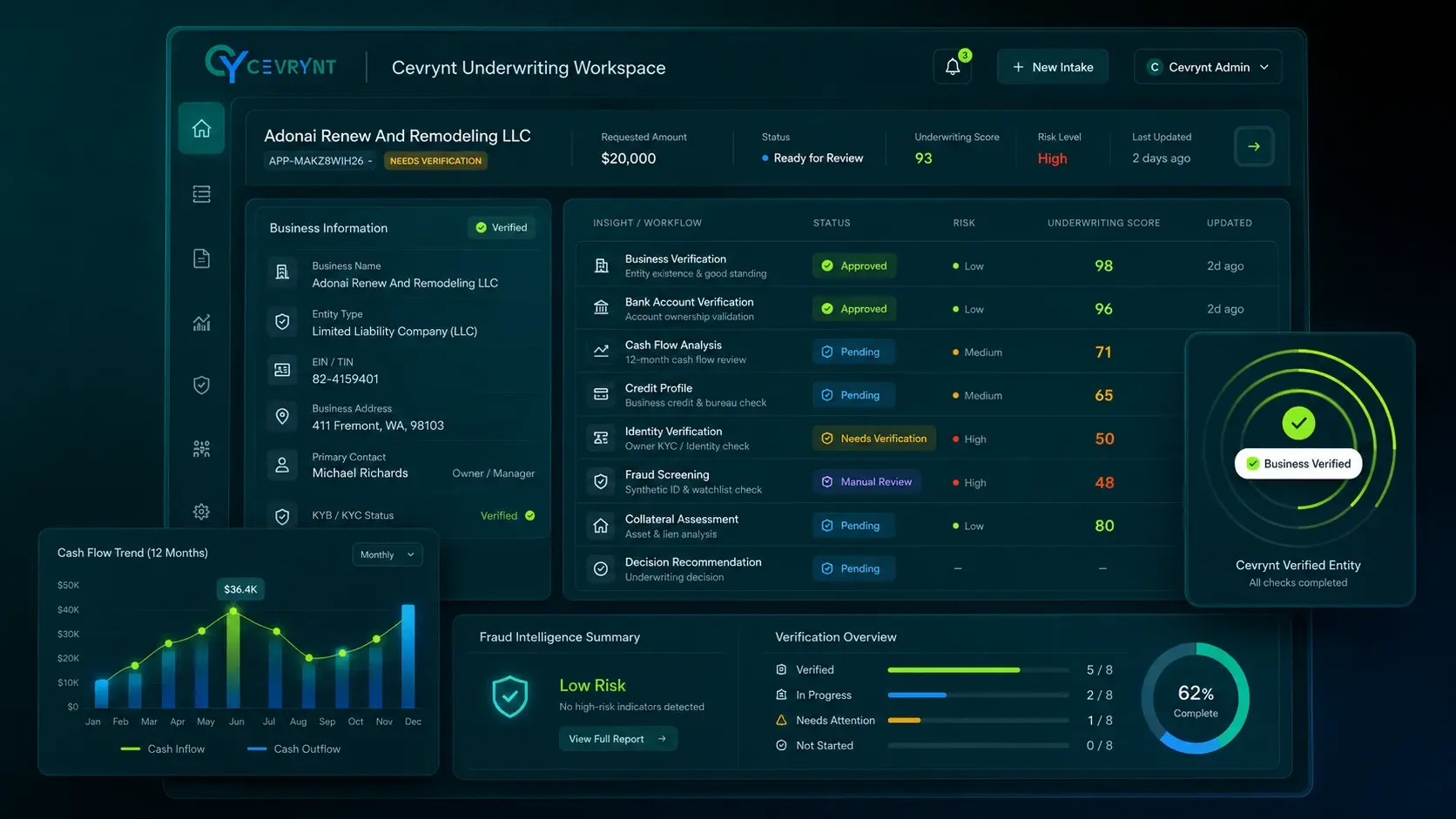
"Decision engine" and "underwriting engine" show up frequently in lending technology marketing, sometimes used as synonyms, sometimes describing meaningfully different scopes of functionality. For a lender evaluating vendors, it's worth understanding the distinction, because the terms imply different levels of automation and different expectations about where human judgment fits in.
Underwriting engine: the broader review process
An underwriting engine typically refers to the fuller set of tools and logic that support the underwriting review process end to end — document handling, financial analysis, verification, fraud checks, and policy evaluation, feeding into a report an underwriter reviews. It describes a workflow, not a single automated output.
Decision engine: the specific logic layer that renders a result
A decision engine more narrowly refers to the logic layer that evaluates an application against defined rules or a model and returns a specific result — approve, decline, or refer for review. This is closer to what we've described as a policy engine in our other guides, though "decision engine" sometimes implies a higher degree of automation, including in some products, fully automated final decisions without human review.
Why this distinction matters for lenders
The practical stakes of this terminology show up when evaluating whether a tool is meant to support underwriters or to replace them for at least some segment of applications. A vendor describing their product purely as a "decision engine" that returns automated approvals may be describing a fundamentally different risk profile than one describing an "underwriting engine" that organizes evidence for a human underwriter to review.
Neither approach is inherently wrong for every use case — some high-volume, low-dollar consumer lending products do rely on largely automated decisioning. But for MCA and SMB commercial lending specifically, where deal sizes are larger, borrower situations are more varied, and regulatory scrutiny of automated credit decisions has intensified, most lenders are better served by a workflow that keeps a human underwriter in the loop for the final call. Our piece on human-in-the-loop AI underwriting covers why this distinction matters beyond terminology.
What 'automated decisioning' actually means in lending practice
Automated decisioning — a system issuing a final approve or decline without a human reviewing the specific file — exists on a wide spectrum in practice. At one end are consumer products (credit cards, personal loans, small-dollar consumer advances) where algorithms issue instantaneous decisions on highly standardized applications with deep historical data. At the other end is commercial lending, where the sheer variety of business types, financial structures, and risk profiles makes clean algorithmic classification genuinely difficult.
MCA and SMB lending sits somewhere in the middle, closer to the commercial end of that spectrum. Some high-volume MCA lenders do automate a portion of small-ticket decisions — particularly for very simple, clean applications from businesses they've funded before. But for the majority of the market, the complexity of each unique business file, and the consequences of a bad decision, make fully automated decisioning a meaningful risk rather than an efficiency gain.
The regulatory and compliance dimension of automated decisions
Beyond the practical risk argument, automated credit decisions face increasing regulatory attention. Fair lending regulations in the U.S. require that credit decisions be explainable — that an applicant who is declined can receive a clear, specific reason for that decision. A system that issues automated decisions based on a complex machine-learning model that's difficult to interpret creates compliance exposure precisely because the explanation is hard to produce.
This is one of the strongest arguments for human-in-the-loop workflows in commercial lending: the human decision-maker can provide a specific, documentable reason for every decision, even when automated analysis has done most of the information-gathering work. The topic of explainability is covered in more depth in our piece on explainable AI in underwriting.
Modes of decisioning: automated, manual, and hybrid
It's useful to think of decisioning as existing on a spectrum with three broad modes. Fully automated decisioning renders a result — approve, decline, refer — without human review at the point of decision. Fully manual review relies entirely on an underwriter's independent judgment, potentially with minimal system support. Hybrid decisioning, which is most common and most defensible for commercial lending, uses automated analysis to structure evidence and apply defined policy rules, while routing the actual approve or decline call to a human underwriter.
Questions to ask a vendor about their terminology
- Does your "decision engine" ever issue a final approval or decline without human review, and under what conditions?
- If it's described as an underwriting engine, what specific stages does it cover — document handling, financial analysis, verification, policy, or all of the above?
- How does the tool distinguish between a policy rule outcome and a final credit decision, if at all?
- What happens when the automated logic and an underwriter's judgment disagree?
From here, this article is about Cevrynt
Where Cevrynt fits
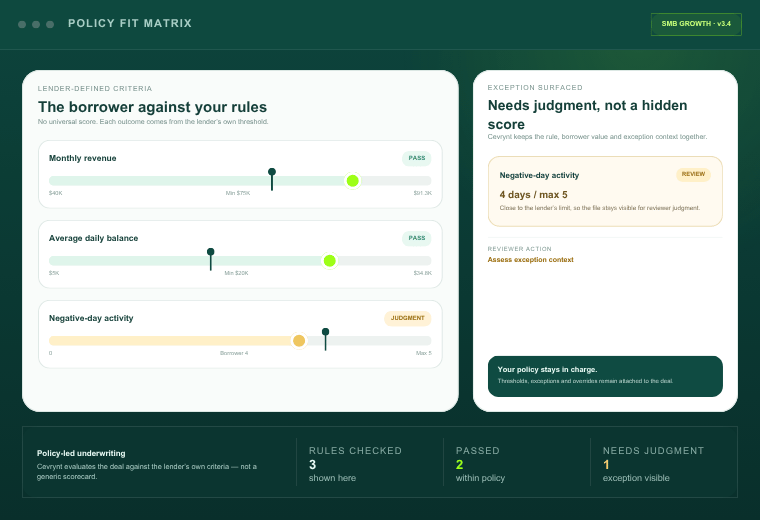
Cevrynt is best described as underwriting infrastructure: it connects document handling, financial analysis, verification, fraud signals, and policy evaluation into one workflow that produces an evidence-backed report for a human underwriter. Cevrynt does not issue automated approvals or declines — the final decision is always the lender's.
If you're evaluating vendors and want to understand exactly where automation ends and human decision-making begins in Cevrynt's workflow, a qualified walkthrough is the clearest way to see it directly.