
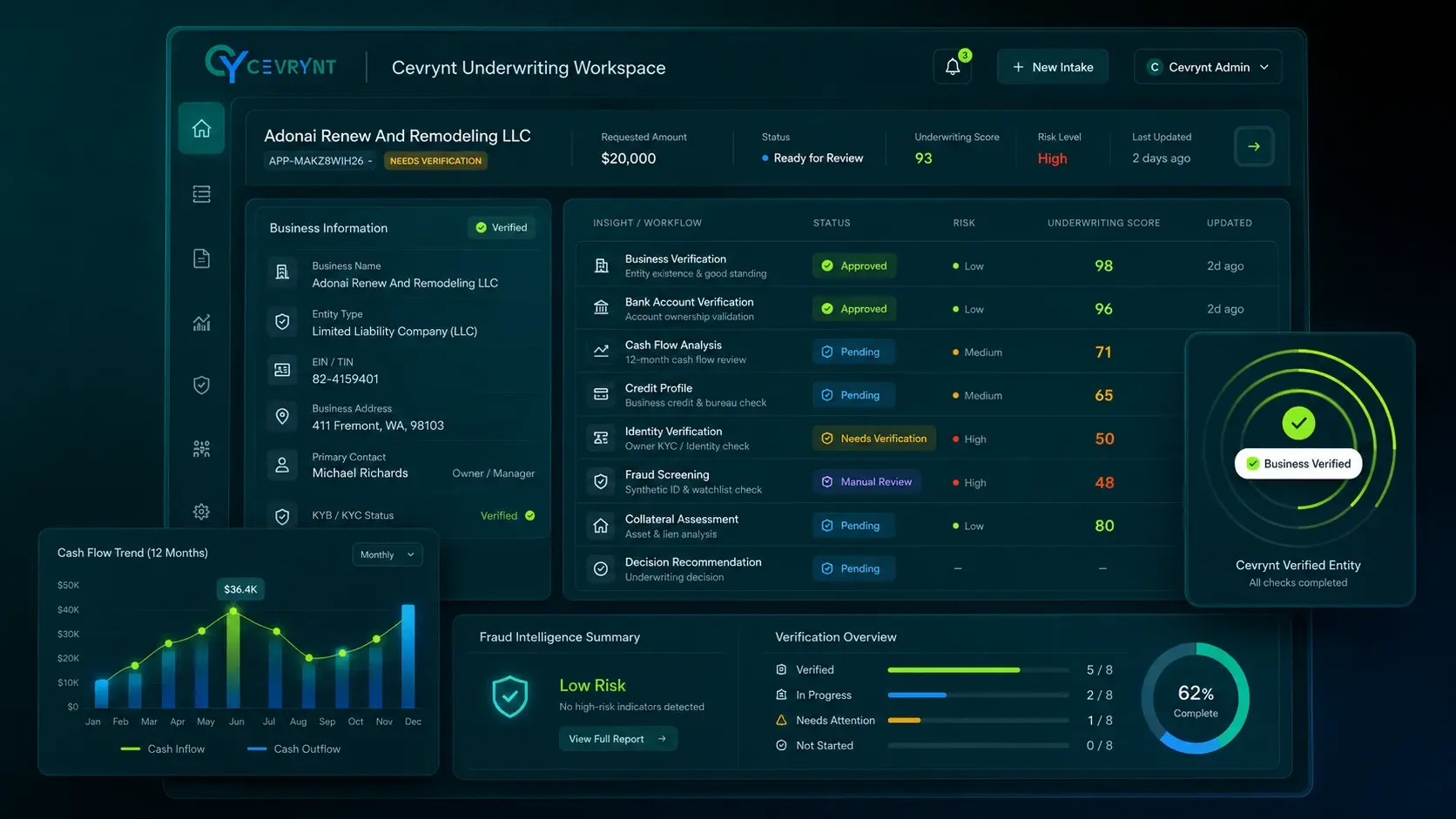
No credit policy, no matter how carefully written, anticipates every situation an underwriter will actually encounter. A strong deal with one unusual data point, a borderline case where an experienced underwriter's judgment says yes despite a policy rule saying no, a genuinely novel business model that doesn't fit neatly into existing criteria — these situations are exactly why underwriters exist, and exactly why every credible underwriting process needs a documented override path.
The problem isn't overrides themselves. The problem is undocumented ones.
Why undocumented overrides are a real risk
Loss of institutional knowledge
When an experienced underwriter overrides a policy rule based on judgment that isn't written down anywhere, that reasoning exists only in their head. If they leave the team, or simply don't remember the specifics of a decision from months earlier, the institutional knowledge behind that judgment call is effectively lost — even though it might represent a genuinely valuable pattern worth incorporating into policy going forward.
Inconsistency across underwriters
Without visibility into how and why overrides happen, different underwriters can develop inconsistent informal standards for when an exception is warranted — one underwriter overriding a rule that another would enforce strictly, with no mechanism to notice or reconcile the difference.
Compliance and audit exposure
When a decision is questioned — during an internal audit, an investor review, or a regulatory inquiry — being able to show not just what was decided but why, including any policy exceptions applied and the reasoning behind them, is materially different from having no record at all. Our broader piece on underwriting audit trails covers this territory in more depth.
What a good override record should include
- Which specific policy rule was overridden, not just a general note that an exception was made.
- The underwriter's stated reasoning, in enough detail that another reviewer could understand the judgment call without needing to ask.
- Supporting evidence, linked to the specific findings that informed the decision.
- Who approved the override, if the lender's process requires a second signature for exceptions above a certain threshold.
- A timestamp and the specific policy version that was in effect, since policy itself may change over time.
Making overrides easy to document, not just possible
A documented override process only works if it's easy enough that underwriters actually use it consistently. If documenting an override requires leaving the primary underwriting system to write a note in a separate spreadsheet or send an email, some overrides will inevitably go undocumented simply due to friction and time pressure — undermining the entire point.
The more effective approach makes override documentation a first-class, low-friction action within the same workflow where the underwriter is already reviewing the file, so capturing the reasoning takes seconds rather than becoming a separate administrative task.
The difference between an exception and an override
Exception and override are used interchangeably in most lending conversations, but some lenders draw a useful distinction between them. An exception is a case where a specific criterion isn't met, but the deal is approved anyway with documented reasoning for why the specific criterion doesn't apply or is compensated for by other strengths. An override is a case where the policy rule itself is set aside in favor of a broader judgment call — the criterion is relevant, it wasn't met, but the underwriter has decided to proceed anyway with a documented explanation.
The distinction matters because different levels of scrutiny or approval authority might be appropriate for each. An exception (criterion doesn't apply) might be approachable at the underwriter level with standard documentation. An override (criterion applies but is set aside) might appropriately require a second signature or a credit-committee review depending on the magnitude of the deviation and the deal size. Whether a lender uses this distinction explicitly or uses both terms interchangeably, the key property is that the type of deviation and its reasoning are captured clearly in the record.
How to set approval thresholds for overrides
Most lenders with a mature override process set tiered approval requirements based on the significance of the deviation. Small deviations from policy — an DSCR that's 0.05 below the threshold on an otherwise strong file — might be approachable by a senior underwriter with documented reasoning alone. Larger deviations — multiple policy rules failing on a file that's being approved anyway — typically require credit-committee review or a second senior signature.
The right threshold structure varies by lender size, deal size, and risk culture. A small team writing relatively uniform deals might operate with a single approval tier. A larger operation with significant deal-size variation might need three or four tiers with escalating approval requirements. What matters is that the tiers are explicitly defined and consistently applied, rather than determined informally deal by deal.
What regulators and auditors actually look for in override records
For lenders subject to regulatory oversight, investor due diligence, or third-party audits, override records are one of the most scrutinized aspects of credit file documentation. Auditors typically want to see: that override rates are tracked and monitored (not just that individual overrides are documented), that override performance is compared to non-override performance (to assess whether exceptions are systematically predictive of higher loss), and that override authority is applied consistently across similarly situated applicants.
This last point is important from a fair lending perspective. If a lender's override data shows that exceptions are approved more frequently for one group of applicants than similarly-situated applicants from another group, that pattern is potentially problematic even if each individual override was documented with a facially neutral rationale. Systematic override data analysis — looking at who gets exceptions, not just whether exceptions are documented — is part of sound fair lending compliance practice.
Turning override history into better policy
A well-documented history of overrides is also a valuable input for improving credit policy itself. If a particular rule gets overridden frequently for a specific, consistent reason, that's a signal the underlying policy might need adjustment — a pattern that's invisible without a systematic record, but obvious once the data is reviewable.
From here, this article is about Cevrynt
How Cevrynt documents overrides
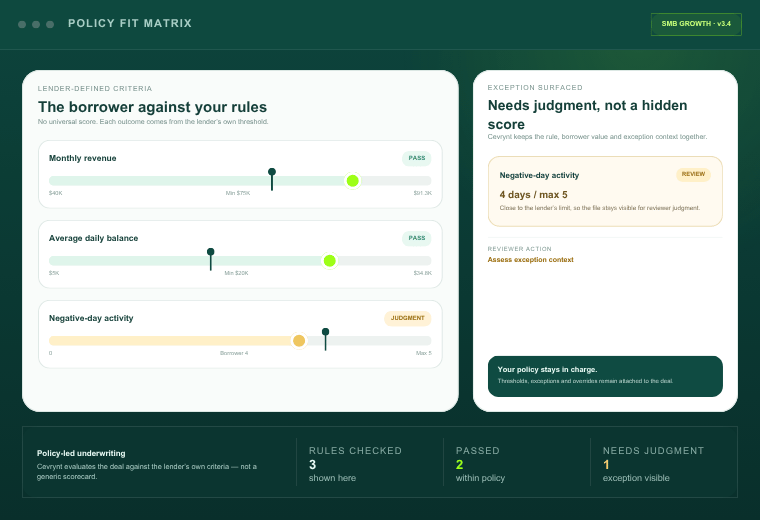
Cevrynt's Policy Engine treats overrides as a supported, first-class part of the workflow — an underwriter can apply and document an exception directly within the file they're reviewing, with the specific rule, reasoning, and supporting evidence preserved together. This becomes part of the file's permanent record, visible in the underwriting report for any future reviewer or auditor.
This is a deliberate part of keeping human judgment central to the workflow: overrides aren't an exception to route around the system, they're a documented, expected part of how underwriting actually works. A qualified walkthrough can show how this fits your own override and approval processes.