
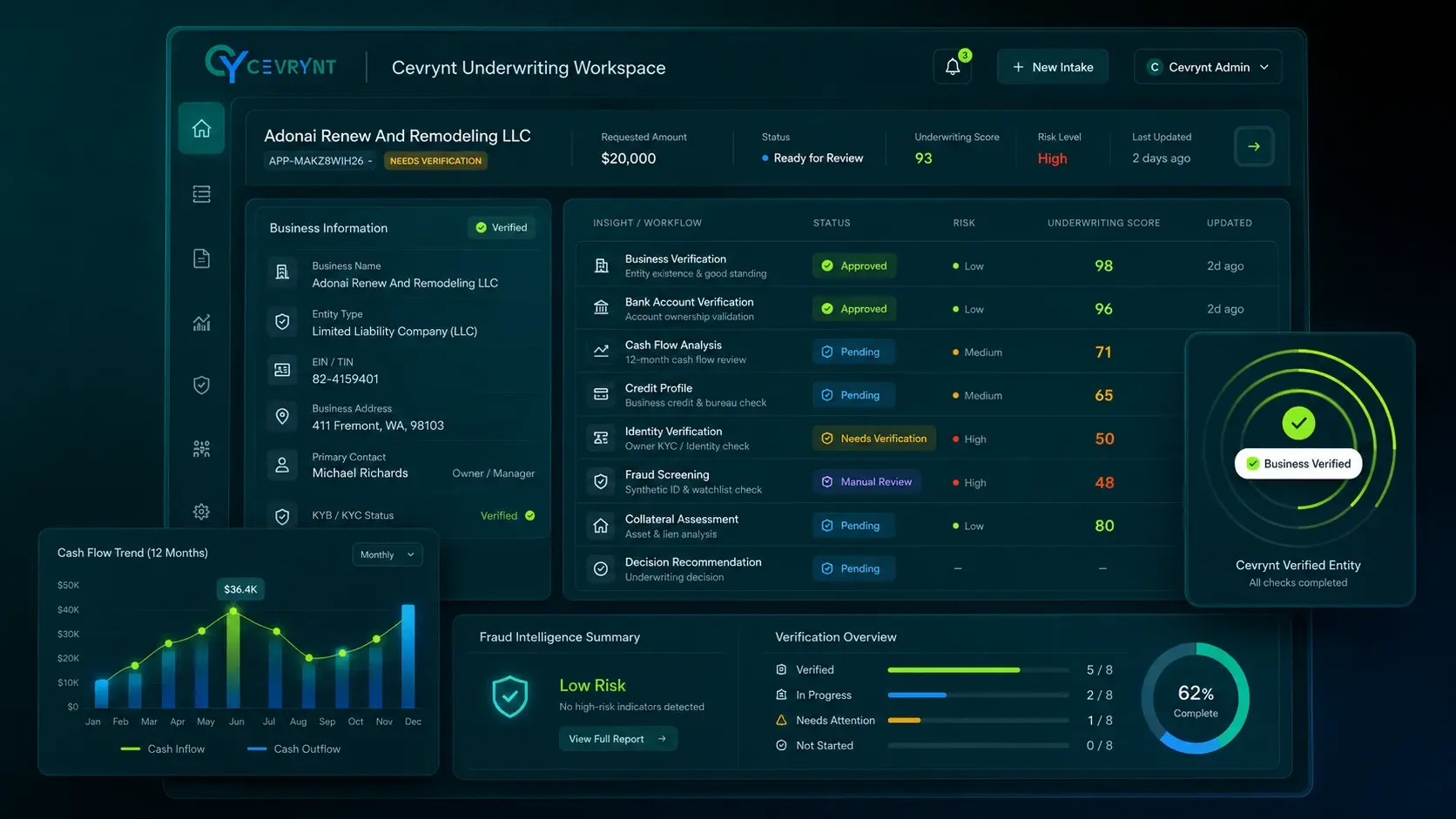
Every lender has a credit policy — a set of rules and criteria that determine what an acceptable deal looks like. In many alternative lending operations, that policy lives partly in a written document, partly in a spreadsheet, and partly in the accumulated judgment of experienced underwriters who know it well enough not to need to look it up. A policy engine's job is to make that policy explicit, consistent, and applied systematically to every deal — without replacing the judgment that lets experienced underwriters handle the edge cases the written policy doesn't fully anticipate.
What a policy engine actually does
At its core, a policy engine takes the findings from earlier stages of underwriting — financial metrics, verification results, fraud signals — and evaluates them against a defined set of rules specific to the lender. The output isn't just a pass or fail; a well-built policy engine shows which specific rules were satisfied or violated, and why, so an underwriter can see the reasoning rather than just a verdict.
Why lender-specific configuration matters
Credit policy varies meaningfully across alternative lenders — an MCA funder focused on retail and restaurant deals has different risk tolerances than a revenue-based financing company working with e-commerce merchants. A policy engine that imposes a generic, one-size-fits-all rule set doesn't reflect this reality and forces a lender to either work around the tool or compromise on their actual credit standards.
The more useful approach lets a lender configure their own thresholds, weightings, and rules directly, and update them as their credit policy evolves — without needing a vendor engineering team to make the change.
Policy engine vs. a black-box scoring model
It's worth distinguishing a policy engine from a purely statistical scoring model. A scoring model might output a single number derived from a machine-learning process that's difficult to interrogate rule by rule. A policy engine, by contrast, is explicitly rule-based and interpretable by design — every outcome traces back to specific, named criteria the lender defined. This distinction matters significantly for explainability and compliance, discussed further in our piece on explainable AI in underwriting.
This doesn't mean a policy engine can't incorporate outputs from more sophisticated analysis — it can evaluate a rule like "deposit consistency score must exceed X" where that score itself comes from a more complex calculation. The key property is that the rule itself, and whether it was satisfied, remains visible and auditable.
What good policy evaluation output looks like
- Rule-by-rule visibility — an underwriter should see which specific policy criteria passed, failed, or triggered a review flag, not just an aggregate result.
- Context alongside outcomes — a failed rule should show the underlying data that caused it to fail, linking back to the source evidence.
- Support for tiered outcomes — approve, decline, and refer-for-review are all legitimate policy outcomes; a good engine shouldn't force a binary result.
- Version history — as policy changes over time, it should be clear which version of the policy was applied to any given historical decision.
How policy gets encoded: rules, thresholds, and weightings
Policy encoding — translating a lender's written credit criteria into a functioning rule set — is the most important and most underestimated step in implementing a policy engine. The quality of the output depends entirely on the quality of the input: a vague policy translated into vague rules produces vague, unreliable outcomes.
Effective policy encoding requires making implicit decisions explicit. An experienced underwriter might say 'we generally want DSCR above 1.2x, but we'll sometimes approve 1.0x for a really strong deal.' In a policy engine, that informal judgment translates into an explicit structure: DSCR below 1.0x triggers a decline-flag, DSCR between 1.0x and 1.2x triggers a review-flag, DSCR above 1.2x passes. The thresholds are explicit and documented, and the override path for review-flagged cases is defined separately. The process of setting these thresholds often surfaces tacit knowledge that the credit team holds collectively but has never formally written down.
Tiered policy outcomes: approve, decline, and refer
A well-built policy engine doesn't force every file into a binary approve/decline output. Many of the most valuable files are neither clean passes nor clear failures — they're in between, with a combination of strong signals and specific concerns that deserve closer review. The "refer for enhanced review" outcome is a first-class policy result, not a fallback for when the engine couldn't decide.
For MCA and SMB lenders, this tiered structure is particularly important because deal variety is high. A clean approve path handles the clear winners efficiently; a clear decline path stops underwriting effort on unqualified files; the refer path captures the borderline cases that deserve human judgment rather than being forced into one of the first two categories by a too-simple rule set. The goal is for each tier to have well-defined criteria, so the underwriter receiving a refer-flagged file knows exactly what they're being asked to evaluate.
Building a policy engine that learns from outcomes
A policy engine configured once and never revisited quickly becomes stale. The most effective implementations build in a feedback loop: tracking how approved deals that passed specific rule sets actually perform, and using that data to inform policy refinements. A rule that consistently approves deals that perform well is worth keeping or potentially relaxing. A rule that frequently approves deals that default is worth tightening.
This feedback loop requires linking policy decisions — including override decisions, as covered in our companion piece on policy exceptions and overrides — to eventual loan performance outcomes. Without that link, the policy engine operates in isolation from its own track record.
Common mistakes when adopting a policy engine
Encoding policy too rigidly
A policy engine that cannot accommodate a documented override or exception forces underwriters to work around the system rather than through it — exactly the outcome a good policy engine is meant to prevent. See our companion piece on policy exceptions and overrides for how this should work.
Treating policy configuration as a one-time setup
Credit policy evolves as a lender's risk appetite, portfolio performance, and market conditions change. A policy engine that's difficult to reconfigure becomes stale quickly, pushing lenders back toward manual workarounds for anything the original setup didn't anticipate.
From here, this article is about Cevrynt
How Cevrynt's policy engine works
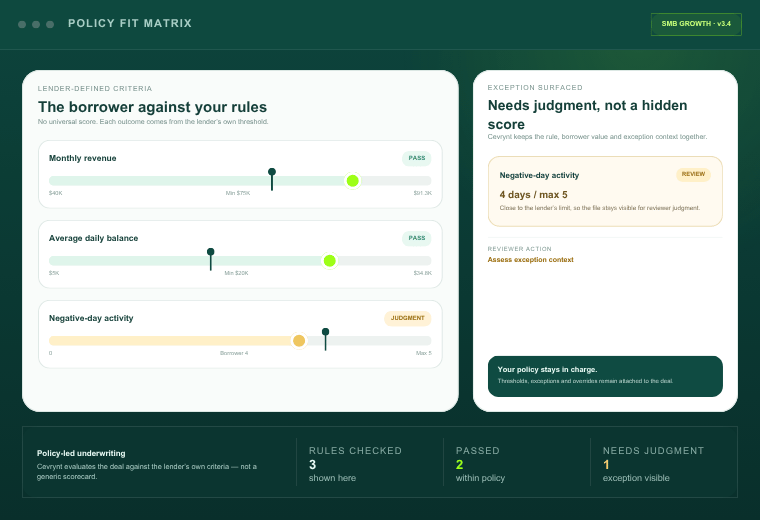
Cevrynt's Policy Engine evaluates every deal against a lender's own defined criteria, showing rule-by-rule outcomes alongside the underlying evidence rather than a single opaque score. It supports documented overrides and exceptions as a first-class part of the workflow, and every outcome links back to the specific finding that drove it.
This is designed to fit the lender's existing credit policy rather than impose a new one — configuration happens in partnership with the lender's own credit, risk, and underwriting teams. A qualified walkthrough is the best way to discuss how your specific policy would be configured.