
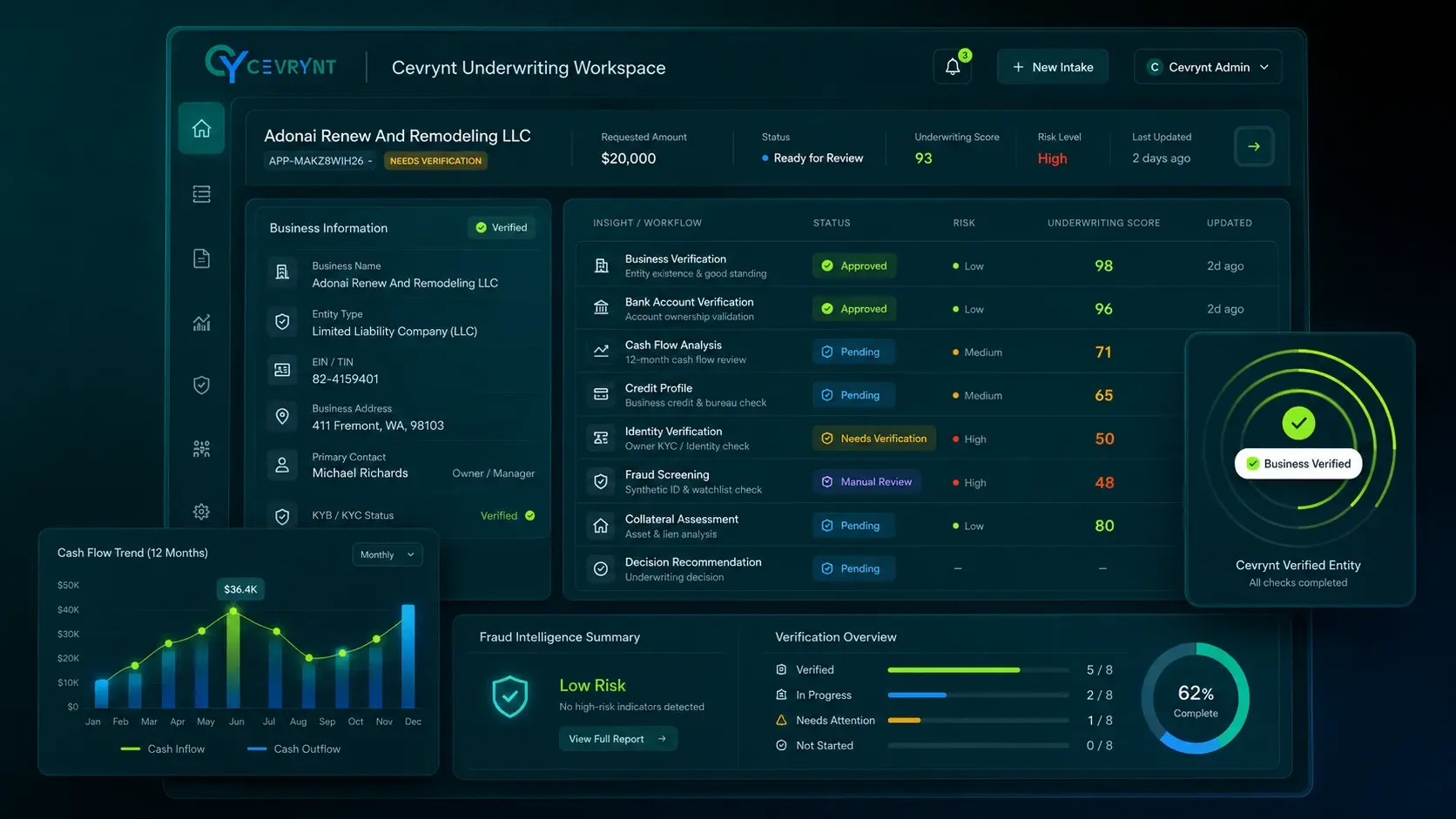
As AI plays a larger role in underwriting workflows, explainability has moved from a nice-to-have talking point to a genuine operational requirement. Regulators, investors, and lenders' own risk teams increasingly expect to understand not just what a system concluded, but why — in language specific enough to defend a decision if it's ever questioned. This piece looks at what explainability actually requires in practice, and why it doesn't have to come at the cost of speed.
What explainability actually means in underwriting
Explainability is often discussed abstractly, but in underwriting it resolves to a fairly concrete requirement: for any finding or outcome, can someone trace the reasoning back to specific evidence and specific rules, in a way that doesn't require deep technical expertise to follow? This is different from asking a vendor to fully disclose proprietary algorithms — it's asking whether the output itself is inspectable.
Why black-box scoring creates real risk
A system that outputs a single opaque score — "this deal scored 68 out of 100" — without a clear path to what drove that number creates a specific kind of exposure. If the decision is ever questioned, the lender has no good answer beyond "the model said so," which is an increasingly weak position both from a regulatory standpoint and from a basic risk-management perspective. It also makes it much harder to identify and correct a systematic error in the underlying analysis, since there's no visibility into which inputs are driving outcomes.
The building blocks of genuine explainability
Evidence linking
As covered throughout our content on source-linked extraction, every finding needs a path back to the specific document or transaction that produced it. This is the foundation explainability is built on — without it, nothing downstream can really be considered explainable.
Rule-based policy evaluation
As discussed in our guide to loan policy engines, evaluating deals against explicit, named rules — rather than a purely statistical score — makes the reasoning behind a policy outcome directly inspectable, rule by rule.
Documented human judgment
Explainability isn't only about the automated parts of the workflow. The underwriter's own reasoning, especially for overrides or judgment calls in ambiguous situations, needs to be captured as part of the same explainable record — see our piece on policy exceptions and overrides.
The regulatory landscape around AI in lending decisions
Regulatory expectations around AI in credit decisions are evolving, and the specific requirements that apply to any given lender depend on their jurisdiction, regulatory classification, and loan product. In the U.S., several frameworks are directly relevant. The Equal Credit Opportunity Act (ECOA) and the Fair Housing Act (FHA) require that adverse action notices — sent when credit is denied or terms are counter-offered — include specific reasons for the adverse action. An AI system whose outputs can't be translated into specific, human-readable reasons creates a meaningful compliance gap here.
The Consumer Financial Protection Bureau (CFPB) has specifically indicated that it expects lenders using AI or machine-learning models to be able to provide specific and accurate reasons for adverse actions, even when those actions are generated by complex models. The bank regulatory agencies (OCC, Fed, FDIC) have issued guidance on model risk management (SR 11-7) that emphasizes documentation, validation, and explainability for models used in credit decisions. The specific applicability of these frameworks to MCA lenders and other non-bank alternative lenders varies — but the direction of regulatory travel is clearly toward more explainability, not less.
What 'adverse action reasons' actually require in practice
Adverse action notices must provide specific, principal reasons for a credit denial or counter-offer. "The model scored you below threshold" or "your AI system declined you" are not acceptable specific reasons under ECOA. Specific reasons are things like: 'insufficient cash flow relative to proposed payment obligations,' 'business entity not in good standing per state registration records,' or 'NSF frequency exceeds our credit policy threshold.' Each of these is a specific, checkable fact traceable back to defined criteria and underlying evidence.
This is exactly why rule-based policy evaluation, as described in our guide to loan policy engines, has an inherent compliance advantage over purely statistical scoring. When a policy rule fails, the rule and the data that caused it to fail are already part of the evaluation record — producing a specific adverse action reason is a trivial step. With a black-box score, reconstructing a specific, defensible reason is a genuine challenge.
Doesn't explainability slow things down?
This is the common objection, and it holds true only if explainability is bolted on after the fact — added as a documentation step performed separately from the actual analysis. When explainability is built into the workflow from the start, with evidence links and rule-based evaluation as native parts of how the system works rather than an add-on report generated afterward, it doesn't add meaningful time. In many cases, it actually speeds up review, because an underwriter working from clear, evidence-linked findings makes decisions faster than one working from an opaque summary they have to independently verify.
What to ask a vendor about explainability
- Can every finding be traced back to specific source evidence, or are some outputs presented without a clear origin?
- Is policy evaluation rule-based and visible, or a single blended score?
- How is human judgment — overrides, notes, exceptions — captured as part of the same explainable record?
- Was explainability designed into the product from the start, or added as a reporting layer afterward?
From here, this article is about Cevrynt
How Cevrynt builds in explainability
Explainability is a foundational design principle across Cevrynt's platform, not a feature added afterward. Every finding across document analysis, financial review, verification, and fraud signals links back to its source, and policy evaluation is rule-based and visible rather than a single blended score. Underwriter notes and overrides are preserved as part of the same record.
This reflects why Cevrynt exists in the first place — see Why Cevrynt for more on the broader philosophy — and it's a topic worth discussing directly during a qualified walkthrough or a security-focused conversation.