
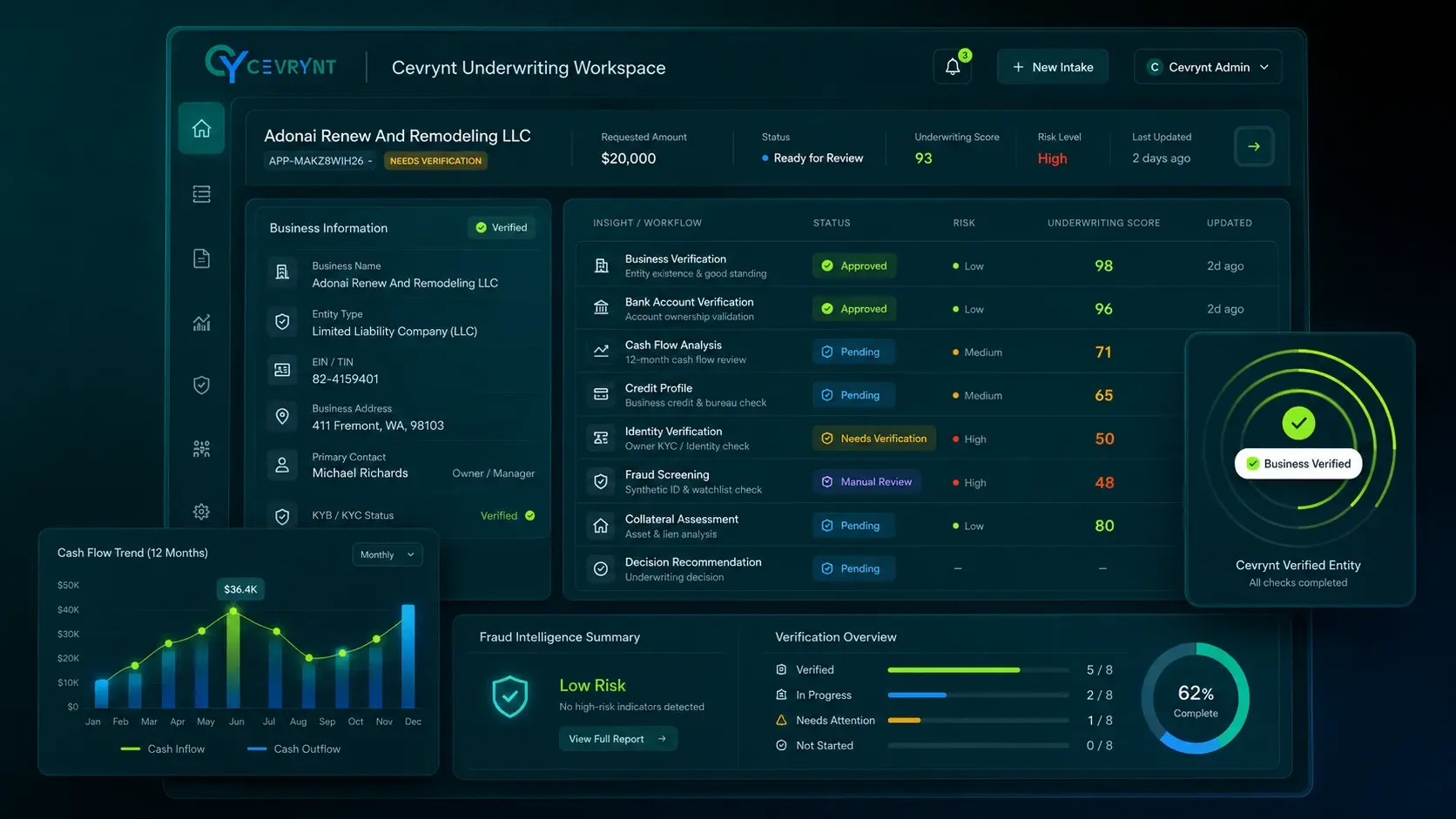
By the time a deal reaches final review, an underwriter has usually touched several distinct sources of information — bank statements, verification results, fraud checks, policy criteria. The underwriting report is where all of that gets compiled into something a person can actually read and decide from. The quality of that report has an outsized effect on decision quality, because an underwriter can only act on what the report actually surfaces clearly.
The difference between a summary and an evidence-backed report
A generic summary condenses a file into a few sentences and a recommendation. An evidence-backed report does something different: it presents the key findings from each stage of review, with a direct path back to the underlying evidence for anything the underwriter wants to verify or dig into further. The summary is faster to produce and faster to skim, but it asks the underwriter to trust the compression. The evidence-backed version lets them check it.
What a well-structured report actually includes
Financial findings with context, not just numbers
Cash flow metrics, deposit trends, and stress signals like NSF frequency shown together with enough context to interpret them — not isolated figures a reader has to independently benchmark against their own mental model of what's normal.
Verification results with conflicts clearly flagged
Business identity and registration findings, with any inconsistencies surfaced explicitly rather than silently resolved one way or another, consistent with the approach covered in our KYB guide.
Fraud signals presented as evidence, not a verdict
Flagged inconsistencies shown with their supporting evidence, framed as something for the underwriter to weigh rather than an automated conclusion baked into the report's recommendation.
Policy outcomes with visible reasoning
Which specific policy criteria were met or not, tied to the underlying data, rather than a single pass or fail label — as discussed in our guide to loan policy engines.
Space for the underwriter's own judgment
A good report isn't just a read-only output — it should capture the underwriter's own notes, questions, and final reasoning as part of the permanent record, since that judgment is often the most valuable part of the file for future reference.
How the Cedar and Stone LLC report illustrates these principles
To make these report quality principles concrete, consider how they apply to an illustrative file for Cedar & Stone LLC — the small general contractor used throughout Cevrynt's product examples. A report on this file should surface: average monthly deposits over the three-month lookback, with the trend visible (not just the average), existing MCA-style debits identified and quantified, ADB and how it compares to the total deposit picture, any NSF events and their clustering pattern, business registration status and ownership consistency, and any policy criteria the deal approaches or breaches — with a direct link to the underlying finding for each.
What it shouldn't do is present a single blended score, hide the NSF trend in a summary footnote, or list policy outcomes without showing which specific criterion triggered each flag. The underwriter reviewing Cedar & Stone should be able to open the report and understand, in one sitting, exactly what they're approving or declining — and why the analysis concludes what it does — without needing to pull original documents separately.
How reports serve future reviewers as much as the original underwriter
One underappreciated function of a well-built underwriting report is that it serves a future reviewer — an auditor, a new team member reviewing a renewal, an investor conducting portfolio due diligence — just as much as it serves the underwriter who made the original decision. If the report is truly evidence-backed, someone reading it months after the decision should be able to reconstruct exactly what was reviewed, what was found, what the underwriter concluded, and why.
This is what distinguishes an evidence-backed report from a contemporaneous summary. A summary produced at the time of the decision may accurately reflect what was known at that moment, but if it doesn't link to the underlying evidence, a future reviewer can't verify it without going back to original documents — assuming those documents are still accessible and haven't been reorganized or lost. A report with preserved evidence links is self-contained in a way that a summary isn't.
Why report quality affects decision quality directly
An underwriter working from a report that buries important context or presents findings without evidence links is effectively working with less information than one working from a genuinely well-structured report — even if the exact same underlying analysis was performed in both cases. The report is the interface between the analysis and the decision; a weak interface degrades decision quality regardless of how good the underlying work was.
Evaluating report quality in a vendor demo
- Ask to see a full report on a genuinely messy file, not a clean curated example built to look impressive.
- Check whether every claim in the report links to evidence, or whether some findings are presented without a clear source.
- See how policy outcomes are shown — rule by rule with reasoning, or as a single blended score.
- Ask where underwriter notes and overrides live within the report, and whether they're preserved as part of the permanent record.
From here, this article is about Cevrynt
How Cevrynt builds the underwriting report
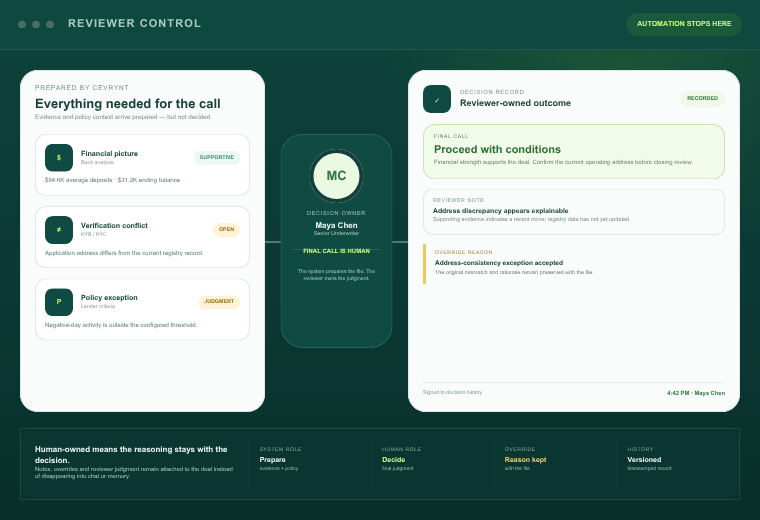
Cevrynt's Underwriting Report compiles financial analysis, verification, fraud signals, and policy outcomes into one document, with every finding linked back to its source and space for reviewer notes and overrides preserved as part of the permanent file. It's built to be read and inspected in one sitting — a complete case, not a black-box summary.
This report is the output of Cevrynt's full workflow, not a standalone feature — it reflects the same evidence trail carried through document handling, financial analysis, verification, and policy review. A qualified walkthrough shows what this looks like against a representative file.