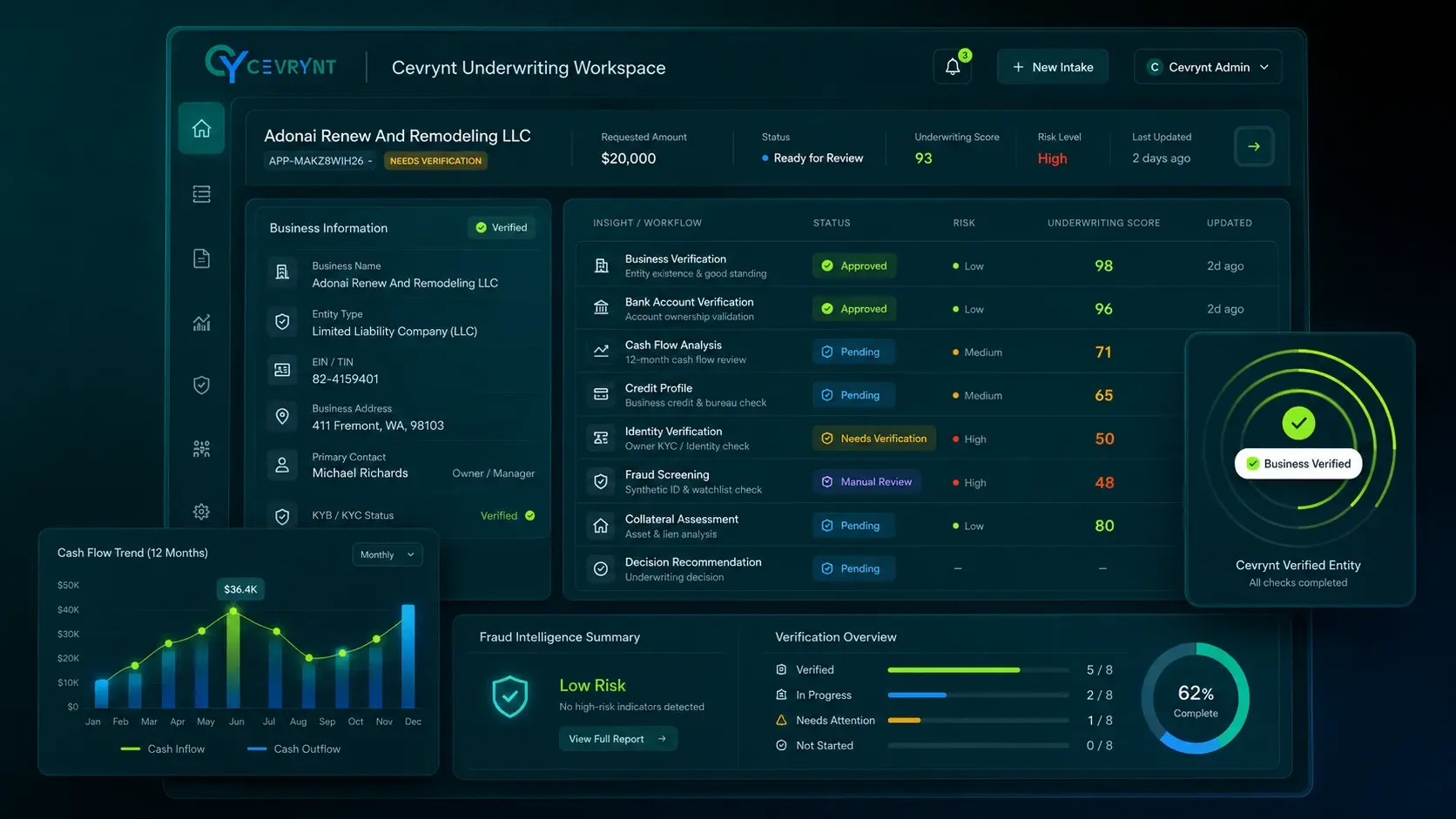
There is a meaningful difference between a system that tells an underwriter "average daily balance: $18,420" and one that shows the same number with a direct link to the specific statement pages and transactions it was calculated from. The first is a claim. The second is evidence. Most of the practical value — and most of the trust — in automated document analysis comes from that distinction, not from extraction accuracy alone.
This matters more in underwriting than in almost any other document-processing use case, because the output isn't just informational — it feeds directly into a credit decision that a lender may need to explain, defend, or reconstruct months later.
Why extraction accuracy alone isn't enough
Vendors in this space often lead with extraction accuracy statistics, and accuracy obviously matters. But accuracy claims are hard for a lender to verify in the abstract, and even a highly accurate system will occasionally get something wrong — an unusual statement format, a smudged scan, an ambiguous transaction description. The real question is not "how often is this right," but "how quickly can an underwriter tell when it's wrong, and fix it."
Source-linking answers that question directly. If every extracted value links back to its exact location on the source document, an underwriter reviewing a borderline finding can verify it in seconds rather than either blindly trusting it or re-deriving it from scratch.
What good source-linking looks like in practice
Bidirectional navigation
The link should work in both directions: from an extracted field or flagged finding to the exact page and location it came from, and from a document page to a list of what was extracted from it. One-directional linking (source to summary, but not summary back to source) still leaves the verification burden on the underwriter.
Granularity at the transaction level, not just the document level
Linking a cash-flow summary back to "the bank statement" as a whole is a start, but linking a specific flagged transaction — an unusual deposit, a recurring NSF fee — back to its exact line on its exact statement page is what actually saves review time. Our guide on NSF patterns and overdrafts discusses why this granularity matters for financial analysis specifically.
Persistence through the full workflow
Source links shouldn't disappear once a finding moves from document analysis into policy evaluation or a final report. If a policy exception references a specific deposit pattern, that reference should still trace back to the original statement page when a second reviewer or an auditor looks at the file six months later.
The compliance and audit angle
Beyond day-to-day review speed, source-linked evidence matters when a decision gets revisited — during an internal audit, an investor review, or a dispute. Reconstructing the reasoning behind a decision from memory or scattered notes is slow and unreliable. Reconstructing it from a report where every finding still links to its source document is comparatively straightforward. Our piece on underwriting audit trails covers this in more detail.
This is also where the distinction between "AI-assisted" and "AI black box" becomes concrete rather than philosophical. A black-box system might produce a similar-looking summary, but without source links, that summary cannot be independently verified after the fact — which is a meaningfully different risk profile for a lender.
A concrete comparison: two ways to present the same finding
Consider a finding that a business had three NSF events in the most recent statement month. Presented without source-linking, this might appear in a report as a single line: "NSF count: 3 (elevated)." An underwriter reading this has no way to quickly confirm the figure, understand which specific transactions triggered it, or notice if two of the three events were actually related to the same underlying cause — say, a single mistimed vendor payment that bounced and was retried twice.
Presented with source-linking, the same finding shows the count alongside direct links to each of the three specific transactions on their respective statement pages. The underwriter can see in seconds that two of the three events trace back to the same retried payment, materially changing the read on the underlying risk compared to three fully independent NSF events. This is not a hypothetical edge case — it is exactly the kind of nuance that a bare summary number erases and that source-linked evidence restores.
Source-linking and underwriter trust over time
There is also a slower, more human effect worth naming: underwriters who can consistently verify automated findings against source evidence build genuine trust in a system over time, in a way that underwriters working with an opaque summary generally do not. That trust matters operationally — an underwriter who trusts the underlying evidence spends less time second-guessing routine findings and more time on the genuinely ambiguous cases that deserve their attention. A system that cannot be verified, by contrast, tends to produce one of two bad outcomes: underwriters either blindly trust outputs they shouldn't, or they distrust the system entirely and quietly revert to manual verification of everything, defeating much of the intended efficiency gain.
From here, this article is about Cevrynt
How Cevrynt keeps evidence connected
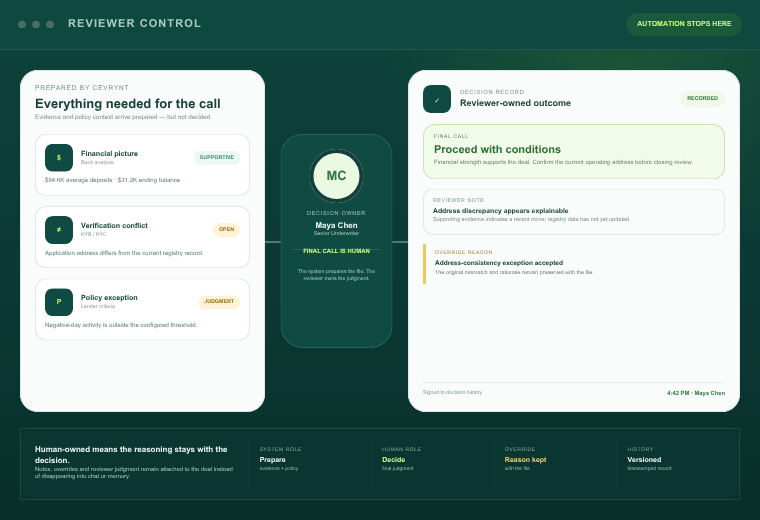
Every stage of Cevrynt's workflow — document intelligence, financial analysis, verification, and fraud signals — keeps extracted values and flagged findings linked back to their exact source. That evidence carries forward into the underwriting report, so a reviewer looking at a finding for the first time, or an auditor looking at a decision months later, can trace it back to its origin without reconstructing the analysis from scratch.
This is a deliberate design choice, not an add-on: Cevrynt is built to support human underwriting judgment, and judgment requires verifiable evidence, not just confident-sounding summaries. See a qualified walkthrough for how this looks against a real file.