
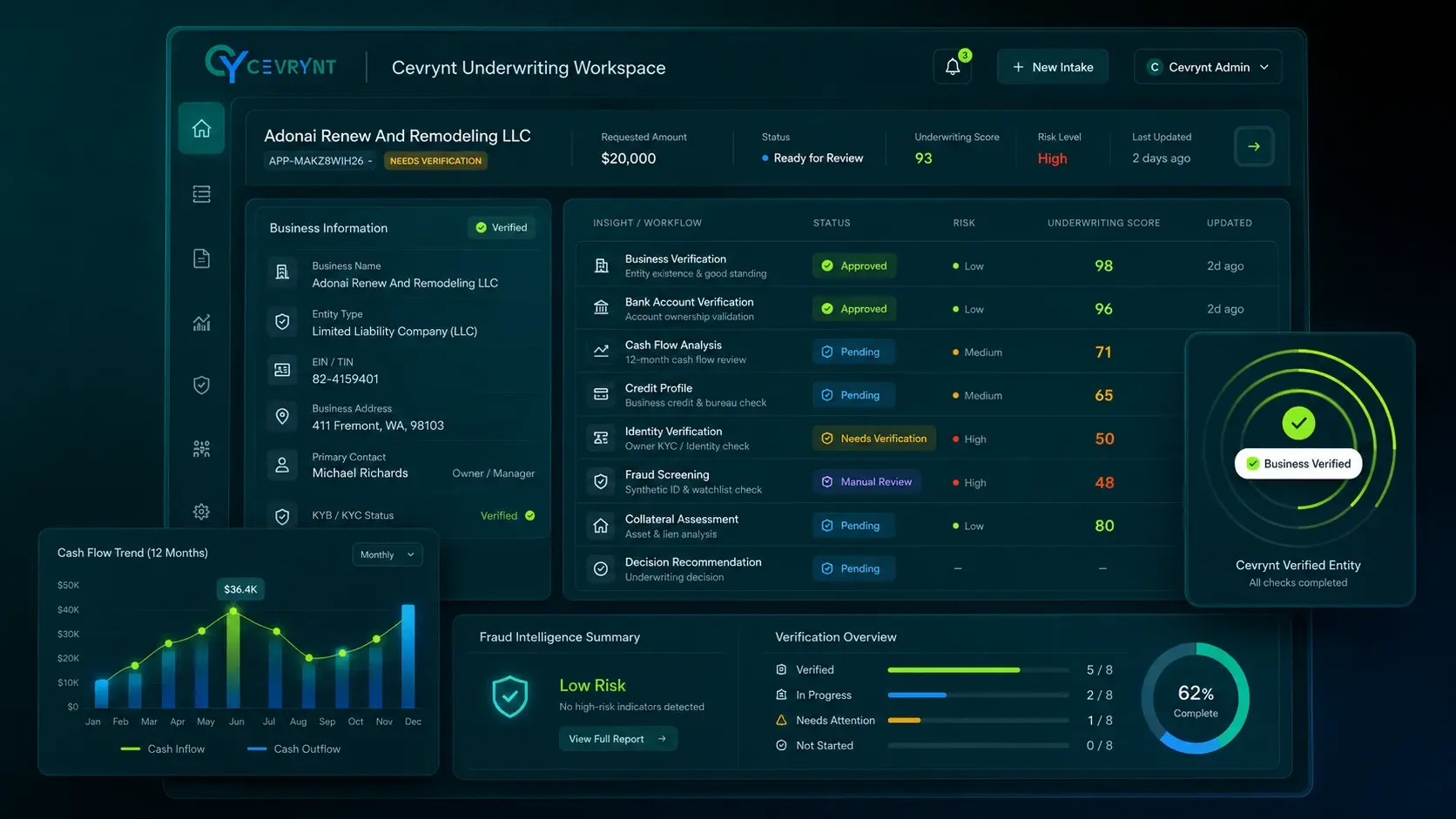
Six months after a decision is made, someone asks about it — an investor doing diligence, an internal auditor reviewing a sample of files, a compliance officer responding to a regulatory inquiry. The question is simple: why was this deal approved, or declined, or approved on different terms than requested? Whether that question can be answered quickly and confidently, or requires reconstructing memory and hunting through scattered notes, depends entirely on whether the original decision left behind a genuine audit trail.
What makes an audit trail genuine versus superficial
Many underwriting operations have something that resembles an audit trail — a decision log, a spreadsheet of approvals and declines, maybe a brief note field. The test of whether it's genuinely useful is simple: can someone who wasn't involved in the original decision reconstruct the full reasoning from the record alone, without needing to ask the original underwriter?
A superficial audit trail records the outcome. A genuine one records the reasoning, with evidence.
The components of a reconstructable decision record
The specific evidence that informed the decision
Not a general reference to "reviewed financials," but the specific figures, documents, and findings that mattered — linked back to their source, consistent with the principle covered in our guide to source-linked extraction.
The policy outcome and any overrides
Which specific policy criteria were satisfied or not, and if the underwriter overrode a rule, the documented reasoning for doing so — covered in more depth in our piece on policy exceptions and overrides.
The underwriter's own notes and judgment
Beyond the automated findings, the underwriter's own reasoning — why a particular pattern was or wasn't concerning in this specific context — is often the most valuable part of the record, since it captures judgment that a purely automated system wouldn't generate on its own.
Timestamps and version context
When the decision was made, under which version of the lender's policy, and by whom — details that matter for reconstructing context accurately, especially if policy has since changed.
Why this matters beyond compliance
Audit trails are often discussed purely in compliance terms, but they have real day-to-day operational value too. A second underwriter reviewing a colleague's prior decision, a manager spot-checking file quality, or a team retrospectively analyzing which policy rules correlate with strong or weak portfolio performance all depend on the same underlying capability: being able to see not just what was decided, but why.
This connects directly to explainability more broadly — see our piece on explainable AI in underwriting for how this plays out when AI-assisted analysis is part of the review.
Building this without slowing underwriters down
The common objection to rigorous documentation is that it slows underwriters down. This is a real risk if documentation is treated as a separate administrative task performed after the actual work. It's a much smaller cost if the audit trail is a natural byproduct of how the underwriting workflow already operates — evidence links preserved automatically, policy outcomes recorded as they happen, notes captured in context rather than reconstructed afterward.
What an audit request actually looks like without a real trail
It's worth being concrete about what happens when a genuine audit trail doesn't exist. An investor or auditor asks for the rationale behind a sample of approved deals from the prior year. Someone has to identify who underwrote each file, hope that person still works at the company and remembers the specifics, and reconstruct the reasoning from memory, supplemented by whatever scattered notes exist in email threads or personal spreadsheets. This process is slow, inconsistent across files, and vulnerable to simply not being possible if the original underwriter has since left. It also creates a credibility problem: reconstructed reasoning, produced after the fact specifically in response to an audit request, understandably carries less weight than a contemporaneous record.
Compare that to a lender with genuine evidence-linked records: the same request gets answered by pulling the original file, which already shows the specific evidence, policy outcome, and underwriter reasoning exactly as they existed at the time of the decision. The difference isn't just speed — it's the difference between a defensible answer and a reconstructed guess.
Audit trails as a feedback loop for improving underwriting itself
Beyond responding to external requests, a well-maintained audit trail is a genuine asset for a lender's own credit and risk teams. Reviewing a sample of past decisions with full context — not just outcomes, but the reasoning and evidence behind them — makes it possible to identify patterns: which policy rules get overridden most often, which types of files tend to take longest to reach a decision, which underwriters' documented reasoning correlates with the strongest portfolio performance. None of this analysis is possible working backward from outcome-only records, since the reasoning that would explain the pattern was never captured in the first place.
From here, this article is about Cevrynt
How Cevrynt builds the audit trail automatically
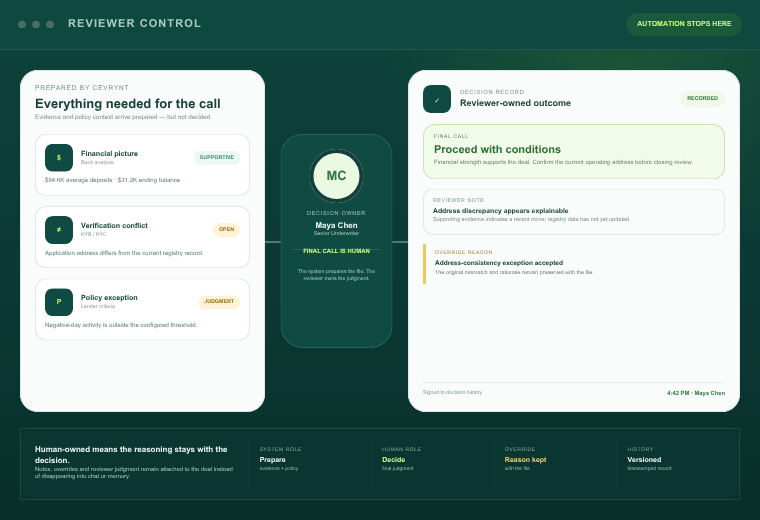
Cevrynt's Underwriting Report compiles financials, verification, fraud signals, and policy outcomes into one evidence-linked record as a natural output of the workflow — not a separate documentation exercise. Reviewer notes and any policy overrides are preserved alongside the findings that informed them, so the full reasoning behind a decision remains reconstructable long after the fact.
This supports — but does not replace — a lender's own compliance and audit program; discuss specific audit and data-handling requirements during a security conversation or a qualified walkthrough.