
Your underwriting rules. Your evidence. Your final call.
Cevrynt prepares the review around lender-defined policy and source-linked evidence, while exceptions and final funding decisions stay with your team.
DECISION MEMORY
Six months later, the file should still explain itself.
Cevrynt keeps the evidence, policy context, exceptions, and reviewer actions with the same deal record — so a future reviewer can understand what was known, what changed, and why the team made the call.
Financial facts
Source evidence
Policy version
Exception rationale
Reviewer history
5of 5Initial review
5of 5After reanalysis
5of 5Months later
The value is not just preserving the final outcome. Cevrynt keeps the evidence, policy context, exceptions, and reviewer history together so the deal can still explain itself later.
CONSISTENCY
Same file. Same evidence. Judgment can still differ.
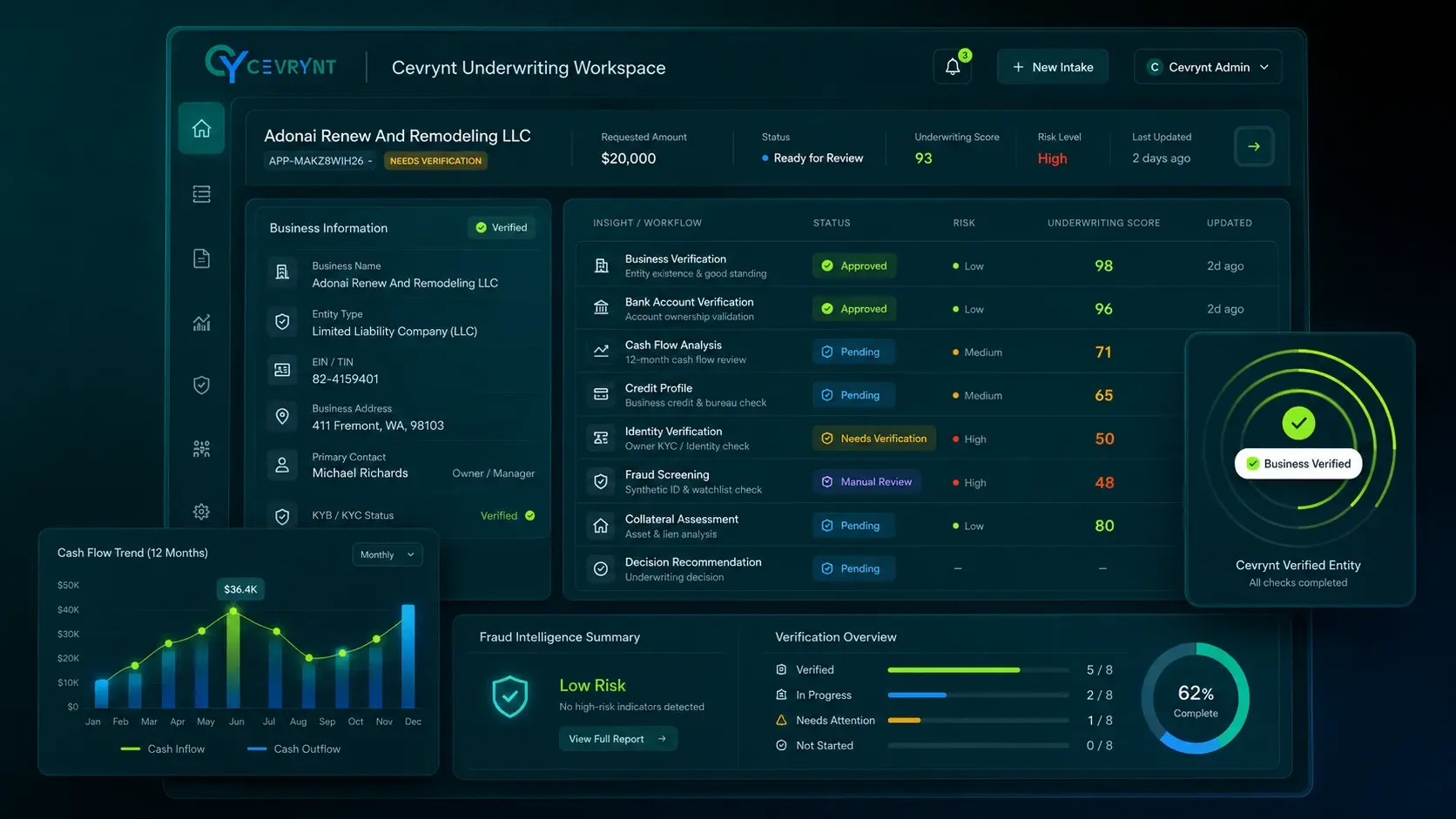
Cevrynt gives every reviewer the same structured financial facts, source evidence, risk signals, and lender-policy context. If two underwriters disagree, the disagreement is about the deal — not because one of them missed a page or rebuilt the numbers differently.
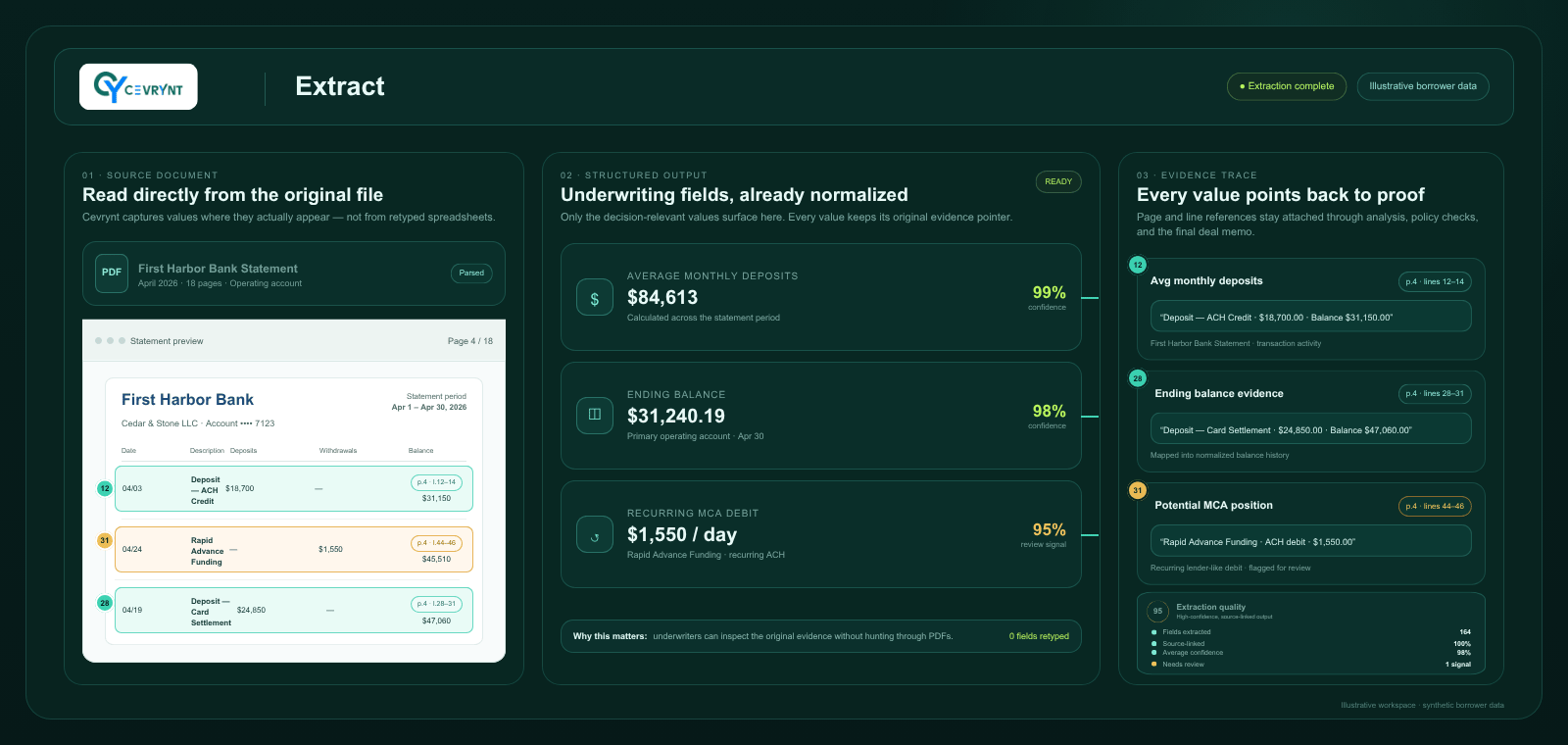
Illustrative workspace · synthetic borrower data
- Start from the same underwriting factsStructured findings
- Go straight back to the sourceDocument · page · transaction
- Surface the same material signalsRecurring MCA debit
- Apply the same policy contextEvidence + policy trace
One dealSame financial factsSame source evidenceJudgment stays human
Cevrynt does not force underwriters to agree. It removes avoidable disagreement by giving every reviewer the same facts, source evidence, material signals, and lender-policy context.
LENDER-SPECIFIC POLICY
Same deal. Different credit boxes. Both should be explainable.
Cevrynt evaluates the same borrower evidence against each lender’s own underwriting thresholds, conditions, and exception rules. The facts stay the same; the policy interpretation changes.
- Minimum $50KpassAverage monthly deposits$84.6KMinimum $75Kpass
- Second position allowedpassActive MCA positions1 activeNo second positionfail
- Maximum 5exceptionNegative days · 90 days6 daysMaximum 8pass
- Minimum $10KpassAverage daily balance$31.2KMinimum $25Kpass
- Minimum 2 yearspassTime in business3 years 2 monthsMinimum 4 yearsfail
Lender A4 rules pass · 1 exception. Moves to human review with the exception and supporting evidence attached.
Lender B3 rules pass · 2 outside policy. The failed thresholds remain visible with the supporting evidence attached.
The borrower evidence did not change — the lender policy did. Cevrynt applies each policy as written and keeps the policy version, threshold, observed value, exception, and reviewer action attached to the deal.
Book a walkthroughCHANGE-AWARE REVIEW
The file can change. The history shouldn’t disappear.
Borrowers send another statement. An agreement gets corrected. A missing document arrives. Cevrynt re-runs what the new evidence affects, shows what moved, and keeps the previous review visible instead of silently replacing it.
- Version 1 · 10:42 AMOriginal borrower package analyzed
- Version 2 · 12:14 PMOne new bank statement and a corrected MCA agreement added
| Signal | Initial review | New evidence added | Moved |
|---|---|---|---|
| Average monthly deposits | $84.6K | $91.3K | +7.9% |
| Average daily balance | $31.2K | $34.8K | +$3.6K |
| NSF activity · 90 days | 6 events | 4 events | Exception cleared |
| Active MCA positions | 2 active | 1 active | Position updated |
| Policy exceptions | 2 open | 1 open | 1 cleared |
| Daily repayment load | $1,550 / day | $775 / day | Reduced |
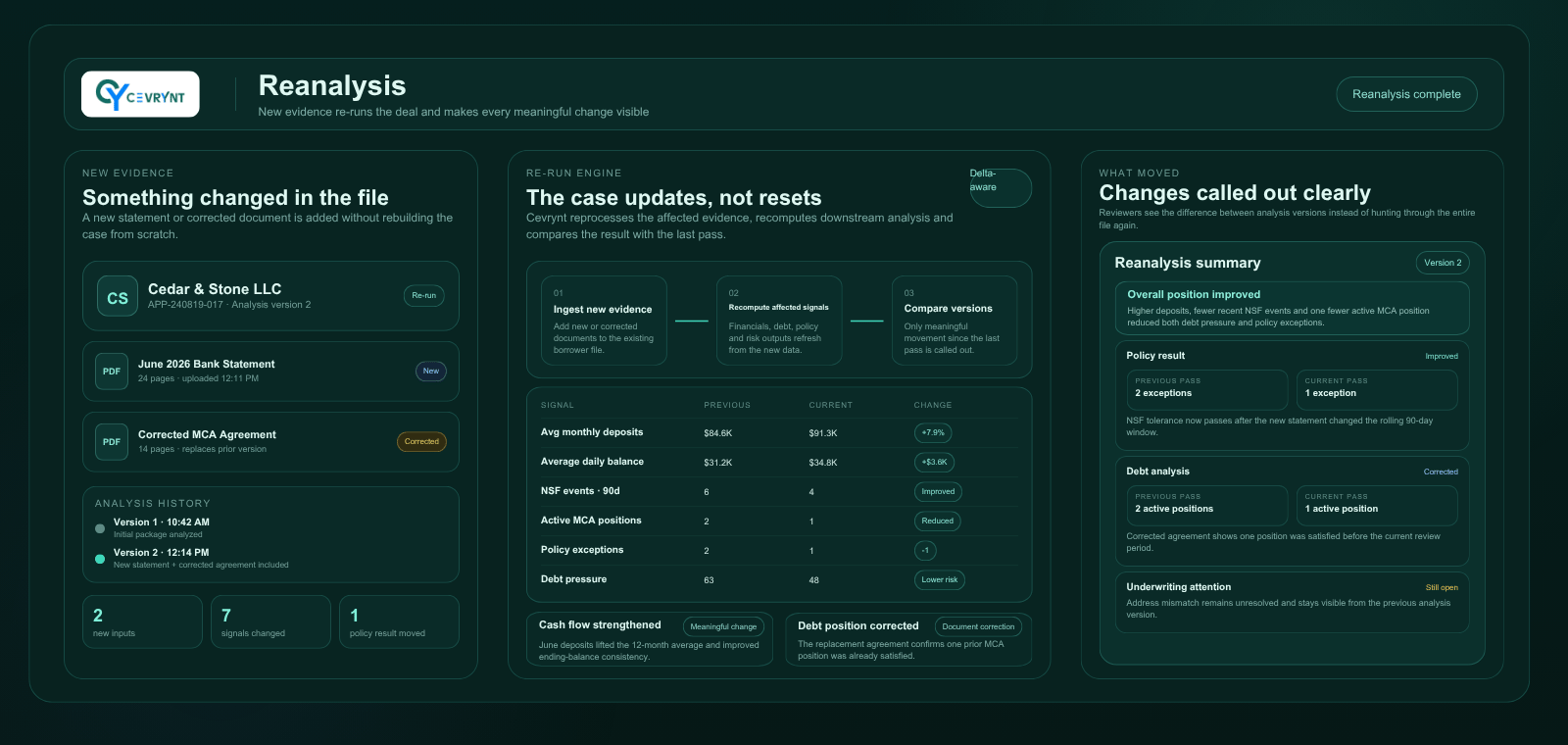
The same re-run, in the product · illustrative workspace, synthetic borrower data
Not every issue disappears when new evidence arrives. The address discrepancy remains open in Version 2 and is carried forward for reviewer resolution. Reanalysis updates what changed without silently clearing what still needs judgment.
WHAT CEVRYNT DELIBERATELY DOESN’T DO
Five shortcuts we chose not to take.
Cevrynt automates the work around an underwriting decision. It does not hide the evidence, replace lender policy, resolve uncertainty silently, or take the final judgment away from your team.
It decides the deal.
It prepares the underwriting review. Approval, decline, counter, pricing, structure, and final sign-off remain with your team.
It replaces your credit policy with a score.
It applies lender-defined thresholds, conditions, and exception rules, then shows what passed, what failed, and what still needs judgment.
It turns uncertainty into a clean answer.
Conflicting evidence, verification mismatches, low-confidence findings, and policy exceptions remain visible until a reviewer resolves them.
It hides the reasoning behind the output.
Material findings stay connected to the document, page, transaction, verification result, or policy rule that supports them.
It rewrites the case when new evidence arrives.
Reanalysis creates a new review version and shows what changed while preserving previous findings, exceptions, policy results, and reviewer actions.
Cevrynt is built to preserve lender control, visible exceptions, source-linked evidence, and review history. If your workflow needs the system to replace those judgment points, it is probably not the right fit.
FOUNDER-LED EVALUATION
Put Cevrynt against files your team already knows.
Bring representative historical deals and the underwriting criteria your team actually uses. Compare Cevrynt’s facts, source evidence, policy results, exceptions, and review history against the work you already trust.