
Design a focused underwriting pilot
Work with the founder to define a narrow workflow, representative files, review criteria, and clear evaluation goals.
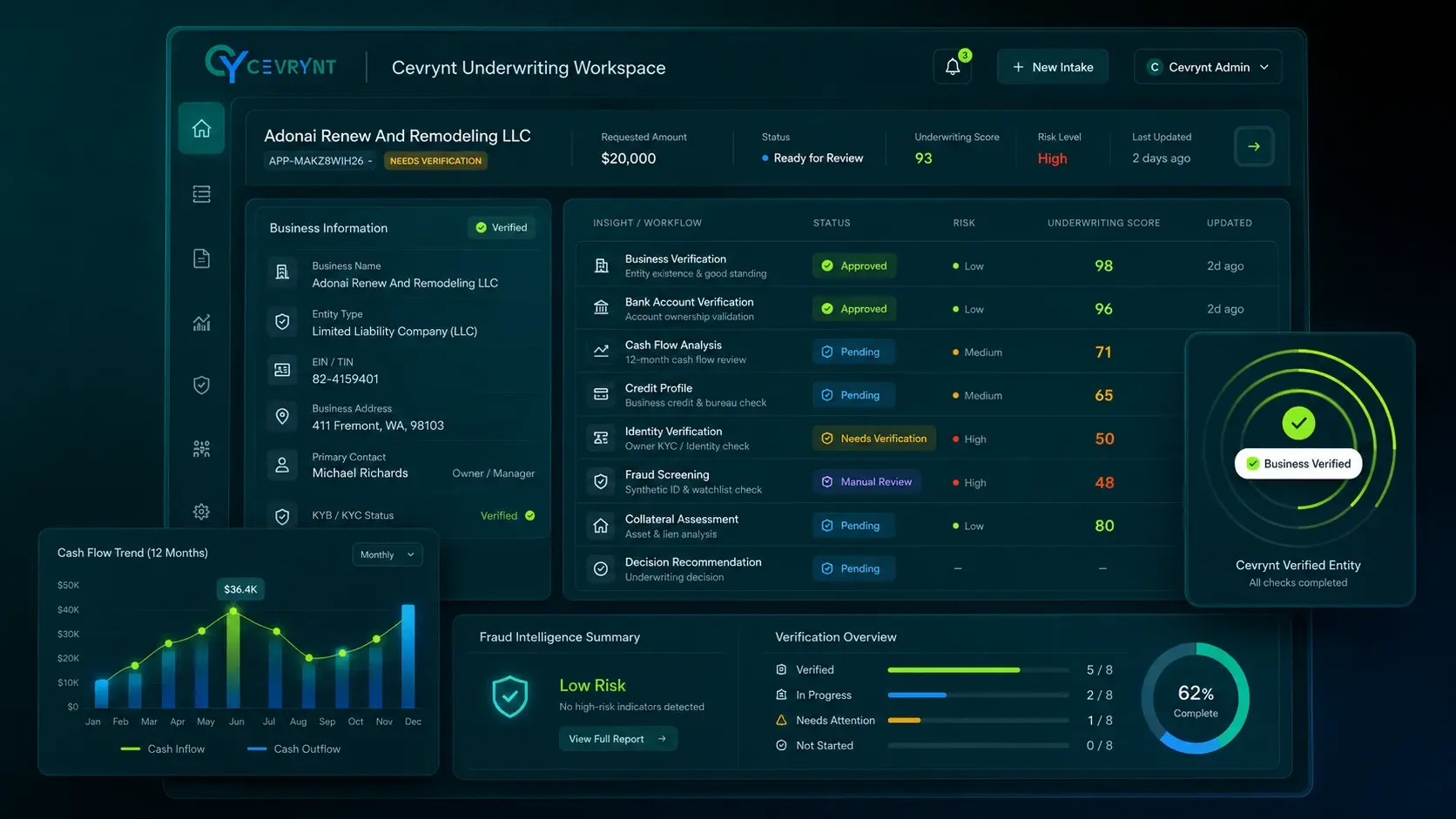
Choosing the scope
A pilot is a bracket drawn around part of the workflow, not a switch thrown across all of it.
Every stage a file moves through, with what a pilot would compare at each one. The three scopes are drawn down the margin, each reaching exactly the stages it covers — and all three stopping short of the same row.
Three scopes a pilot is commonly drawn around
The whole fileIntake → Report
A complete file prepared end to end, compared against the deal memo your underwriter wrote — including the exceptions they raised and the ones they decided not to.
A run of stagesDocuments → Verification
Enough of the chain to show whether evidence survives the handoffs: what the documents produced feeding the financial analysis, and both feeding the verification checks.
One stageDocuments
The narrowest useful pilot, and the quickest to set up. Cevrynt reads intake packs your team has already worked through, and the comparison is simply whether the output matches the documents.
The workflow, stage by stage
No bracket reaches the last stage.
A pilot evaluates the preparation, never the judgment. Cevrynt issues no approval or decline at any scope, your underwriters keep every call, and nothing in the evaluation asks them to hand that over.
Deciding what better means
A pilot is judged against the review your team has already done, one rung at a time.
Files your underwriters know, run again. Each rung joins what they found to what Cevrynt prepared, and every rung is agreed before the first file goes through — including the one drawn cut, which is the comparison this evaluation refuses to make.
- Agree the comparisons
- Run the files
- Read both sides together
What your team already found
Compared on
What Cevrynt prepared
The figures your reviewer keyed from the pack
Extracted values
The same figures, each carrying the page it came from
Averages, balances and debt totals your analyst worked out
Financial calculations
The same calculations, shown with their inputs
The statements your reviewer had to go back to
Source links
A link from every figure to its statement, page and line
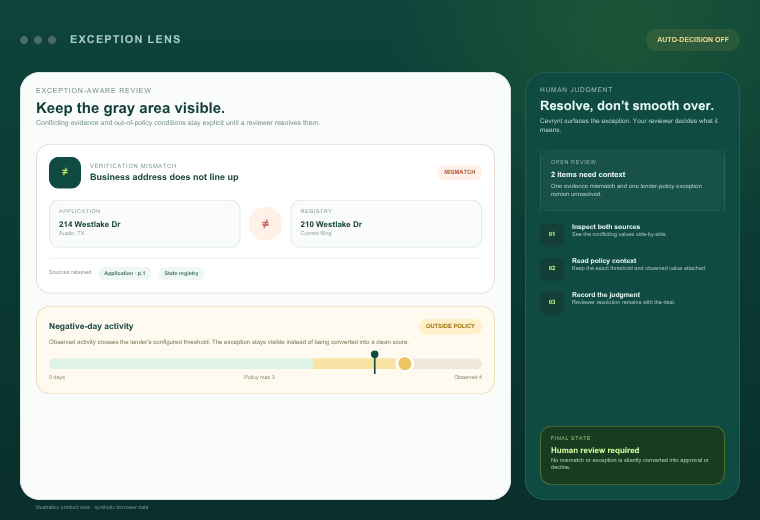
The mismatches your reviewers caught in the file
Conflicts surfaced
The mismatches raised — and anything raised that was not real
The passes and exceptions your team recorded
Policy results
The same criteria applied, with the reading behind each result
Anything your team found late, or only on a second pass
Missed flags
Whether it was surfaced on the first read
The time your reviewer spent rebuilding the file
Reviewer corrections
What had to be corrected before the output could be used
Your credit policy and risk appetite
Approval rateNo approval, no decline, at any scope
The one rung a pilot will not run. A change in approval rate would measure your own lending decisions, not the work done on the file — which is why it is left out of the comparison rather than quietly counted in it.
Every rung is something both sides can check on a file that has already been reviewed. None of them is a claim about accuracy, and none is a guarantee.
Whose rules it runs on
Three things go in, and all three of them are yours.
A pilot is configured against the policy your credit team already works to — at the version it is written, at the numbers you set, with your own exception paths. What comes back is the reading behind each result, never a rule Cevrynt decided on your behalf.
What goes in — all of it yours
What comes back
Your criteria, at the version they are written
The rules your credit team already works to, taken as they stand rather than translated into somebody else's model. The version is recorded with the file, so a later change to policy does not quietly rewrite an earlier result.
Your thresholds, at the numbers you set
Minimums, maximums and windows exactly as your policy states them. A pilot does not propose different numbers, and nothing is tuned to make the comparison look better.
Your exception paths, including who may override
Which conditions need judgment rather than a pass or a fail, who is allowed to resolve them, and what has to be attached when they do.
What Cevrynt adds
The reading behind each result: the threshold, the borrower value, where the value came from, and the reasoning attached when a reviewer resolved it. Never a rule of its own.
- No generic score standing in for your policy.
- A policy break is not an automatic decline — it is an exception with reasoning attached, for a reviewer to settle.
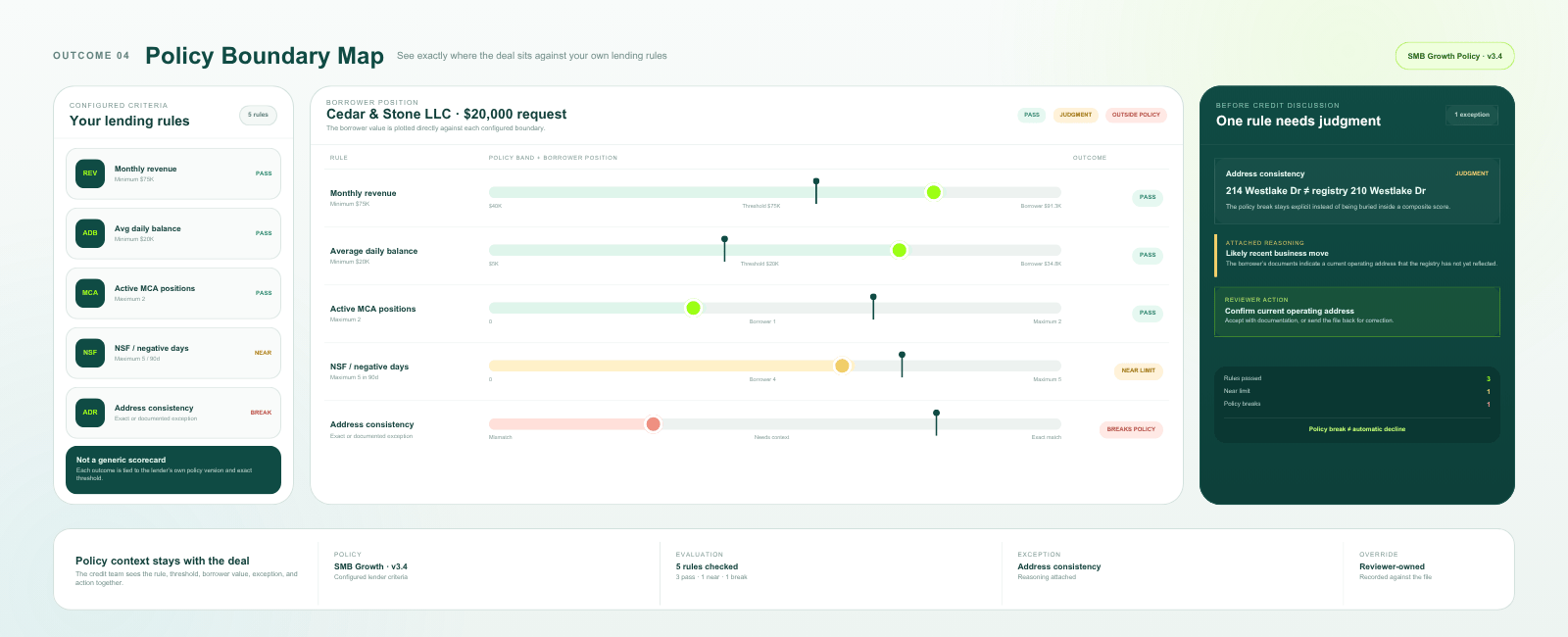
Configuring the criteria is part of setting the pilot up, not a separate project: they are read from how your team already writes them.
Before a file moves
Eight things are settled before the first file is opened. Exactly one of them is settled by Cevrynt.
Scope, files, criteria, access, how long anything stays, what gets recorded, what counts as a result, and whether it goes any further. The lane each one sits in is the point: four are yours outright, three are agreed together, and the only one that is ours is what the system writes down.
Settled before a file moves
Your team
Together
Cevrynt
Which stages the pilot covers
TogetherWhich files it runs on, and how many
Your teamThe criteria and thresholds it applies
Your teamWho may open the files, and from where
Your teamHow long the files stay, and when they are removed
TogetherWhat is recorded against each file as it is reviewed
CevryntWhat counts as a result worth acting on
TogetherWhether anything goes further afterwards
Your teamDecided by
4of the eight
3of the eight
1of the eight
Access, data handling and audit requirements in full
After the run
Two ways this ends, and the page owes you both of them.
A pilot that can only end one way is a demo. These two hang from the same line at the same width, because the comparison is run to answer the question either way — and one thing stays true down both of them.
The run ends
The decision is yours
It earns a place in the workflow
Then the production workflow is scoped around the systems already moving your deals — intake, your LOS or CRM, document sources, verification providers and downstream reporting — rather than the other way round. That scoping is its own conversation, and it starts from what the pilot showed.
It does not
Then you have a file-by-file comparison against your own review, your criteria written down as your team actually applies them, and a workflow sitting exactly where it was. Knowing precisely where the output fell short of your underwriters is a result worth having.
True on both paths
Nothing was connected to find out. The run works from representative historical files your team has already reviewed, so the evaluation never depends on wiring Cevrynt into the systems your deals move through today.
The limits
Five things a pilot will not tell you, said now rather than at the point they matter.
Every evaluation has an edge, and a page that leaves you to find it is wasting your team’s time. These are the questions a focused pilot cannot answer, each with what is actually true in its place.
That your approval rate will go up.Approval depends on your policy and your risk appetite, both of which stay exactly where they are. A pilot changes how a file arrives at that decision — not the decision, and not what you choose to fund.
That it holds for files you did not include.A run answers for the stages you bracketed and the files you chose, and nothing beyond them. Messy packs, thin files and unusual document sets only count in the result if you put them in.
That your data handling requirements are satisfied.A comparison of underwriting output proves nothing about access, retention or audit. Those are settled before a file moves, as their own review, against your own requirements.
That your underwriters can stop reading.The output still has to be read by somebody who knows the file. A pilot measures the preparation in front of the judgment; the judgment stays where it already was.
That another lender's result would be yours.Every run is tied to one lender's criteria, thresholds and files. Nothing about it transfers to a different policy, which is also why this site publishes no accuracy figures to compare against.
Founder-led
Bring the workflow you would want a pilot to prove.
Walk through how a deal moves through your team today. We'll agree which stages a focused pilot should cover, what it would be compared against, and what would count as a result worth acting on.