
Building the evidence layer for modern underwriting.
Cevrynt turns fragmented deal files — applications, bank statements, business verification, risk signals, and lender policy — into a structured, source-linked underwriting review. We help MCA and alternative lending teams move faster without hiding exceptions or taking the final credit decision away from the lender.
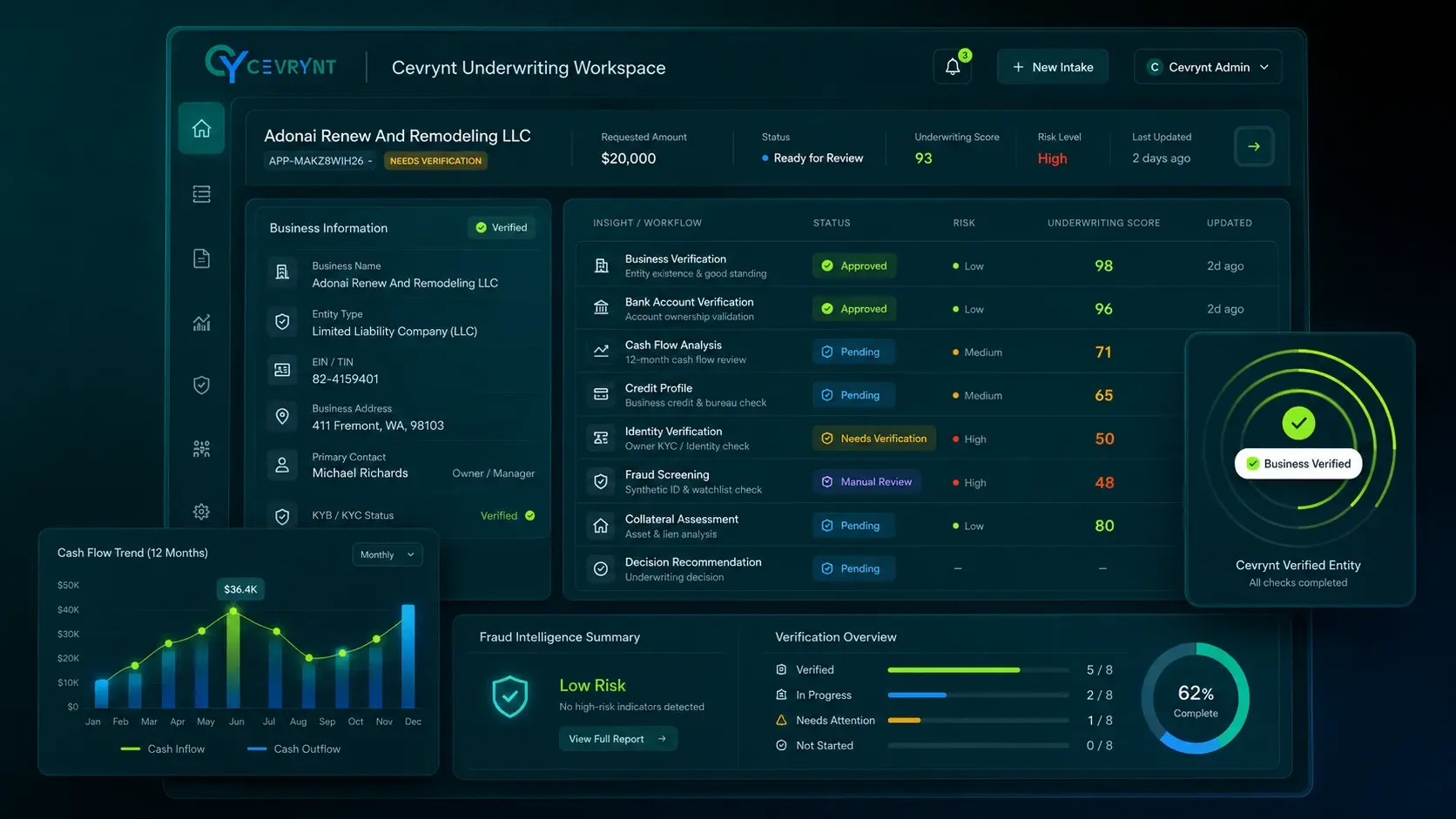
WHY THIS EXISTS
One principle runs through the whole product.
Every stage can transform the file — extracting, calculating, comparing, checking, or applying policy. But the source path should survive the transformation. Otherwise a faster answer is simply harder to review.
- 08
- stages from intake to deal memo
- 03
- things every material finding should keep
- 01
- evidence path through the review
- Intake
- Extract
- Financials
- KYB / KYC
- Fraud & Review
- Policy
- Reanalysis
- Deal Memo
An underwriting answer1 is only as strong as the evidence2 you can trace it back to3.
- 1answerA finding, not the final decision.Cevrynt can calculate, compare, verify, and apply policy, but approval, decline, pricing, conditions, and funding remain with the lender.
- 2evidenceThe material behind the finding.A document page, transaction, bank period, verification result, submitted field, calculation input, or lender policy rule can remain attached to the conclusion it supports.
- 3trace it back toThe source path survives the workflow.Material findings remain connected to their source as they move through analysis, exceptions, reanalysis, and the final underwriting memo.
What the rule above preservesThe evidence path should survive all eight stages. If the source drops away anywhere in the workflow, the finding at the far end becomes harder to verify and easier to misread as an unsupported assertion.
WHAT WE HOLD OURSELVES TO
The review is ours to prepare. The decision is theirs to own.
Cevrynt can extract, calculate, compare, verify, apply policy, surface exceptions, and assemble the underwriting record. It does not turn those outputs into an automatic approval or decline. The final disposition stays with the lender.
- 04
- lender dispositions available
- 00
- issued by Cevrynt
- 01
- accountable decision owner
Cevrynt prepares the underwriting record underneath these choices. The lender selects the disposition and retains responsibility for the outcome.
- 01No score replaces lender policy.Commerce activity, cash flow, verification, and risk signals stay visible instead of being collapsed into one universal number that quietly becomes the decision.
- 02Exceptions stay visible.When evidence conflicts with the lender's criteria, Cevrynt keeps the observed value, applicable rule, and supporting source in the review.
- 03Evidence stays attached.Material findings remain connected to the document, transaction, verification result, calculation, or policy rule that supports them.
- 04Claims stop where evidence stops.Product behavior can be demonstrated. Performance, certification, customer-outcome, and scale claims should only appear when there is evidence to support them.
What that means todayCevrynt is early and founder-led. Product reviews, lender conversations, workflow questions, and feedback still come directly to the founder.
CHECKABLE, NOT CLAIMABLE
Three claims you can inspect. One we will not invent.
A product claim should have something behind it that a lender can actually inspect. These three can be demonstrated inside Cevrynt. The fourth requires performance evidence we do not yet have, so we do not make it.
- 03
- product behaviors you can inspect
- 01
- claim we withhold until proven
- 01
- illustrative file used across the views
Claim · where to inspect it · what to look for
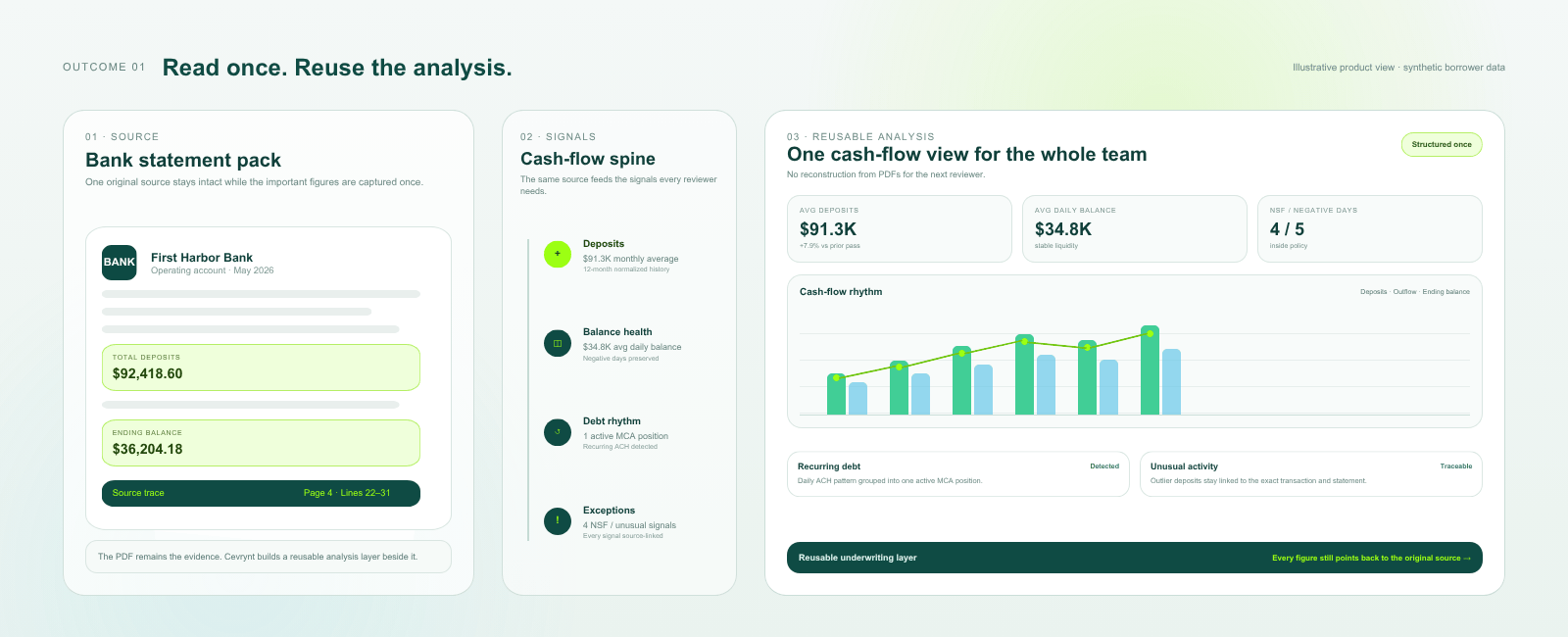 01The evidence stays attached to the finding.InspectA material value keeps the document, page, lines, transaction, or other source reference that supports it — so the reviewer can move from the finding back to the evidence.
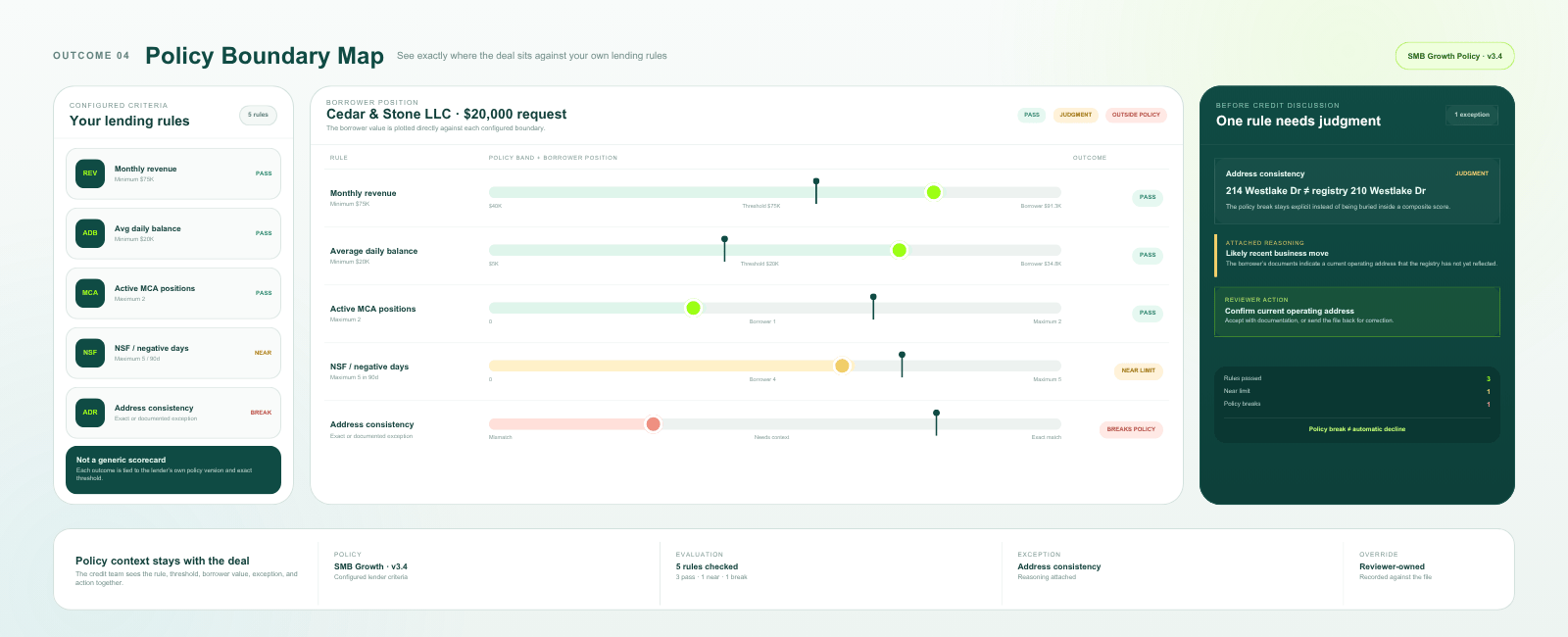 02The lender's rule stays visible.InspectThe observed value, configured threshold, policy result, and exception remain visible instead of being collapsed into a generic score or automatic decision.
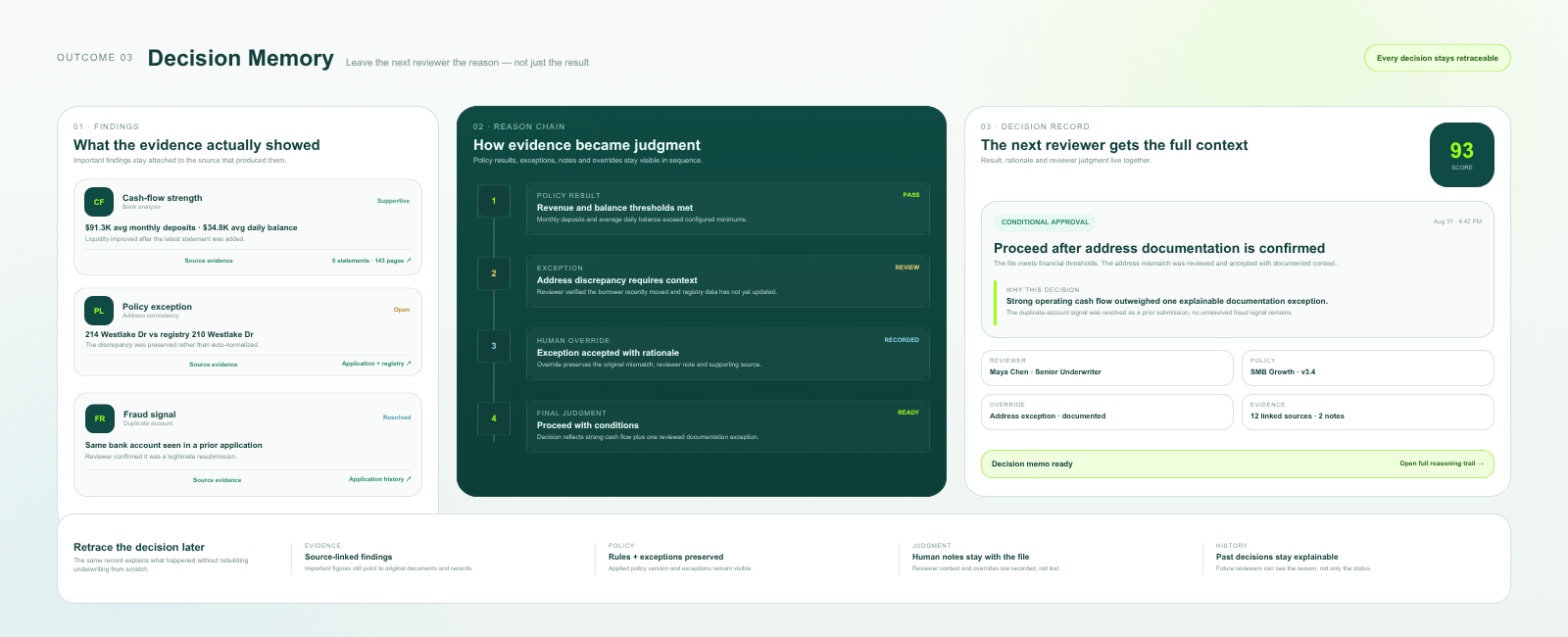 03New evidence does not erase the earlier review.InspectWhen the file changes, affected findings can be reanalyzed while prior context, exceptions, reviewer actions, and the policy version remain available for comparison.
The fourth claim · withheld until proven
No performance number without evidence.
Cevrynt does not currently publish a universal accuracy figure, approval uplift, funding-rate improvement, or production-scale time-to-decision benchmark. Those claims require representative measured results and a clear methodology, so we leave them out until the evidence exists.
Why we separate themA product behavior you can inspect is different from a performance claim that depends on measured evidence. Cevrynt keeps those categories separate rather than letting demonstrable product behavior imply results we have not yet proven.
DIVISION OF LABOUR
Automate the preparation. Preserve the judgment.
Cevrynt handles the repetitive, evidence-heavy work around underwriting. The lender still decides what the evidence means when context, policy, or accountability requires human judgment.
- 07
- underwriting tasks Cevrynt prepares
- 04
- judgments that stay human
- 01
- final decision owner
Cevrynt prepares this
Illustrative underwriting record · synthetic borrower data
- Structure borrower documents and keep source references attached to material fields
- Analyze bank activity across deposits, balances, cash flow, NSF activity, transfers, and repayment obligations
- Compare submitted business and identity claims with available verification evidence
- Surface fraud, document-integrity, and other review signals with supporting evidence attached
- Apply lender-configured criteria while keeping observed values, thresholds, and exceptions visible
- Incorporate new evidence, update affected findings, and preserve prior review context
- Assemble findings, policy outcomes, exceptions, and source-linked evidence into a decision-ready deal memo
The lender decides this
- Interpreting an exception in context.Cevrynt can surface the threshold break and the evidence around it. Whether that exception materially changes the case remains a judgment for the lender.
- Resolving conflicting evidence.Cevrynt can preserve both values and show where each came from. The reviewer determines which evidence should govern the case.
- Defining the underwriting policy.Eligibility rules, thresholds, exception logic, and risk appetite belong to the lender. Cevrynt applies the configured policy rather than inventing one.
- Making the final disposition.Approval, decline, conditions, requests for more information, pricing, and funding remain lender actions.
Why the line sits hereCevrynt handles the work that can be made consistent across files. Context, policy judgment, and accountability stay with the lender because those decisions depend on the borrower, the product, and the lender's own risk appetite.
WHAT ONE FILE BECOMES
143 pages in. One review out. The evidence stays behind it.
A useful underwriting memo should make a large borrower package easier to review without pretending the package disappeared. Cevrynt structures the file, surfaces the material findings, and keeps the path back to the supporting evidence available.
- 10
- source documents in one borrower package
- 143
- pages mapped into the underwriting review
- 04
- example findings traced below
Each mark represents one source page · move across to read its number
Example findings traced to these pages
- p.1Legal business nameCedar & Stone LLC remains linked to the application field it was extracted from.
- p.46Recurring MCA repaymentA repeating $1,550 daily ACH pattern is surfaced as an existing repayment obligation while the underlying transactions remain available.
- p.84April depositsThe $84,613 deposit finding stays linked to the bank statement page and source lines supporting the value.
- p.129Bank account evidenceBank proof for the account ending 7123 remains available alongside the account information used elsewhere in the review.
The record this row is drawn from
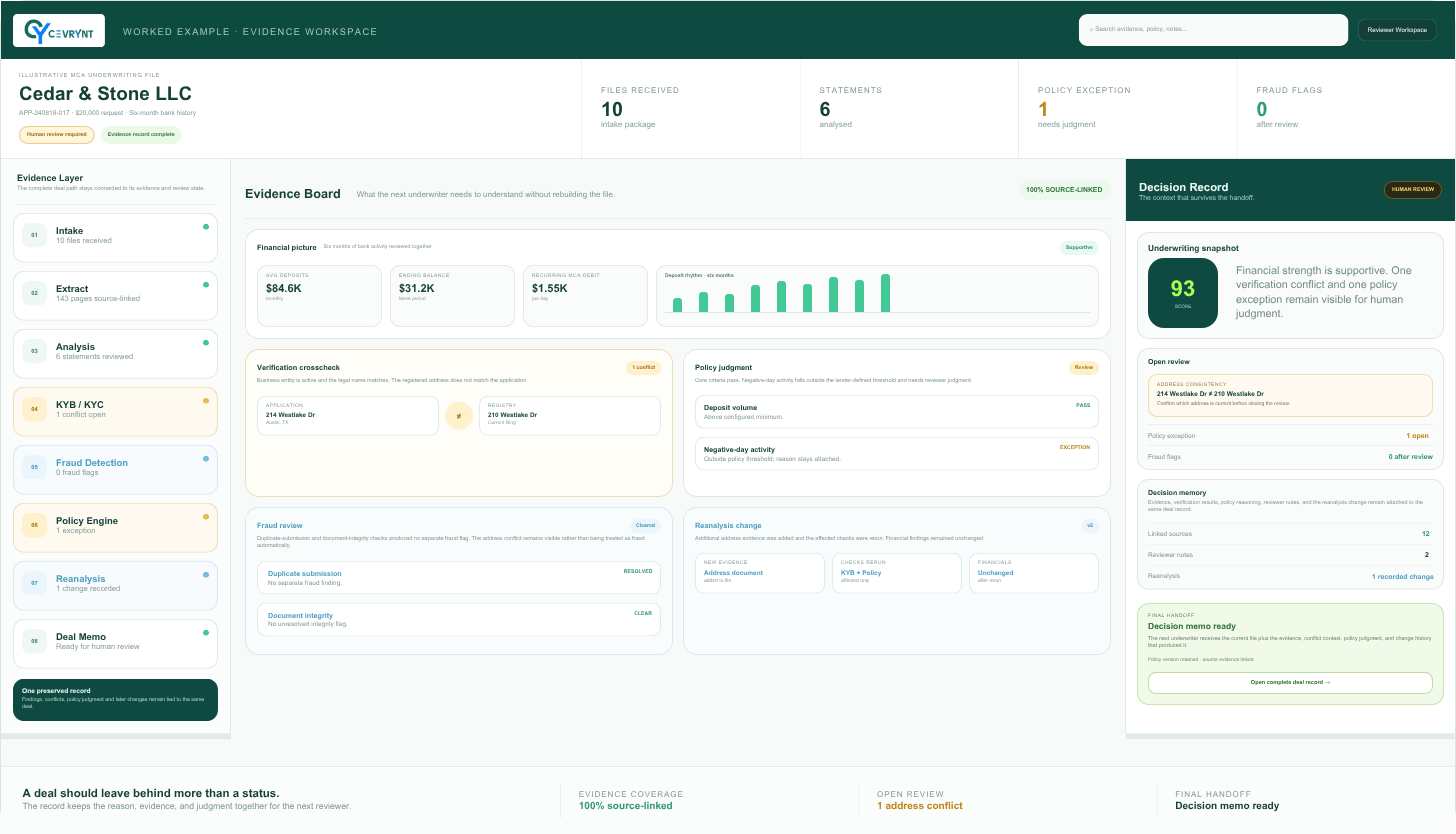
Ten files received, 143 pages linked, and every stage of the trail still pointing back into them. That is the reason the other 139 pages have to stay where they are.
What the field is actually showingThe memo is a map into the evidence, not a replacement for it. The full 143-page package remains available behind the review, so each material finding can be traced back to the source that supports it.
WHAT WE WON’T OPTIMIZE AWAY
Four tempting shortcuts. One boundary rules them out.
Every new Cevrynt workflow should pass four tests: can the lender inspect it, does judgment stay with the lender, does the evidence remain attached, and does it still work when the file is messy? The important column is the second one — each shortcut below would quietly move judgment toward the software.
- 04
- shortcuts that look faster
- 04
- tests every idea must pass
- 00
- allowed to quietly move judgment
Open ring · passes Struck ring · fails01 The lender can inspect it · 02 Judgment stays with the lender · 03 The evidence stays attached · 04 It survives a messy file
The column that rules them out
Four different shortcuts. The same boundary every time.
Test 02 fails for all four. The mechanics differ, but the consequence is the same: judgment moves from the lender into the software. Cevrynt can automate preparation, analysis, and policy evaluation without crossing that line.
Why the boundary mattersEach shortcut could make the workflow look faster, but each also transfers judgment into the software. Cevrynt is designed to automate the work around the decision without becoming the decision-maker.
WHO THIS IS FOR
Four workflows we are built around. Four we are not.
Cevrynt fits underwriting operations where software prepares the evidence and a person still owns the judgment. If the goal is to remove the reviewer entirely, originate consumer credit, or turn underwriting into lead routing, this is a different product.
- 04
- workflows Cevrynt is built for
- 04
- workflows outside its product scope
- 01
- question that settles the fit
Does someone on your underwriting team still own the final call?
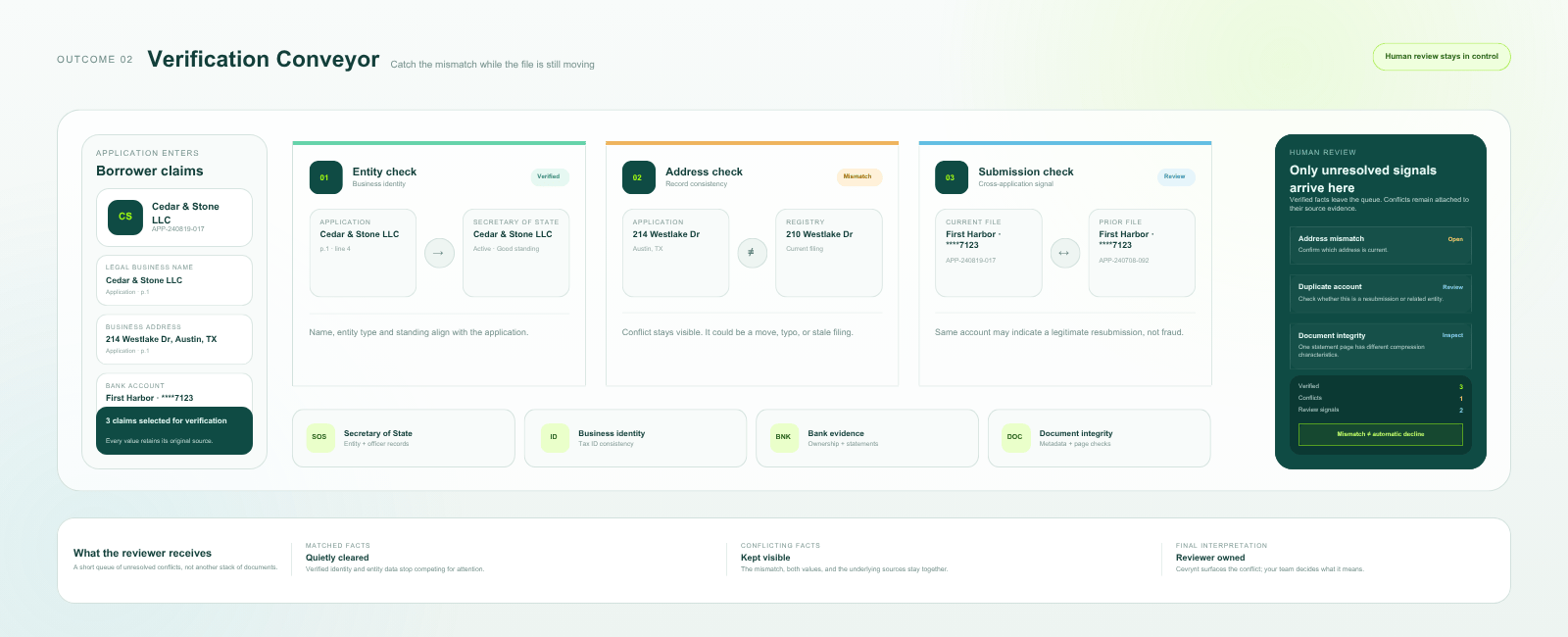
What the built-for workflows receive
A review queue of unresolved issues, not another pile of documents.
Cevrynt structures the evidence, resolves what can be verified, and keeps conflicts, mismatches, and open questions attached to their sources. The remaining queue is there for an underwriter to judge — which is why the fit test starts with whether a person still owns the call.
Why we publish the boundaryA clear fit test saves both sides time. Cevrynt is built for teams that want less manual underwriting work while keeping human judgment, lender-defined policy, and final decision authority in place.
FOUNDER-LED
Bring the messy file. Ask the hard questions.
If you are evaluating Cevrynt, bring the underwriting case, policy exception, evidence conflict, workflow constraint, or edge case your team actually deals with. We will show you what Cevrynt can handle today, where it still needs work, and how it fits around the judgment your team already owns.