
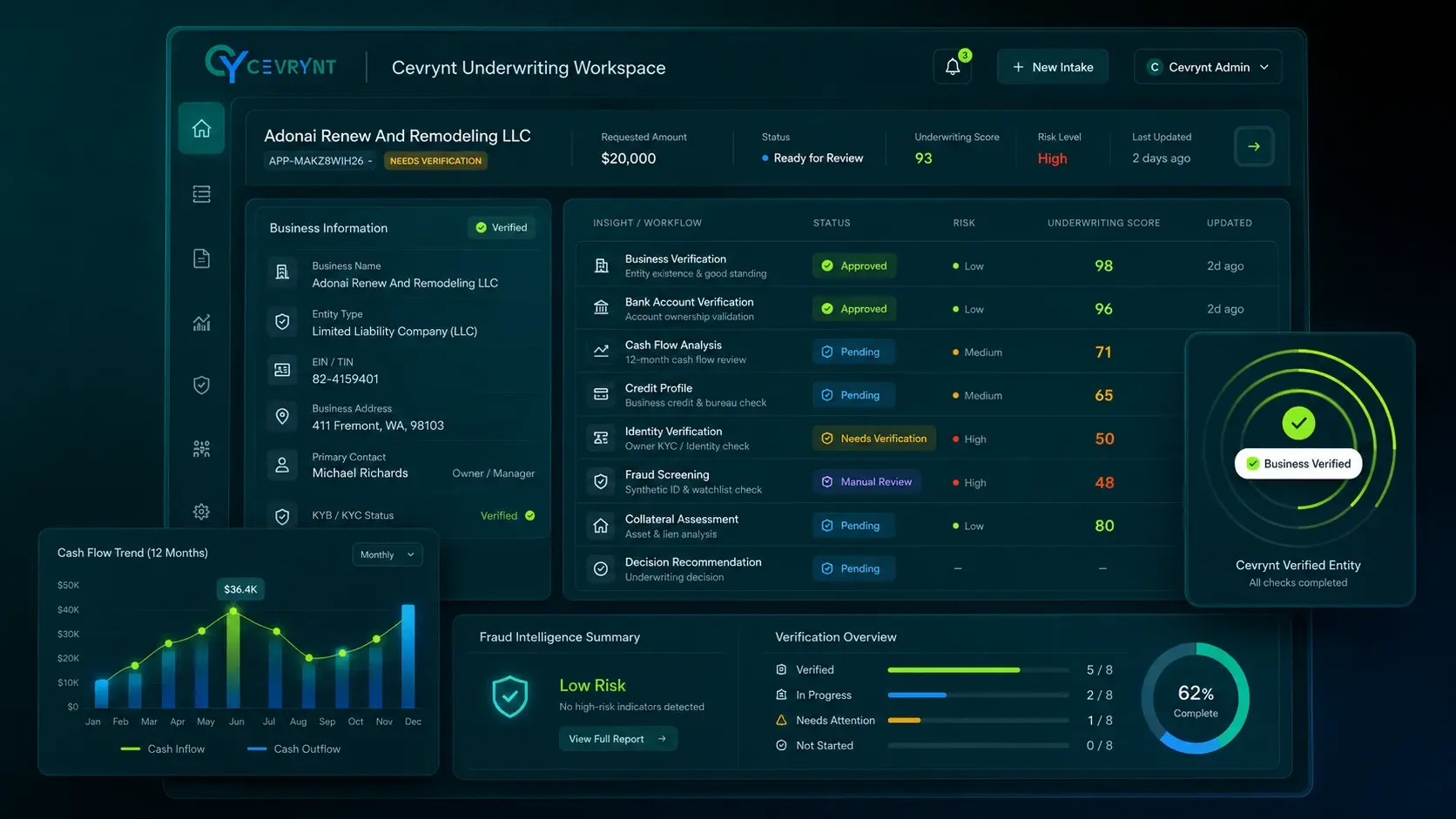
Before an underwriter spends time evaluating a business's cash flow or credit history, a more basic question needs answering: does this business exist as claimed, and are the people applying actually authorized to do so on its behalf? This is the job of KYB — know your business — verification, and it is a distinct discipline from financial analysis, with its own methods, data sources, and failure modes.
What KYB actually covers
KYB verification typically spans several layers: confirming the business is legally registered where it claims to be, checking that key details (name, address, formation date, entity type) are consistent across submitted documents and official records, identifying beneficial owners, and verifying that the individual submitting the application has authority to act for the business.
Registration and entity verification
This confirms the business is registered with the relevant state (in the U.S., typically the Secretary of State), that its status is active and in good standing, and that formation details match what's been submitted. A business claiming to have operated for five years but only recently registered is a discrepancy worth investigating, not necessarily disqualifying on its own.
Identity and ownership consistency
Business name, address, and ownership details should match consistently across the application, bank statements, tax documents, and official registration records. Inconsistencies don't automatically indicate fraud — businesses do relocate and restructure — but they warrant a documented explanation rather than being silently ignored.
Authorized signer verification
Confirming that the individual applying is actually authorized to bind the business — an owner, officer, or someone with documented authority — matters both for fraud prevention and for the basic enforceability of any resulting agreement.
What KYB verification data sources actually look like
Unlike financial analysis, which draws primarily from bank statements and tax documents supplied by the applicant, KYB verification relies on independent data sources — records the applicant didn't generate. The primary sources in U.S. business verification include state Secretary of State registration databases (which confirm legal entity status and good-standing), federal EIN records through the IRS, commercial databases that aggregate business registration data across states, and identity verification services that match individual identity to a claimed business role.
Each source has coverage limitations. State SOS databases vary in their data quality, update frequency, and accessibility. Some states maintain searchable online records that update within days of a filing; others have significant lags or require manual record requests. Commercial aggregation services attempt to bridge these gaps, but they introduce their own potential for stale data and classification inconsistencies. A business that recently registered in a new state may not appear in a commercial database that was last refreshed several weeks ago. Understanding these coverage gaps is important context when interpreting verification results — a 'not found' response doesn't necessarily mean a business doesn't exist.
Verification during the origination workflow
In a well-structured underwriting workflow, KYB verification happens before — or at minimum alongside — financial analysis, not as a final checkpoint. The reason is pragmatic: if basic identity and registration verification fails, further financial analysis is working on a potentially invalid premise. Spending significant review time analyzing the cash flow of a business that turns out to be unregistered or inactive wastes underwriting capacity.
The canonical underwriting workflow — Intake → Documents → Financials → Verification → Fraud → Policy → Report — treats verification as a dedicated stage because the findings from that stage directly inform how the fraud and policy evaluation stages are conducted. A file that clears verification cleanly gets evaluated differently than one where there are unresolved inconsistencies — even if the financial metrics look identical.
Why KYB is a distinct discipline from financial analysis
It's tempting to fold identity checks into general underwriting review, but KYB requires different data sources (state registries, business databases, identity verification services) and different failure patterns than financial analysis. A business can have a strong bank statement history and still fail basic verification if it's using inconsistent identity information — a pattern more common in synthetic business identity fraud than most underwriters expect.
Treating KYB as a genuine, separate stage of review — rather than a quick checkbox before the "real" underwriting begins — is what allows conflicts to surface clearly rather than getting lost in a broader review process.
The specific challenges of verifying newer and smaller businesses
Verification tooling built for enterprise compliance tends to work best on established, well-documented businesses with years of public records. Alternative lenders, particularly those focused on MCA and SMB working capital, serve a very different borrower segment: newer businesses, sole proprietors, single-owner LLCs, and businesses that may have begun operating before formally registering. This population creates specific verification challenges that the standard enterprise KYB stack doesn't handle cleanly.
A business formed eight months ago may have limited registry presence in commercial databases, no published credit history, and no public web footprint beyond perhaps a basic Google Business Profile. None of this indicates fraud — it just reflects a genuinely early-stage business. Treating verification gaps as fraud signals in this context would systematically penalize exactly the small businesses that most alternative lending products are designed to serve. The alternative is a verification approach that accounts for where a business is in its lifecycle: distinguishing 'insufficient data' from 'conflicting data' rather than treating both as equivalent risk.
What verified KYB data actually changes in the underwriting decision
Lenders sometimes treat KYB as a compliance exercise — a box to check before the real underwriting begins — rather than as a meaningful input to the credit decision. This understates what verification actually contributes. A business that clears KYB cleanly — legal entity active, address and ownership consistent across all sources, authorized signer identity confirmed — provides a meaningful level of assurance that the file represents a real, legitimate business operating as described. That assurance changes the frame through which the financial analysis is read.
Conversely, a business with unresolved KYB inconsistencies — a claimed five-year operating history that registry records show as a two-year-old entity, or an owner identity that doesn't match the business's documented principals — should prompt the underwriter to read the financial data more critically, not just note the inconsistency and proceed. A bank statement showing strong deposits from a business that can't be independently verified as a legitimate, operating entity represents a different risk than the same statements from a fully verified business.
A tiered approach to verification
Not every deal warrants the same depth of verification. A useful framework separates verification into tiers: initial identity and registration checks for every application, deeper investigation when initial checks surface inconsistencies, and ongoing monitoring for approved relationships where risk profile could change over time. This tiered approach balances thoroughness against the practical reality that most applications don't need the deepest level of scrutiny to clear basic verification confidently.
Common KYB pitfalls
- Relying on stale registry data. Business registration status can change; verification pulled from outdated sources can miss a business that has since become inactive or dissolved.
- Treating new formations as automatically suspicious. Legitimate new businesses need financing too — the goal is contextualizing recency, not penalizing it outright.
- Missing DBA and trade name variations, which can cause false mismatches between how a business is legally registered and how it operates day to day.
- Not verifying sole proprietors and newer entities with the same rigor as established LLCs and corporations, since legacy verification tools sometimes return incomplete results for these structures.
From here, this article is about Cevrynt
How Cevrynt approaches business verification
Cevrynt's Business Verification module organizes verification findings — registration status, identity consistency, ownership details — into the same review as financial and fraud analysis, with conflicts surfaced clearly for human review rather than silently resolved. Sources and reviewer notes are preserved as part of the file's evidence trail.
This is not a replacement for a lender's own compliance and KYB program, but a way to bring verification findings into the same evidence-linked workflow as the rest of the underwriting review. A qualified walkthrough is the best way to discuss how this fits your specific verification requirements.