
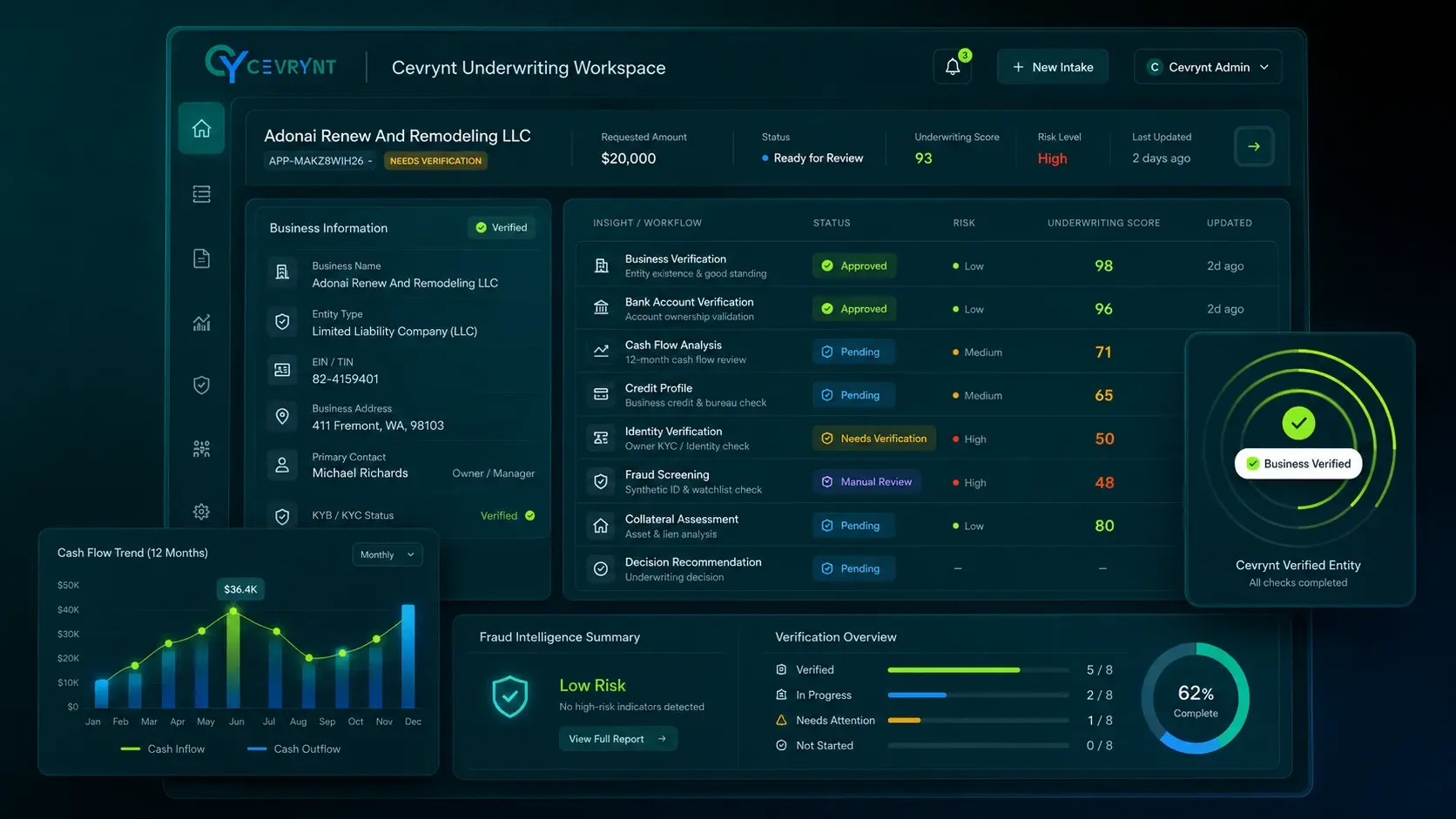
A decade ago, a forged bank statement was relatively easy to catch — fonts didn't quite match, alignment was off, numbers didn't add up correctly. Modern document editing tools have narrowed that gap considerably. A well-executed alteration can look completely convincing to the naked eye, which means underwriting teams relying primarily on visual review are increasingly at a disadvantage against document fraud that has kept pace with easily available editing technology.
How documents typically get altered
Direct figure manipulation
The most straightforward form of document fraud involves directly editing figures on a real statement — inflating a deposit amount, removing an NSF event, adjusting an ending balance. When done carefully, this can be visually undetectable, especially on a statement viewed as a static image or printout rather than analyzed at the data layer.
Composite documents
Some fraud involves combining elements from multiple genuine documents — the header from one statement, transaction data from another — to construct a document that appears legitimate but doesn't represent any single real account accurately.
Fabricated documents from scratch
Less common but more severe, some fraud involves generating an entirely fabricated statement using a template that mimics a real bank's format, populated with invented transaction data designed to present a favorable financial picture.
Signals that indicate possible document manipulation
- Metadata inconsistencies — file creation and modification dates that don't align with the claimed statement period, or software signatures inconsistent with typical bank statement generation.
- Internal arithmetic errors — running balances that don't correctly reflect the sum of listed transactions, which is a strong signal since genuine bank-generated statements are internally consistent by construction.
- Formatting inconsistencies within a single document — font, spacing, or alignment shifts partway through a document, particularly around specific transaction lines.
- Statement format mismatches — layout or terminology inconsistent with how a specific bank is known to format its statements, when compared against a reference library of known formats.
- Cross-document inconsistencies — figures that don't reconcile between a bank statement and other submitted documents describing the same period or account.
How AI-generated and AI-assisted document fraud is changing the threat
The fraud landscape in document review has evolved meaningfully over the past few years. A few years ago, creating a convincing altered bank statement required either significant design skill or access to specialized software. Today, widely available AI image-editing tools can make targeted text replacements in a scanned document with near-perfect visual consistency — the kind of edit that would have been detectable through visual review a few years ago often is not today.
This shift has two implications for underwriting teams. First, visual review by itself is less reliable than it once was as a fraud detection method. Second, the signals that remain reliable — arithmetic consistency, metadata, and cross-document reconciliation — become correspondingly more important, because they don't depend on spotting a visual anomaly in the document itself.
The role of PDF metadata and digital artifact analysis
PDF documents retain creation and modification metadata that can contradict the document's claimed origin. A bank statement claimed to represent transactions from six months ago, but carrying a PDF creation timestamp from last week, is an immediate discrepancy worth investigating — either the statement was provided in a delayed format (which some banks legitimately do), or the document was generated more recently than the claimed date.
Beyond timestamps, PDFs may retain information about the software used to generate them. A statement purportedly from a major bank, but with a PDF generator signature consistent with a generic office productivity tool rather than the bank's statement generation system, is a discrepancy that suggests the document wasn't directly produced by the bank. Not every such discrepancy indicates fraud — statements sometimes get converted or processed through intermediate software — but combined with other signals, it adds meaningful context.
Cross-document verification as a structural check
One of the most reliable document fraud detection methods doesn't depend on analyzing a single document in isolation at all. Instead, it compares figures and facts across multiple submitted documents that should, if genuine, tell a consistent story. A bank statement's average monthly deposit figure should be in a plausible range relative to the revenue figure on a tax return for the same period. An ending balance on a statement should be consistent with the opening balance on the next period's statement.
These cross-document checks can catch cases where each individual document looks clean but the story they tell together doesn't add up. A sophisticated fraudster may alter one document carefully while leaving a second document inconsistent with the first — because maintaining perfect cross-document consistency across several altered documents is substantially harder than altering any single document convincingly. This is why the document intelligence foundation of a review matters so much: structured extraction from every document in the file, with cross-document reconciliation built in, is what enables these checks reliably.
Why arithmetic verification is one of the most reliable checks
Among the available signals, verifying that a statement's running balance correctly reflects every listed transaction is one of the most reliable and hardest-to-fake checks. A fraudster editing a single figure often fails to correctly propagate that change through every subsequent running balance on the page — an error that's tedious to catch by eye across a multi-page statement, but straightforward to verify systematically. This is the kind of check that benefits enormously from structured, source-linked document analysis rather than visual review, as covered in our guide to document intelligence.
What to do when manipulation is suspected
As with other fraud signals discussed in our broader guide to fraud signals in small business lending, a suspected document alteration should route to closer human review rather than an automatic decline — some anomalies have innocent explanations, such as a bank's own formatting quirks or a scanning artifact. But a confirmed alteration is a serious finding that typically warrants declining the application and, depending on the lender's policy, further action.
From here, this article is about Cevrynt
How Cevrynt approaches document fraud detection
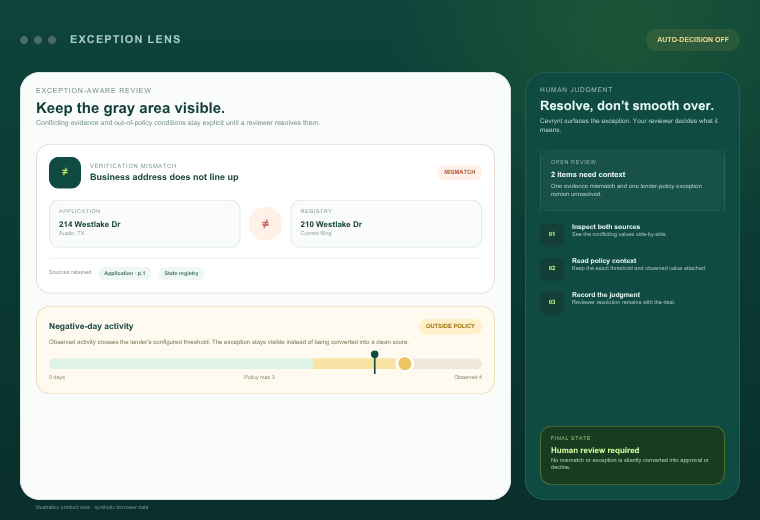
Cevrynt's Fraud Signals module includes systematic checks like running-balance verification and cross-document consistency, applied to every submitted file rather than left to visual review. Flagged inconsistencies link back to their exact location in the source document, so an underwriter or fraud analyst can verify the finding directly.
These checks work alongside document intelligence and business verification as part of one connected review. Cevrynt surfaces findings for human judgment — it does not issue a fraud determination on its own. A qualified walkthrough can show how this works against your own document types.