
Fraud in small business lending rarely arrives as a single, unmistakable red flag. More often, it shows up as a collection of small inconsistencies — a document that doesn't quite match, a deposit pattern that doesn't fit the stated business model, an identity detail that shifts slightly across submissions — none of which is individually damning, but which together paint a clear picture once someone is looking for it.
This piece surveys the main categories of fraud signal relevant to SMB and MCA underwriting, and how to think about acting on them without over-relying on any single indicator.
The main categories of fraud signal
Document inconsistencies
Mismatched fonts, inconsistent formatting within a single document, metadata that suggests recent editing, or figures that don't reconcile between related documents (a bank statement and a tax return, for instance) are classic signs of document manipulation. Our dedicated guide on document fraud detection covers this category specifically.
Identity and business verification conflicts
Discrepancies between how a business or individual is described across the application, submitted documents, and independent registration or verification records — covered in depth in our KYB guide — are a recurring category of fraud signal, particularly in synthetic business identity schemes.
Financial pattern anomalies
Circular transactions, deposit timing that doesn't match a plausible business model, or existing debt obligations that weren't disclosed — including the stacking pattern common in MCA fraud — all surface through careful bank statement analysis.
Behavioral and application-level signals
Rapid application resubmission after a decline, applications submitted at unusual hours relative to the stated business's operating model, or patterns matching known fraud rings tracked across the industry can add useful context, though these signals typically require aggregated data beyond a single lender's own file.
How fraud signals stack and compound
The compounding effect of multiple signals is what makes fraud review genuinely analytical rather than purely procedural. Consider two files. File A has a document inconsistency — a slight font variation in the header of a bank statement. File B has that same font variation, plus a deposit pattern that doesn't match the stated business model, plus an identity detail in the application that differs from what shows up in the state registration database. File A might be a bank statement generator formatting quirk. File B is a different conversation entirely.
This is why experienced fraud analysts talk about signal combinations rather than signal thresholds. The question isn't 'how many flags does this file have?' but rather 'which signals are present, do they reinforce each other, and do they point toward a consistent explanation?' Three signals that could each be independently explained away but all point in the same direction are far more concerning than three signals that reflect three entirely different, plausible innocent causes.
The fraud signals most specific to MCA and alternative lending
Some fraud signals are essentially universal across loan products; others are specific to the MCA and alternative lending context because they exploit characteristics of how these products are structured and processed.
MCA-specific signals worth knowing include: circular deposit activity — where funds move in and out of an account rapidly in a way that inflates apparent deposit volume without representing genuine revenue (a topic covered in more depth in the bank statement analysis guide); undisclosed existing positions that appear as recurring debits in the statements, consistent with stacking; and the bust-out pattern, where a business builds a legitimate-looking track record specifically to access larger advances before defaulting intentionally.
The speed and volume of MCA origination creates specific pressure on fraud review. Unlike traditional small business loans, where weeks of processing time allow for deeper investigation, MCA advances are often expected to fund within a day or two. Fraud schemes designed for this environment exploit that timeline, submitting applications that look clean enough to pass a quick review but would not survive deeper scrutiny if time permitted. A structured analysis workflow — one that captures the right signals in a consistent, rapid way rather than relying on a slow manual process — is the practical answer to this challenge.
Distinguishing fraud from legitimate distress
One of the more nuanced challenges in SMB fraud review is distinguishing a business engaged in deliberate fraud from one that is genuinely struggling and cutting corners to access capital it hopes will save it. A cash-strapped business owner who submits a slightly embellished bank statement — a deposit moved from one month to another, or a one-time payment presented as recurring revenue — is doing something fraudulent, but the underlying situation and risk profile differs from an organized scheme explicitly designed to never repay.
For underwriting purposes, the distinction matters less than it might seem: material misrepresentation in an application is problematic regardless of the applicant's deeper intent, and the financial risk from a business that overrepresented its condition is real either way. But it does affect how a lender might respond — whether to decline outright, request additional documentation, or structure a smaller advance than requested — and it informs how fraud findings get documented for regulatory and compliance purposes. Underwriters trained to think about intent as well as fact are better equipped to make these downstream judgments.
Why no single signal should drive a decision
Nearly every individual fraud signal has a plausible innocent explanation. A recently formed business isn't automatically fraudulent. A document formatting inconsistency might just reflect how a particular bank's statement generator behaves. Treating any single signal as automatically disqualifying produces both false positives — declining legitimate businesses — and a false sense of security, since fraud specifically designed to pass a single check will often do exactly that.
The more reliable approach weighs multiple signals together, in the context of the specific deal, and routes ambiguous cases to a trained fraud analyst or senior underwriter rather than resolving them automatically in either direction.
Building a fraud-signal review process
- Define clear escalation thresholds for when a combination of signals routes a file to specialized fraud review rather than standard underwriting.
- Document every flagged signal and its resolution, whether the file proceeds, gets declined, or requires additional information — this builds an internal record of what patterns actually predict outcomes over time.
- Keep fraud signals separate from policy decisions in the file, so it's clear whether a decline was driven by credit policy, fraud concern, or both.
- Review declined files periodically to check whether flagged signals were correctly predictive, refining thresholds based on actual outcomes rather than assumptions.
From here, this article is about Cevrynt
How Cevrynt surfaces fraud signals

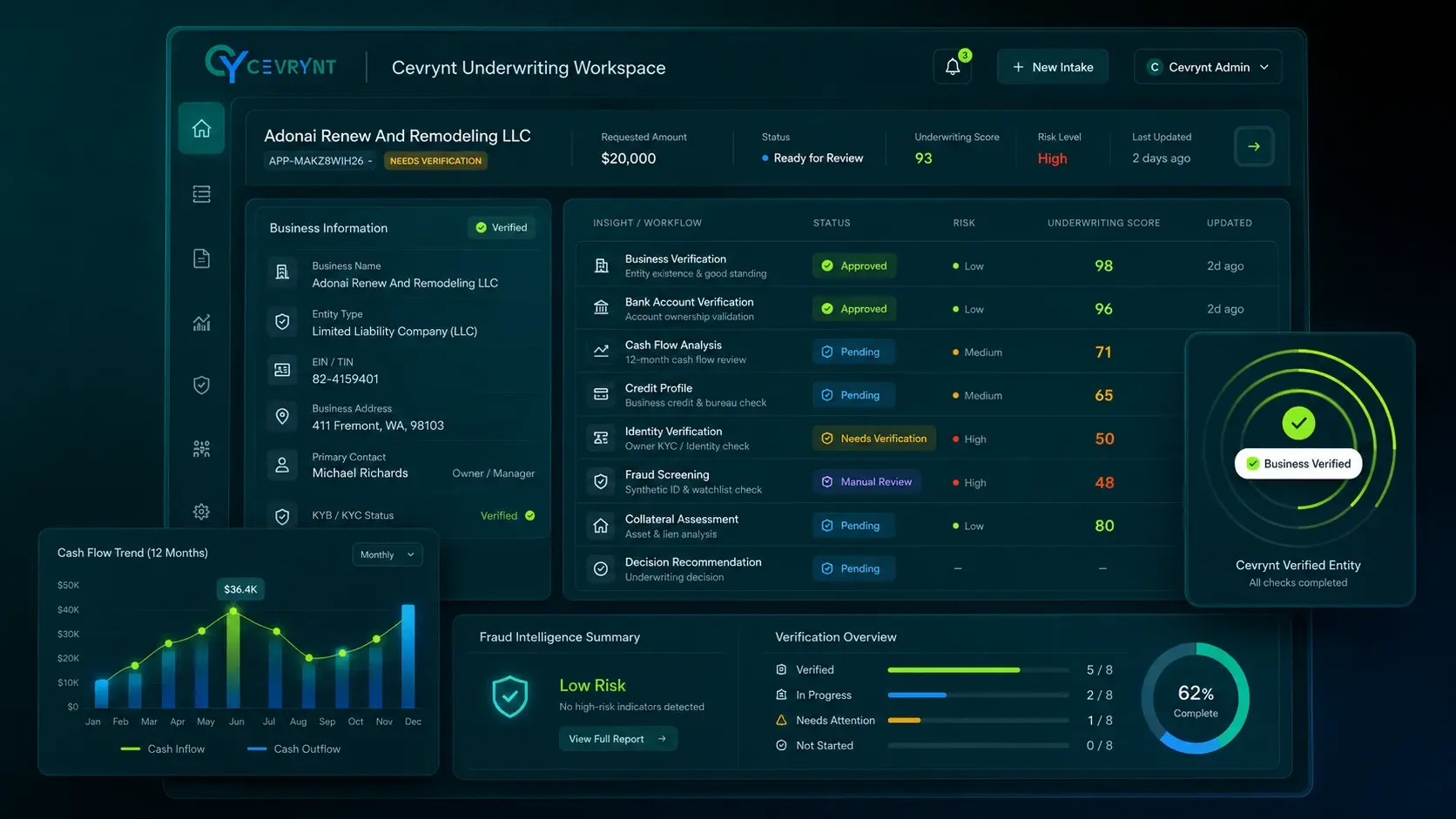
Cevrynt's Fraud Signals module surfaces document, identity, and transaction inconsistencies from across the full underwriting file — documents, verification, and financial analysis — in one connected view, rather than requiring a fraud analyst to manually reconcile separate reports. Each signal links back to its source evidence.
Consistent with Cevrynt's broader approach, fraud signals are inputs to a human decision, not an automated verdict. The underwriter or fraud analyst weighs the full picture and makes the call. A qualified walkthrough shows how this looks against representative files.