
In conversations about lending compliance and fraud prevention, "KYB" and "KYC" often get used as if they're interchangeable. They're related, but they answer fundamentally different questions, and conflating them can leave real gaps in an alternative lender's verification process. This piece lays out the distinction plainly and explains why both matter for business lending specifically.
KYC: know your customer
KYC — know your customer — verifies the identity of an individual person: confirming who they are, typically through government-issued identification, and screening them against relevant watchlists or sanctions databases. KYC has deep roots in consumer banking and financial services, where the "customer" is almost always an individual.
KYB: know your business
KYB — know your business — verifies the identity and legitimacy of a business entity: confirming it's legally registered, checking its formation and operating history, and identifying its beneficial owners. Where KYC asks "is this person who they claim to be," KYB asks "does this business exist as claimed, and who actually controls it." Our detailed guide to KYB for lenders covers this in more depth.
Why business lending needs both
In merchant cash advance and SMB lending, the applicant is a business, but a business is a legal fiction — it can only act through people. A complete verification process needs to confirm both: that the business itself is legitimate (KYB), and that the specific individual applying is who they claim to be and has authority to act for that business (KYC).
Skipping either half leaves an exploitable gap. A lender that only performs KYC on the applicant, without KYB on the business, could approve financing for a business that doesn't legitimately exist as described. A lender that only performs KYB on the business, without KYC on the applicant, could approve financing based on an application submitted by someone without actual authority to bind the business — or by someone impersonating an authorized signer entirely.
How the two connect in practice
Beneficial ownership verification sits at the intersection
Identifying who actually owns and controls a business is technically part of KYB, but it inherently requires verifying individual identities — meaning it draws on KYC methods and data sources. This is often where the two disciplines overlap most directly in practice.
Fraud patterns often exploit the gap between them
Synthetic business fraud — where a fabricated or improperly controlled business entity is paired with a real or stolen individual identity — specifically exploits the space between KYB and KYC verification when the two are performed separately and not cross-referenced. Our piece on shell companies and synthetic business identities covers this risk pattern directly.
The specific verification challenges of business lending versus consumer lending
Consumer KYC is a relatively mature, well-established discipline. The subject of verification is an individual, identity documents are standardized, and verification tools have decades of refinement. Business KYB for alternative lending faces meaningfully different conditions: the subjects range from well-documented multi-year corporations to newly formed single-member LLCs with minimal external data, the documentation submitted can vary widely, and the identity data sources have variable coverage and freshness.
This creates a challenge for alternative lenders that consumer-oriented compliance tooling doesn't fully address. A KYB process designed for enterprise business-banking due diligence may be over-engineered (and too slow) for MCA origination. A KYC-only process designed for consumer lending doesn't capture the business entity dimensions at all. Alternative lenders often have to compose a verification approach from tools and processes designed for different contexts, which is where gaps tend to emerge.
How authorized signer verification fits between KYB and KYC
Authorized signer verification — confirming that the individual applying has actual authority to bind the business to the agreement — sits squarely at the intersection of KYB and KYC. It requires KYC to confirm the individual's identity (who is this person?), and KYB to confirm their authority relative to the business entity (does this person's role in the business give them authority to sign for it?). Performing only one half produces a gap: confirming the individual's identity doesn't tell you they have authority, and confirming the business entity's legitimacy doesn't tell you the person applying is actually connected to it.
In practice, authorized signer verification often involves checking that the individual applicant appears in the business's registered ownership or officer records, or has been explicitly designated with authority to act for the business in its formation or operating documents. This cross-reference — individual identity against business records — is where the KYB/KYC integration is most directly valuable.
Regulatory context: what's required and what's best practice
Lenders operating in the U.S. should be aware that regulatory requirements around business verification vary by entity type, loan size, and funding source. The FinCEN Customer Due Diligence (CDD) rule requires certain financial institutions to collect and verify beneficial ownership information for legal entity customers — but the specific applicability depends on the institution type and regulatory classification. Alternative lenders, particularly those that aren't bank-sponsored or don't fall under certain federal regulatory frameworks, may face different requirements than traditional banks.
Beyond regulatory minimums, there is meaningful value in treating KYB and KYC verification as genuine business risk management, not just compliance exercises. A lender that verifies business identity thoroughly as part of underwriting — not just to satisfy a regulatory requirement — is building better information about who it's lending to, which reduces fraud losses and default risk regardless of what the specific regulatory minimum requires. Cevrynt is not a compliance or regulatory advisory service; lenders should work with their own compliance and legal counsel to determine applicable requirements.
What this means for building a verification process
- Treat KYB and KYC as complementary, not substitutes — passing one does not reduce the need for the other.
- Cross-reference findings between the two — an authorized signer's identity should match the ownership or officer records surfaced during KYB.
- Document both separately in the underwriting file, so a later reviewer can see exactly what was verified and how.
- Apply consistent rigor regardless of business size — smaller businesses and newer formations shouldn't receive lighter scrutiny by default.
From here, this article is about Cevrynt
How Cevrynt brings verification together
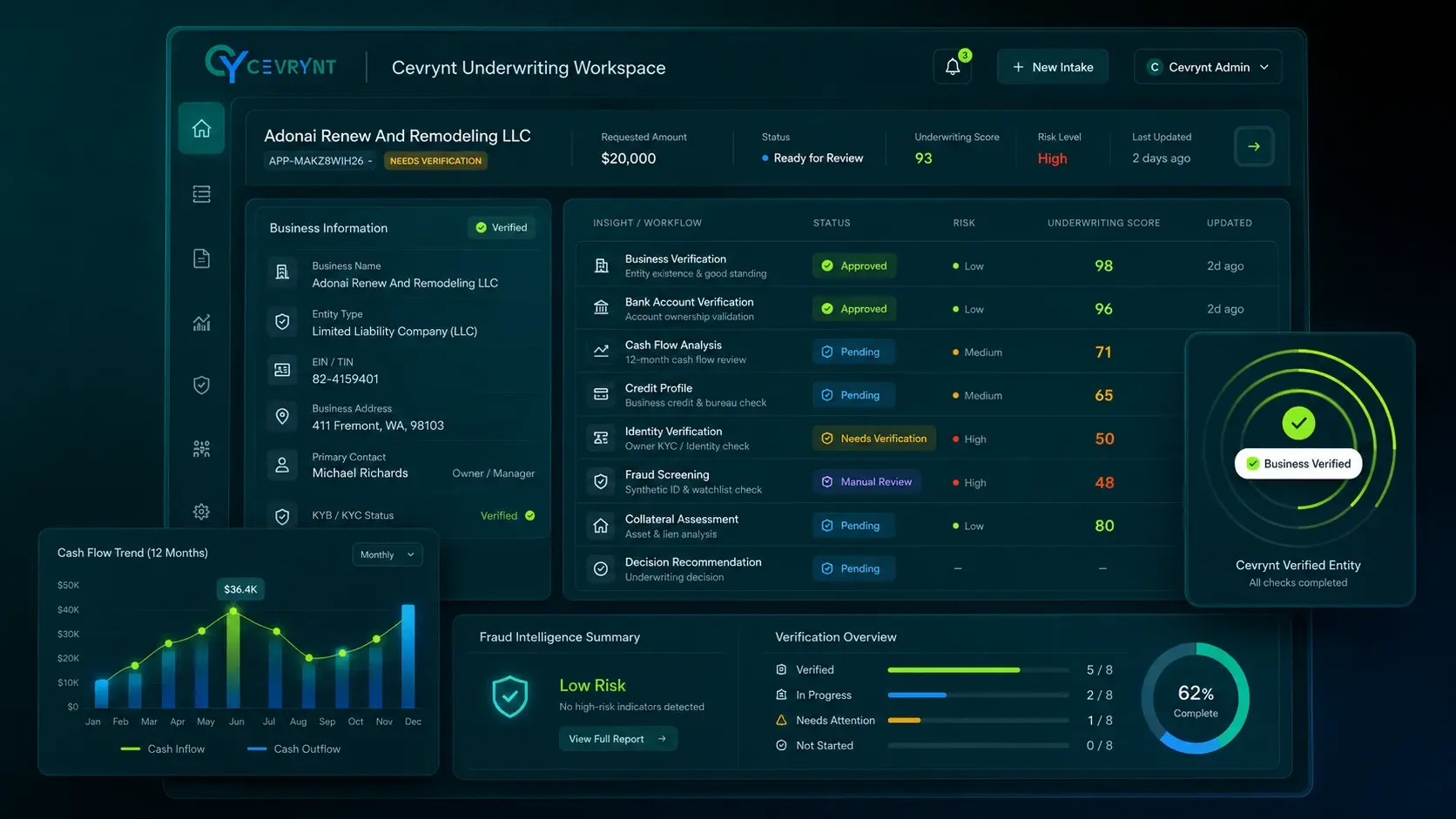
Cevrynt's Business Verification module organizes business identity, registration, and ownership findings alongside applicant identity checks, surfacing conflicts between the two for human review rather than treating them as separate, disconnected steps. This keeps the underwriting file coherent, with sources and reviewer notes preserved throughout.
Cevrynt does not replace a lender's own compliance program, but it does make sure verification findings are visible in the same connected review as financial analysis and fraud signals. A qualified walkthrough can walk through how this fits your specific KYB and KYC requirements.