
"Decision intelligence" gets used loosely in lending technology marketing, often as a stand-in for "we use AI." That vagueness is a problem for underwriting teams evaluating new tools, because the term can describe anything from a single scoring model to a fully automated approval pipeline. If you are an underwriting, credit, or risk leader at an alternative lending shop, it is worth being precise about what the term should mean before you let it shape a buying decision.
In practical terms, decision intelligence in underwriting is the discipline of connecting data collection, analysis, and human judgment into a single, traceable workflow — rather than treating each step as a disconnected tool or spreadsheet. It is less about a specific algorithm and more about how information flows from a borrower's raw documents to a reviewer's final call.
Decision intelligence is a workflow property, not a model
A common misconception is that decision intelligence means replacing underwriters with a machine-learning model that outputs an approve or decline. That framing misses what actually breaks down in most merchant cash advance underwriting software and SMB lending operations. The failure point is rarely a lack of scoring sophistication — it is fragmentation. Bank statements sit in one tool, business verification happens in a separate browser tab, fraud checks run through a third vendor, and the underwriter is left manually reconciling all of it before applying policy.
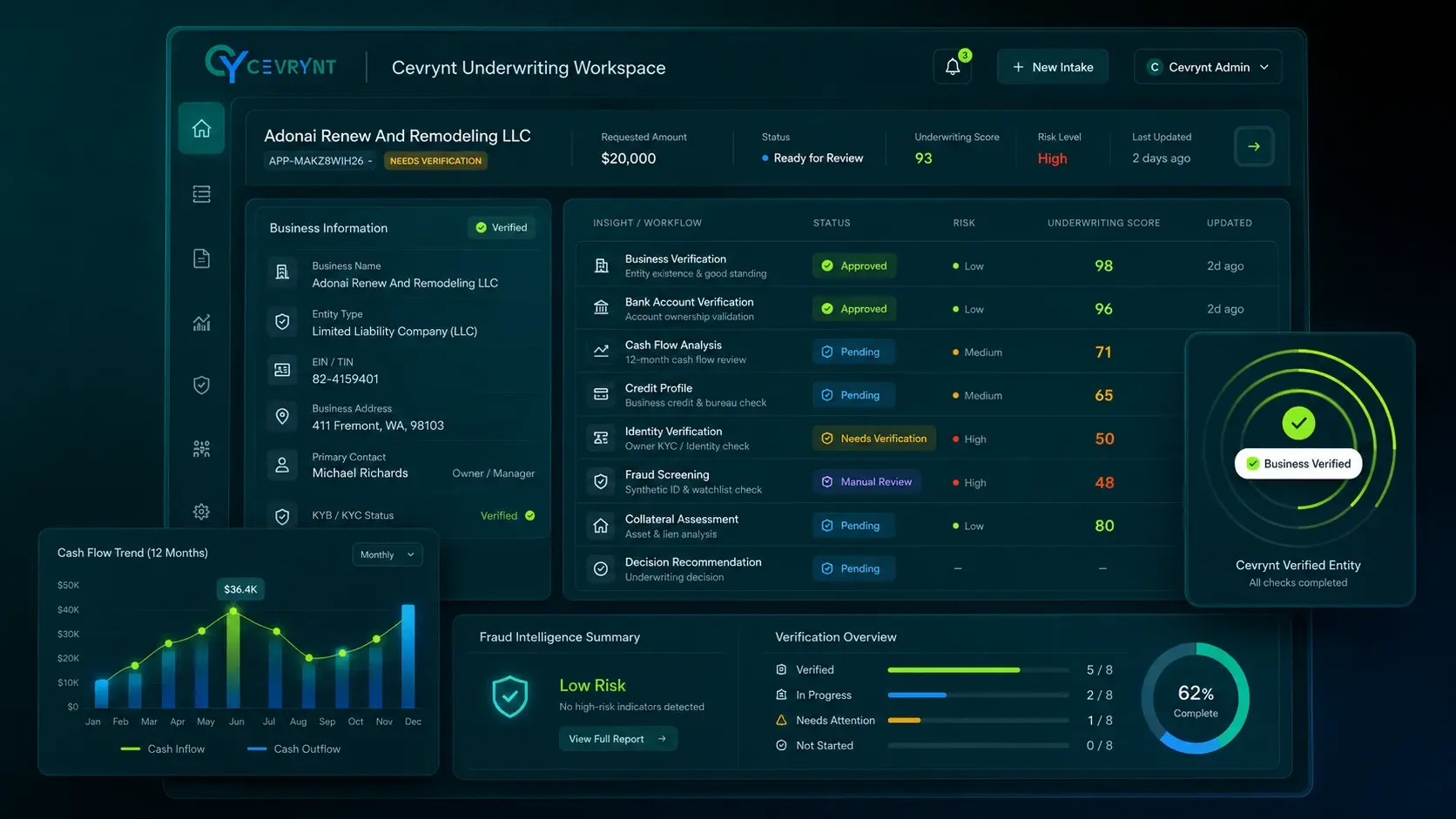
Decision intelligence, properly defined, is what happens when those steps share a common data model and a common evidence trail. A finding from bank statement analysis should be visible next to a business verification flag, which should be visible next to the relevant policy rule, all without the underwriter re-keying information or hunting across five browser tabs. That connectivity is the actual product of decision intelligence — not a black-box score.
Why this distinction matters for lenders
If a vendor pitches decision intelligence as a single opaque score, you should ask a simple question: can an underwriter see exactly why that score landed where it did, and can they trace it back to the specific document or transaction that drove it? If the answer is no, you are buying a black box, not decision intelligence. The value of connecting workflow steps evaporates if the connective tissue itself is not inspectable.
- Traceability — every output should link back to a specific document, transaction, or verification result.
- Consistency — the same categories of evidence should be evaluated the same way across every file, regardless of which underwriter is reviewing it.
- Reviewability — a second underwriter, a compliance officer, or an investor should be able to reconstruct how a decision was reached without re-doing the analysis from scratch.
The five components underwriting teams should expect
When alternative lenders evaluate decision intelligence tooling, it helps to break the concept into components that map to a real underwriting file, rather than evaluating a vendor's marketing language. These components generally mirror the stages any experienced MCA or SMB underwriter already recognizes from manual review.
1. Structured intake and document handling
Before any analysis can happen, submitted files need to be classified and organized — bank statements separated from tax returns, application forms separated from supporting identification. This sounds mundane, but it is the stage where the most underwriter time is lost in manual operations. Our companion guide on document intelligence for lenders goes deeper on this specific stage.
2. Financial analysis with context, not just numbers
Cash flow, deposit patterns, average daily balance, and NSF activity all need to be computed consistently, but the number alone is not the useful output. What underwriters need is context: is this NSF pattern seasonal, or is it accelerating? Is the deposit volume growing, flat, or declining relative to the requested advance? See our detailed guide to bank statement analysis for underwriting for how this typically works in practice.
3. Business and identity verification
Confirming that the business exists, is registered where it claims to be, and matches the ownership and identity details on file is a distinct discipline from financial analysis — often called KYB, or know-your-business. It deserves its own evaluation criteria, which we cover in KYB for lenders: a practical guide to business verification.
4. Fraud and risk signal surfacing
Decision intelligence platforms should surface inconsistencies — mismatched business names across documents, unusual deposit timing, signs of stacking — without pretending to render a final fraud verdict. That verdict belongs to a trained underwriter or fraud analyst, not an algorithm. We explore this balance in fraud signals in small business lending.
5. Policy evaluation with visible reasoning
Finally, every one of the above findings needs to be evaluated against the lender's own credit policy — not a generic industry policy, but the specific rules that particular funder or lending shop applies. This is the role of a loan policy engine, and it is where lender-specific judgment gets encoded without removing the ability to override it manually.
What decision intelligence is not
It is worth being explicit about the boundaries, because vendors in this category sometimes blur them. Decision intelligence is not automated approval — a workflow that outputs a final funding decision without a human reviewer is a different (and riskier) category of product. It is also not a guarantee of accuracy or a substitute for a lender's own credit policy; a decision intelligence platform should adapt to the policy a lender already has, not impose a generic one. And it is not a compliance shortcut — evidence trails support audit and explainability, but they do not replace a lender's own compliance program.
There is also a subtler distinction worth naming: decision intelligence is not the same as "more data." Many lenders already pull in bureau data, bank-linking feeds, and third-party verification reports. Piling more data sources onto an underwriter's desk without connecting them coherently often makes review slower, not faster, because the underwriter now has more disconnected tabs to reconcile rather than fewer. The goal of a well-built workflow is fewer, better-connected signals — not a larger pile of raw inputs.
How to evaluate a decision intelligence vendor
Underwriting, credit, and operations leaders sitting through vendor demos in this category tend to see a lot of polished dashboards and very few concrete answers about how the underlying workflow actually behaves on a messy real-world file. A short evaluation checklist can cut through most of the ambiguity.
- Ask to see a single deal end to end. Not a curated demo file — ask how the platform handles a borrower with incomplete statements, inconsistent business names across documents, or a gap in deposit history. That is where workflow quality actually shows up.
- Ask where the evidence lives. For any given finding — a flagged NSF pattern, a verification mismatch, a policy exception — can the underwriter click through to the exact source document or transaction in one step, or does it require a separate export or support ticket?
- Ask how policy is configured. A platform that hard-codes a single generic credit policy will not fit most alternative lenders, since underwriting criteria vary meaningfully between an MCA funder, a revenue-based financing company, and a broker-facing platform.
- Ask what happens when the underwriter disagrees. Every serious underwriting operation needs a documented override path. If a platform cannot show you how an underwriter's manual override is captured and preserved for audit, that is a meaningful gap.
- Ask who owns the final decision. Any vendor that frames their product as replacing the underwriter's judgment — rather than supporting it — deserves closer scrutiny, both for accuracy risk and for regulatory exposure.
Three levels of decision intelligence maturity
Most alternative lending operations sit somewhere on a maturity curve, whether or not they think about it in these terms. Recognizing which level your own operation is at helps clarify what a meaningful upgrade actually looks like, rather than chasing a vendor's marketing language.
Level 1: Disconnected point tools
At this level, a lender has individual tools for individual jobs — a bank statement parser, a business lookup service, maybe a fraud database subscription — but no shared data layer connecting them. An underwriter opens each tool separately, copies relevant findings into a worksheet or spreadsheet, and manually reconciles everything before applying policy. Every file requires this reconciliation from scratch, and the underwriter functions as the sole integration point between systems that were never designed to talk to each other.
Level 2: Centralized data without shared reasoning
Some lenders progress to a stage where data lives in one place — a shared database or a loan origination system that stores documents and figures centrally — but the reasoning connecting those data points still happens manually. An underwriter can see bank statement figures and verification results in the same screen, which is real progress, but nothing automatically flags that a verification conflict should change how a financial finding gets weighed, or that a fraud signal should route a file for a different level of policy scrutiny. The data is connected; the judgment logic is not.
Level 3: Connected evidence and policy
At full maturity, findings from one stage actively inform how the next stage gets evaluated. A verification conflict doesn't just sit next to a financial summary — it changes how that summary should be read, and the policy engine reflects that connection explicitly. This is the level genuine decision intelligence describes, and it is meaningfully different from simply having all the same data visible in one interface. Most lenders evaluating new tooling are actually trying to move from Level 1 or Level 2 to Level 3, even if they describe the goal simply as "faster underwriting."
A worked comparison: the same deal, two different workflows
It's easier to see what connected decision intelligence actually changes by walking through the same illustrative deal under two different workflows — one fragmented, one connected.
Without connected decision intelligence
An underwriter opens a borrower's combined PDF, manually separates the bank statements from the application and identification documents, and calculates cash flow figures by hand or with a spreadsheet template. Separately, they run a business lookup to confirm registration status, noting the result in a different document. A fraud check happens through a third system, producing a report the underwriter has to read and manually cross-reference against what they already found. By the time policy review starts, the underwriter is working from memory and scattered notes to recall which findings mattered, rather than from a single connected picture — and if a verification conflict surfaced twenty minutes earlier, there's a real chance it doesn't get weighed properly against the financial analysis, simply because the two pieces of information never sat side by side.
With connected decision intelligence
The same borrower's documents get classified and organized automatically on intake. Cash flow figures, deposit trends, and NSF activity get calculated consistently and displayed with links back to the source statements. A verification conflict — say, a business address mismatch between the application and the state registry — is surfaced directly alongside the financial findings, not buried in a separate report. When policy evaluation runs, it reflects that conflict explicitly, flagging the file for a documented human review rather than silently passing or failing it. The underwriter reaches the same ultimate decision-making moment, but with a coherent, connected picture in front of them instead of a set of disconnected facts they have to hold in their head simultaneously.
Common mistakes lenders make when adopting decision intelligence
Alternative lending teams that have tried to modernize their underwriting stack tend to run into a similar handful of mistakes, regardless of loan product or company size.
Buying point solutions instead of a connected workflow
It is common for a lending operation to accumulate a bank-statement parser, a separate KYB tool, and a separate fraud vendor over time, each purchased to solve an immediate pain point. Individually, each tool might work fine. Collectively, the underwriter is still the integration layer — manually copying findings from one system into another. The fragmentation problem this creates is often worse than the one the tools were meant to solve, because now there are more systems to reconcile, not fewer.
Treating explainability as an afterthought
Some platforms are built primarily to produce a score or recommendation quickly, with the underlying evidence trail added later as a compliance feature. This ordering matters. When explainability is retrofitted, it tends to be shallow — a summary paragraph rather than a genuine link back to the source. Lenders evaluating vendors should ask when and how the evidence trail was built into the product, not just whether one exists.
Underestimating the change management involved
Even a well-designed decision intelligence workflow requires underwriters to change how they work — reviewing evidence in a new interface, trusting flagged findings enough to act on them, and learning where manual override is appropriate versus where the underlying analysis is reliable. Lending teams that treat this as a pure technology rollout, without investing in underwriter training and a feedback loop, tend to see slower adoption and more manual workarounds than the tool was meant to eliminate.
From here, this article is about Cevrynt
How Cevrynt approaches decision intelligence
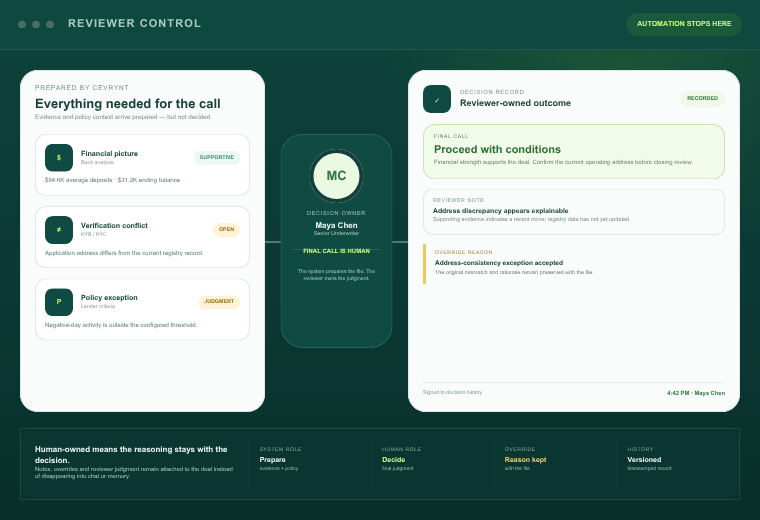
Cevrynt's platform is built around the workflow described above: intake, documents, financials, verification, fraud, policy, report, and human decision. Every stage produces evidence that stays linked to its source, so an underwriter reviewing a file — like the illustrative Cedar & Stone LLC deal used throughout our product walkthroughs — can see exactly why a given finding appeared, not just the finding itself.
The output of that connected review is an evidence-backed underwriting report that a human underwriter reads, annotates, and ultimately decides on. Cevrynt does not issue approvals or funding decisions. Lenders retain final approval authority in every case — the platform's job is to make sure the underwriter reaches that decision with a complete, consistent, and explainable picture in front of them.
If you want to see how this looks against a real underwriting file, a qualified walkthrough is the most direct way to evaluate fit for your specific credit policy and file mix.