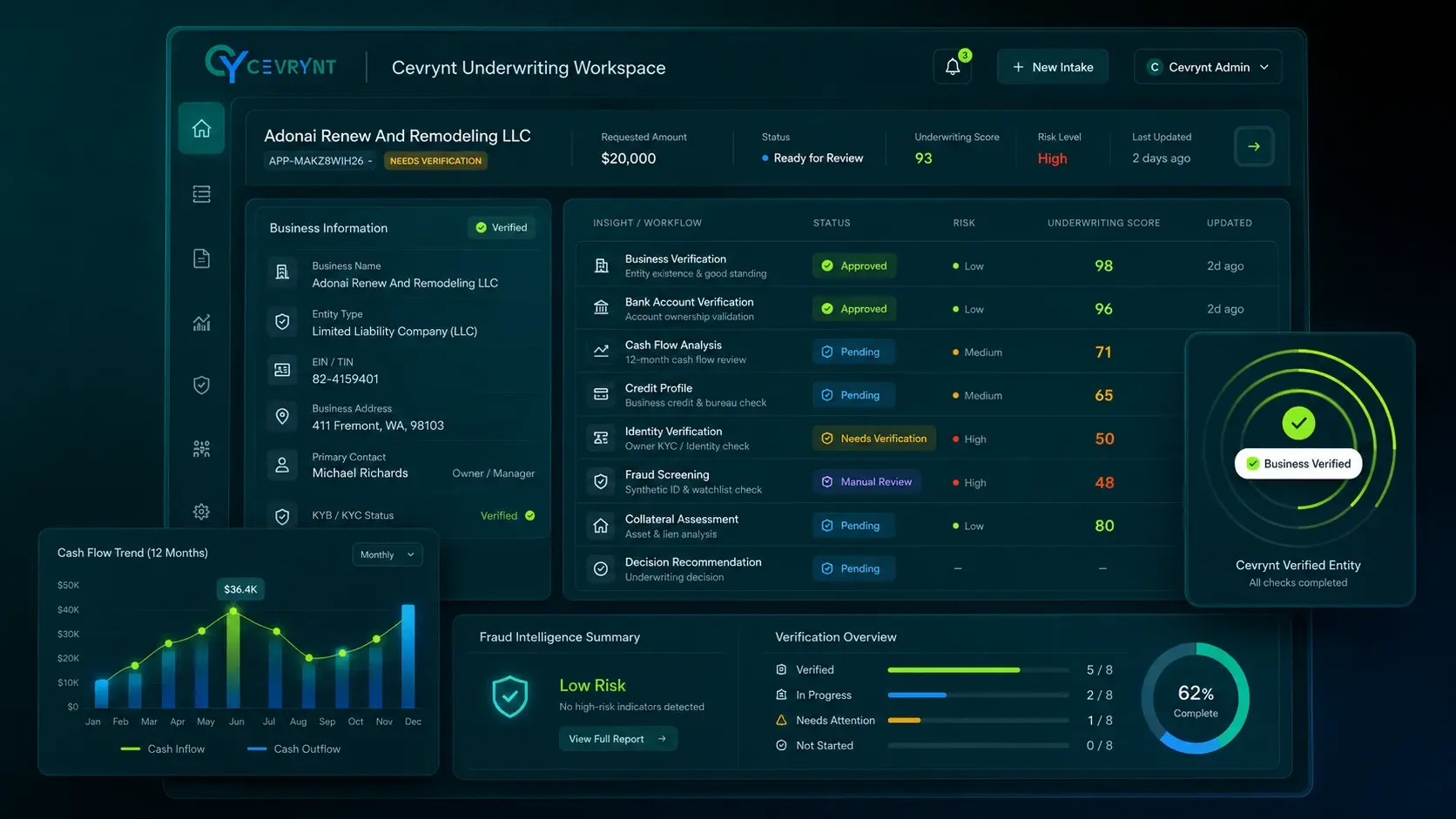
Ask ten underwriting leaders at alternative lending shops what slows their team down, and most will not point to a single missing feature. They will describe a process: documents arriving in inconsistent formats, financial analysis happening in one tool, verification happening in another, and an underwriter manually stitching all of it together before they can even begin applying credit policy. The gap between "we received a borrower's documents" and "we have a decision-ready file" is where most operational time in MCA and SMB underwriting actually goes.
This guide lays out a practical framework for closing that gap — not by adding another point tool, but by connecting the stages that already exist in every underwriting operation: intake, documents, financials, verification, fraud, policy, report, and human decision.
Why fragmented review is the real bottleneck
Most alternative lenders already have the analytical building blocks: someone reviews bank statements, someone checks business registration, someone screens for fraud indicators. The building blocks are rarely the problem. The problem is that they live in separate systems, get performed by different people or tools at different times, and rarely share a common evidence trail. An underwriter reviewing a file for merchant cash advance underwriting might have a bank statement PDF open in one window, a business lookup tool in another tab, and a spreadsheet tracking policy checks in a third — reconstructing a coherent picture of the deal by hand every single time.
That reconstruction work is invisible in most process diagrams because it does not show up as a distinct "step" — it is the connective tissue underwriters provide manually, deal after deal. It is also the first thing that breaks down under volume, when a fast-growing MCA funder or ISO needs to review more files without proportionally growing headcount.
The eight-stage connected workflow
A decision-ready underwriting workflow can be described as eight connected stages. None of these are novel individually — every underwriting team already does some version of each. What changes is whether the output of one stage becomes a structured input to the next, or whether it has to be manually re-entered.
1. Intake
Intake is where a submission — whether from a direct borrower, a broker, or an ISO — first enters the review process. The quality of intake determines how much rework happens downstream. A structured intake step captures what was submitted, flags what is missing, and creates a single record the rest of the workflow can attach findings to.
2. Documents
Submitted files get classified — bank statements, tax returns, application forms, identification — and decision-relevant fields get extracted with a link back to the source page. This is the subject of our dedicated guide on document intelligence for lenders.
3. Financials
Cash flow, deposits, balances, and transaction patterns get structured into consistent metrics — deposit trends, NSF counts, average daily balance — so underwriters can compare deals on a like-for-like basis. See bank statement analysis for underwriting for detail.
4. Verification
Business identity and operating signals — registration status, ownership, address consistency — get checked against the documents on file, with conflicts surfaced rather than silently resolved. Our guide to KYB for lenders covers this stage in depth.
5. Fraud
Document, identity, and transaction inconsistencies get flagged — mismatched business names, irregular deposit timing, signs of stacking — without a fraud score silently overriding underwriter judgment.
6. Policy
Every finding from the previous stages gets evaluated against the lender's specific credit policy, with outcomes shown alongside their reasoning so an underwriter can agree, disagree, or apply a documented override. This is the role of a loan policy engine.
7. Report
Financials, verification, fraud signals, and policy outcomes are compiled into a single evidence-backed report — not a raw data dump, but a structured summary an underwriter can read start to finish in minutes rather than hours.
8. Human decision
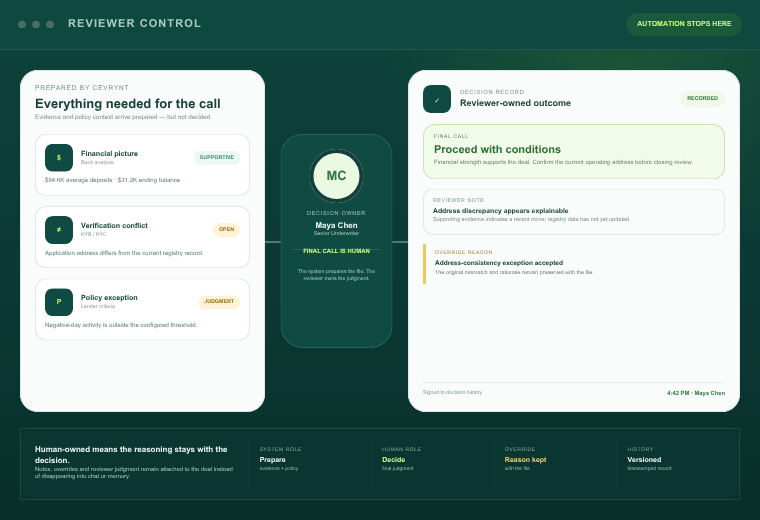
The underwriter reads the report, adds notes, and makes the final call: approve, decline, counter-offer, or request more information. This stage is not optional or ceremonial — it is the point of the entire workflow, and every prior stage exists to make it faster and better-informed, not to replace it.
What good looks like at each handoff
The quality of a connected workflow shows up most clearly at the handoffs between stages — the moments where fragmented systems typically lose information.
- Intake to documents: nothing submitted should require manual re-uploading or re-classification once it has entered the workflow.
- Documents to financials: extracted transaction data should feed directly into cash flow analysis, not require a separate export and re-import.
- Financials to verification: a business name or address discrepancy found during financial review should be visible to whoever is running verification, not rediscovered independently.
- Verification and fraud to policy: policy evaluation should reference the actual verification and fraud findings for that specific file, not a generic checklist.
- Policy to report: the report should show policy outcomes with their underlying reasoning, not just a pass or fail flag.
- Report to human decision: the underwriter should be able to click from any statement in the report back to its source evidence in one step.
Signs your underwriting workflow is still fragmented
Fragmentation is easy to normalize inside a busy underwriting operation, because it has usually been the status quo for years. A handful of concrete signals tend to show up consistently in operations that would benefit from a more connected approach.
- Underwriters routinely have three or more browser tabs or applications open per file just to assemble a full picture.
- The same borrower information — business name, address, requested amount — gets typed into more than one system during a single review.
- A second underwriter reviewing a colleague's decision has to redo significant analysis rather than reviewing existing evidence.
- Turnaround time varies heavily by which underwriter handles a file, rather than by the complexity of the file itself.
- Policy exceptions are tracked in a spreadsheet or email thread rather than attached to the file they apply to.
- Preparing for an investor or compliance audit requires reconstructing decision rationale from memory or scattered notes.
None of these signals point to a single missing feature. They point to the same root cause: information generated at one stage of review is not structurally available at the next. Addressing that is a workflow design problem, and it is the one a connected underwriting platform is built to solve.
What connecting the workflow looks like for different roles
A connected workflow changes day-to-day work differently depending on where someone sits in the underwriting operation. It's worth looking at each perspective separately, since the value is easy to underestimate if you only consider one role.
For the underwriter
The most direct change is time spent per file shifting away from assembly and toward judgment. Instead of opening five systems and reconciling their outputs by hand, an underwriter opens one file that already reflects the connections between documents, financials, verification, and fraud signals. Their attention goes to the parts of the deal that actually require a decision — an unusual pattern worth investigating, a policy exception worth documenting — rather than the mechanical work of assembling a coherent picture in the first place.
For the credit or risk lead
A connected workflow gives credit and risk leadership something that's genuinely hard to get from a fragmented one: consistent, comparable data across every file and every underwriter. When policy evaluation happens the same way for every deal, it becomes possible to actually analyze which policy rules correlate with strong or weak portfolio outcomes over time — an analysis that's far harder to run when policy checks live in individual underwriters' personal spreadsheets and habits.
For operations and leadership
From an operations standpoint, a connected workflow changes what growth actually costs. In a fragmented workflow, review capacity scales roughly linearly with headcount, since each underwriter is doing meaningful manual integration work on every file. In a connected workflow, that integration work is handled structurally, which means deal volume can grow without demanding proportional headcount growth — a distinction that matters directly for unit economics as an MCA funder or alternative lender scales.
How this plays out on a representative file
It helps to walk through how these eight stages connect on a single illustrative file, similar to the Cedar & Stone LLC example used across Cevrynt's product walkthroughs. The business submits three months of bank statements, a completed application, and a driver's license for the owner, bundled into a single PDF through a broker.
At intake, the submission is logged and checked against a completeness checklist; nothing is missing, so the file proceeds immediately. At the documents stage, the combined PDF is separated into its component parts — statements, application, identification — with fields extracted and linked back to their source pages. At financials, deposit trends, average daily balance, and NSF activity get calculated from the extracted transaction data, without anyone re-typing figures from the statements. At verification, the business's registration status and the owner's identity are checked; here, a minor address discrepancy between the application and the state registry gets flagged rather than silently ignored. That flag is visible immediately to whoever handles fraud review, rather than requiring a separate report to be generated and cross-referenced. At the fraud stage, the address discrepancy is weighed alongside the financial data — in this case, everything else checks out cleanly, so the flag is noted but doesn't escalate further. At policy, the deal is evaluated against the lender's specific criteria, with the address discrepancy triggering a documented note rather than an automatic decline, since the underwriter's own judgment ultimately governs that call. The report compiles all of this into one document, and the human decision stage is where the underwriter reads it, confirms the discrepancy is a minor and explainable one, and approves the deal — all without having independently reconstructed each of the preceding steps by hand.
Common mistakes when trying to connect the workflow
Automating a broken sequence instead of fixing it
Adding automation to individual stages without addressing the handoffs between them tends to produce faster fragmentation rather than a faster workflow. A faster bank statement parser does not help much if its output still has to be manually copied into a policy checklist.
Optimizing for speed at the expense of evidence
Some workflow redesigns prioritize turnaround time so heavily that the evidence trail gets thinned out — findings appear without a clear path back to their source. This creates real risk during compliance review or when a decision is later questioned, and it undermines underwriter confidence in the tool itself.
Ignoring how brokers and ISOs feed the front of the workflow
For lenders who rely heavily on broker and ISO submissions, the intake stage is often the weakest link, because submission quality varies widely by source. Our guide on how brokers and ISOs can submit cleaner deals addresses this from the submission side of the relationship.
From here, this article is about Cevrynt
How Cevrynt builds this workflow
Cevrynt's platform is structured around exactly this eight-stage sequence, with evidence carried forward automatically at every handoff. In our product walkthroughs, we use an illustrative deal — Cedar & Stone LLC — to show how a single file moves from a folder of mixed borrower documents to an evidence-backed underwriting report an underwriter can review in one sitting.
Cevrynt does not remove the underwriter from the process at any stage, and it does not issue approvals. It is infrastructure that keeps every stage's output connected to the next, so the person making the final call has a complete, source-linked picture rather than a set of disconnected reports to reconcile by hand.
If your team is evaluating what a connected workflow would look like against your own file mix and credit policy, a qualified walkthrough is the most useful next step.