Brokers and ISOs sit at the front of the underwriting funnel, and the quality of what they submit has an outsized effect on how quickly a funder can move — often more than the underlying strength of the deal itself. A strong deal buried in an incomplete, disorganized submission can take longer to fund than a more marginal deal submitted cleanly. This piece is written from that vantage point: practical steps that improve submission quality and, in turn, speed up decisions.
Why submission quality matters more than it might seem
From a funder's side, every incomplete or unclear submission triggers a request-and-wait cycle that adds calendar days regardless of the deal's actual merit — a dynamic covered in more depth in our piece on underwriting turnaround time. Brokers who consistently submit complete, well-organized packages tend to see faster decisions across the board, not because funders play favorites, but because clean submissions simply require less back-and-forth before real underwriting can begin.
What a complete submission actually includes
- Full, current bank statements covering the lookback period the funder typically requires — usually three to six months — with no missing pages.
- A clearly completed application with consistent business name, address, and ownership details that match across every submitted document.
- Identification for all relevant owners or signers, matching the names on the application and business registration.
- Disclosure of existing financing positions, including any active MCA advances — this is one of the most consequential gaps discussed in our guide on detecting stacking, and proactive disclosure builds trust with funders reviewing the file.
- A voided check or bank letter confirming account details, when required by the specific funder.
Common submission mistakes that slow things down
Inconsistent business details across documents
A business name that appears slightly differently on the application versus the bank statements versus the registration documents will trigger a verification flag that requires manual resolution, even when the discrepancy has an entirely innocent explanation like a DBA or recent rebrand.
Submitting statements out of order or with pages missing
A combined PDF with pages out of sequence or gaps in the statement period forces the underwriter to identify and request the missing information before analysis can proceed — see our broader guide on document intelligence for why this stage matters so much.
Omitting existing financing positions
Beyond the compliance risk, undisclosed existing positions that surface during underwriting review — rather than being disclosed upfront — tend to slow the process down considerably and can damage the broker relationship with the funder over time.
Understanding what funders are looking for at intake
Brokers who understand what a funder's underwriting team actually needs — not just what the application says is required — tend to submit better packages than those who treat intake as a form-filling exercise. From the funder's perspective, the intake package needs to be complete enough that underwriting can begin without a back-and-forth cycle, and clear enough that the business being represented can be independently verified from the materials provided.
That means the documents need to be legible and complete, the details need to be internally consistent, and anything unusual about the deal — an existing MCA position, a business that recently changed ownership, a merchant whose revenue seasonality is unusual for the industry — is better surfaced proactively by the broker than discovered during underwriting. A broker who surfaces complications proactively is easier to work with than one who submits a clean-looking package that produces surprises in review.
How deal quality versus submission quality are different
Submission quality is not the same as deal quality, and the two are worth keeping distinct in a broker's own internal evaluation process. A strong deal can be submitted poorly; a marginal deal can be submitted perfectly. Submission quality affects turnaround time and funder relationship management. Deal quality affects approval odds and offer terms. Brokers who conflate the two — either assuming a strong merchant doesn't need a clean submission, or assuming that a polished submission will carry a genuinely weak file — tend to be surprised in both directions.
The practical implication: invest the same level of submission care across all files, regardless of how strong the deal looks on the surface. A clean submission on a borderline deal can meaningfully improve outcomes, and a sloppy submission on a strong deal is an unnecessary own-goal.
What brokers should know about how funders assess submission history
Funders who work with multiple brokers and ISOs develop a track record for each relationship — not just in terms of deal quality, but submission completeness, accuracy, and the frequency with which incomplete packages or verification issues arise. A broker who consistently submits complete, accurate packages builds credibility that genuinely affects how their deals are prioritized and processed. A broker with a pattern of incomplete or inaccurate submissions creates friction that slows every deal they send, even strong ones.
Brokers who have an existing relationship with a funder can sometimes ask directly for feedback on their submission quality — what's consistently missing, what's being flagged, what would improve turnaround time. This kind of direct feedback is more specific and actionable than any general guide, including this one.
Building a consistent intake checklist
Brokers who consistently perform well with funders often have a standardized internal checklist they run through before submitting any deal — confirming document completeness, cross-checking business details for consistency, and proactively flagging anything unusual before it becomes a funder's question. This upfront discipline pays off directly in faster turnaround and stronger funder relationships over time.
From here, this article is about Cevrynt
How Cevrynt supports brokers and ISOs
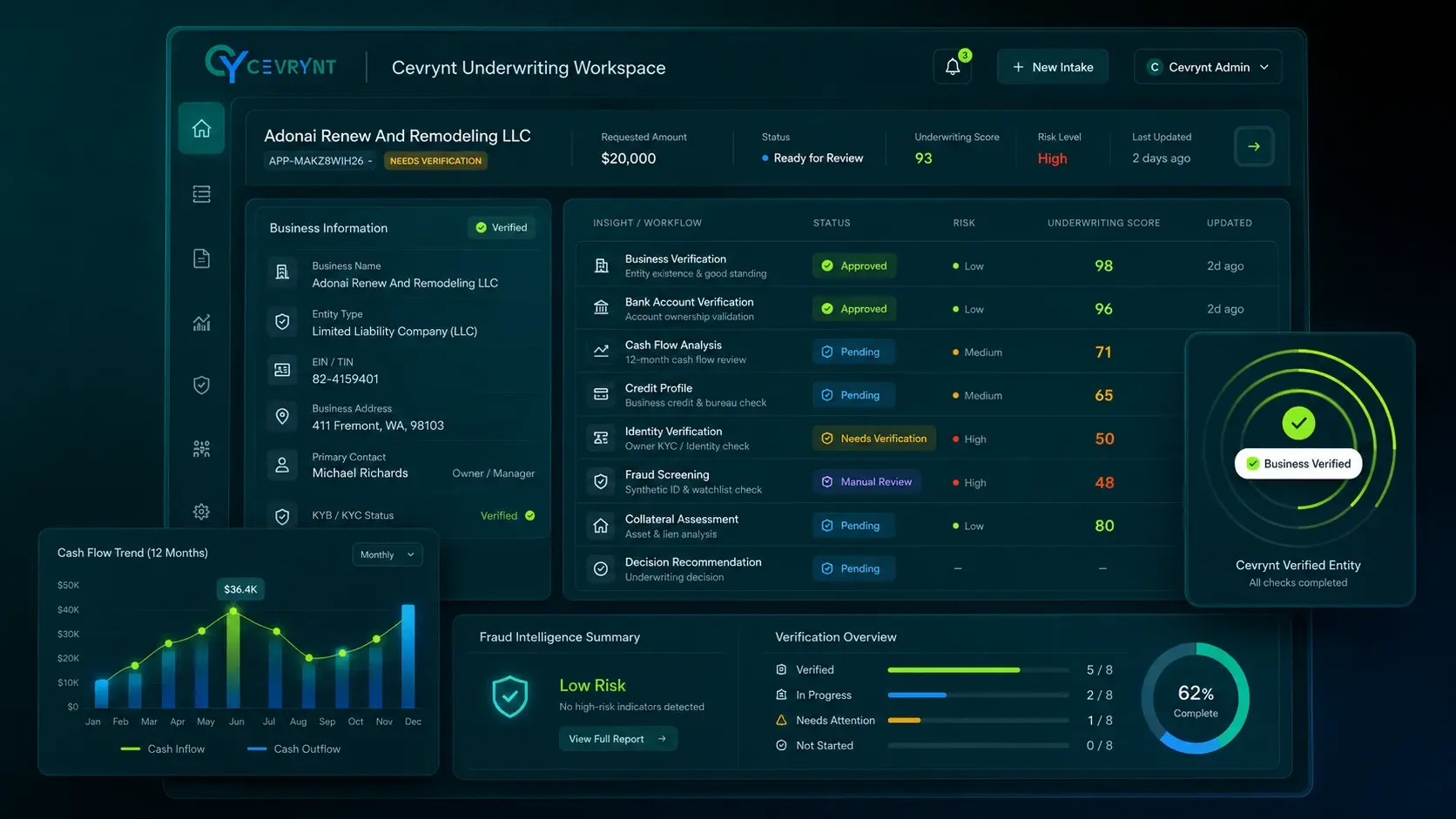
Cevrynt helps funders working with brokers and ISOs identify incomplete submissions and flag missing information earlier in the review process, before a file consumes significant underwriter time on a deal that isn't yet ready for full review. This benefits brokers too — faster, clearer feedback on what's needed means fewer stalled deals and better-informed clients.
For funders interested in how this fits their broker relationships specifically, a qualified walkthrough can walk through the submission and intake workflow in detail.