
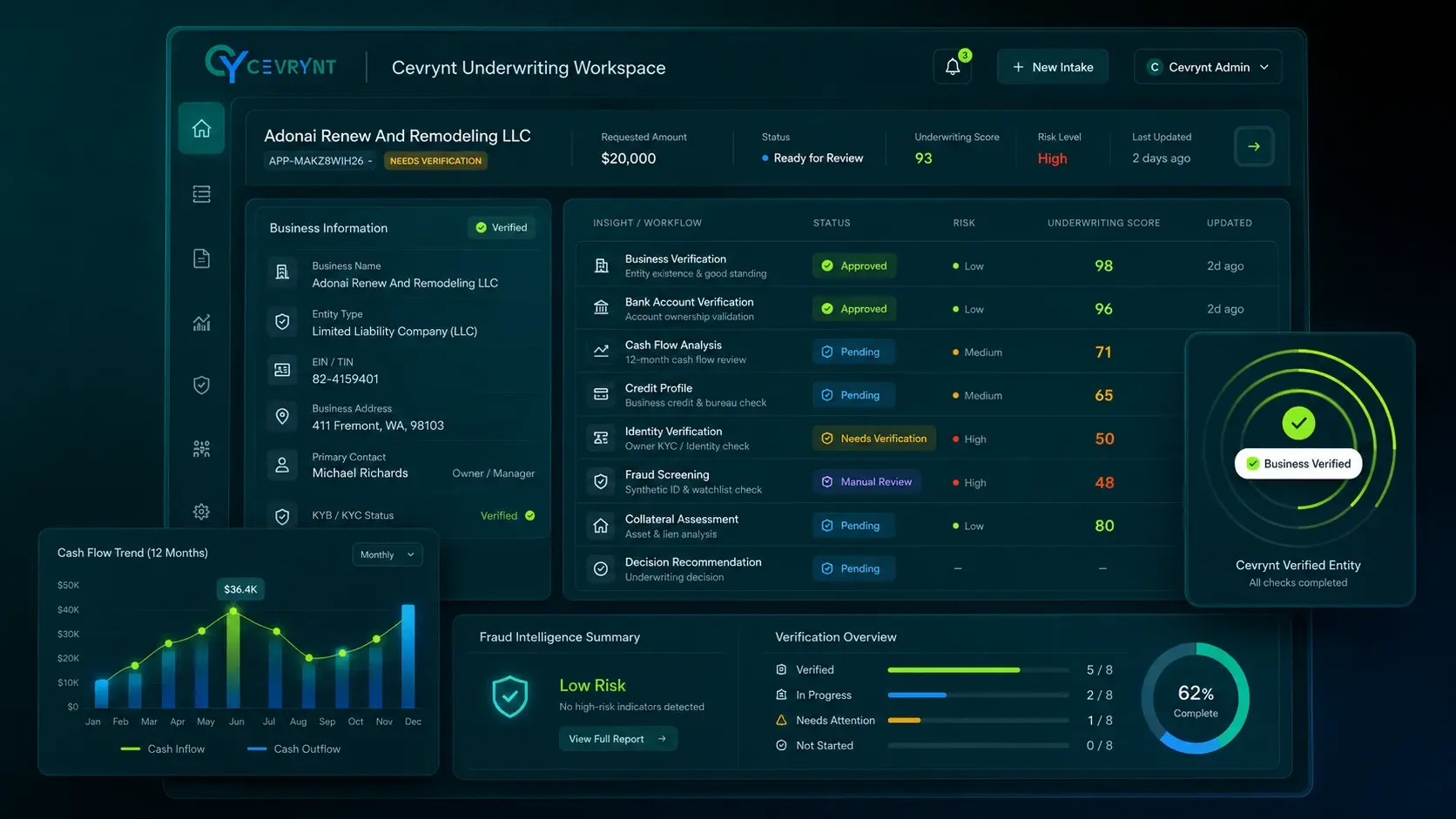
If you asked an MCA underwriting manager to name their biggest operational cost, few would say "sorting PDFs." It doesn't show up on a process map as its own line item, it doesn't get its own budget category, and it rarely gets discussed in the same breath as underwriting model accuracy or funding volume. And yet, for many merchant cash advance funders, manual document handling is one of the largest hidden drags on how many deals a team can review well in a given week.
This piece breaks down where that cost actually comes from, why it is easy to underestimate, and what it means for a funder trying to grow deal volume without proportionally growing headcount.
Where the time actually goes
A typical MCA submission bundles several document types together — recent bank statements, a signed application, a voided check, sometimes tax returns or a driver's license copy — often as one combined file from a broker or ISO. Before any real underwriting analysis can start, someone has to figure out what's actually in that bundle.
Sorting mixed submissions
Separating a combined PDF into its component documents, confirming nothing is missing, and flagging what needs to be requested again — this happens before any cash-flow or verification work begins, and it happens on every single file, regardless of how straightforward the underlying deal turns out to be.
Re-keying information across systems
Business name, requested amount, statement periods, and other basic details often get typed manually into multiple systems — a CRM, an underwriting worksheet, a policy checklist — because those systems don't share a common data layer. Every re-entry point is also a new opportunity for a transcription error to enter the file.
Chasing missing or unclear documents
Incomplete submissions are common, especially from newer brokers or first-time applicants. Identifying what's missing, requesting it, and waiting for a resubmission adds calendar days to a deal's timeline even when the underlying credit decision would have been quick.
Why this cost is easy to underestimate
Manual document handling is invisible in most operational metrics because it gets absorbed into a broader "time to decision" number rather than measured on its own. A funder tracking average turnaround time sees the total, but rarely breaks out how much of that total was actual credit analysis versus document wrangling.
It is also a cost that scales in an uncomfortable way. Adding a new broker relationship or a new referral channel increases deal volume, but it can also increase the variability of submission quality — meaning the document-handling burden can grow faster than deal volume itself if intake isn't standardized.
How to estimate the real cost for your team
- Time a sample of files from submission received to "ready for financial analysis," separate from the analysis itself.
- Track resubmission rates — what share of files require a follow-up request for missing or unclear documents.
- Ask underwriters directly how much of their day feels like document handling versus judgment calls. Their intuition is often more accurate than official process metrics.
- Compare turnaround consistency across underwriters and across broker sources — large variance often points to document-handling friction rather than credit-policy differences.
What changes when document handling is structured
When intake and document classification are handled systematically rather than manually, the effect isn't just faster processing — it's more consistent processing. Every file gets the same completeness checks applied the same way, regardless of which underwriter picks it up or which broker submitted it. That consistency matters as much as the raw time savings, particularly for funders trying to standardize review across a growing team.
It also changes what underwriters spend their attention on. Removing sorting and re-keying work doesn't just save minutes — it shifts the underwriter's cognitive load toward the parts of the file that actually require judgment: unusual deposit patterns, verification conflicts, policy edge cases. Our guide to decision intelligence in underwriting goes deeper on this shift in focus.
A rough model of how this cost compounds with growth
Consider a funder processing a fixed number of files per week with a fixed underwriting team, where document handling consumes a meaningful share of each underwriter's time on every file. As deal volume grows — whether from new broker relationships, expanded marketing, or organic demand — that per-file document-handling time doesn't shrink; it simply gets multiplied by more files. Eventually, the team either needs to hire proportionally, which erodes the unit economics of growth, or turnaround time starts to degrade as the existing team absorbs more volume than the manual process can comfortably handle.
This dynamic is easy to miss because it develops gradually. A funder doesn't usually experience a single dramatic breaking point — instead, turnaround time creeps upward, resubmission backlogs grow, and underwriter overtime becomes more common, all attributable in hindsight to the same root cause: document handling that didn't scale with volume.
Why this is often the first place worth fixing
Among the various stages of underwriting review, document handling is frequently the highest-leverage place to start improving, for a specific reason: it's a largely mechanical, repetitive task rather than one requiring nuanced judgment. Financial analysis, verification, and policy evaluation all benefit from structure too, but they still involve genuine judgment calls that a lender may want to approach carefully. Document classification and organization, by contrast, is closer to pure administrative overhead — which makes it both lower-risk to change and often the fastest source of measurable time savings for a team just beginning to modernize their underwriting workflow.
From here, this article is about Cevrynt
How Cevrynt removes this bottleneck
Cevrynt's Document Intelligence stage classifies and organizes submitted files automatically, flags missing or incomplete documents before a file reaches full review, and extracts decision-relevant fields with a link back to the exact source page — so an underwriter starts financial analysis with an already-organized file instead of a folder of mixed PDFs.
For funders working through brokers and ISOs, this also means submission quality issues get caught earlier, before a file consumes underwriter time on a deal that isn't actually ready for review. A qualified walkthrough is the most direct way to see how this applies to your own submission mix.