
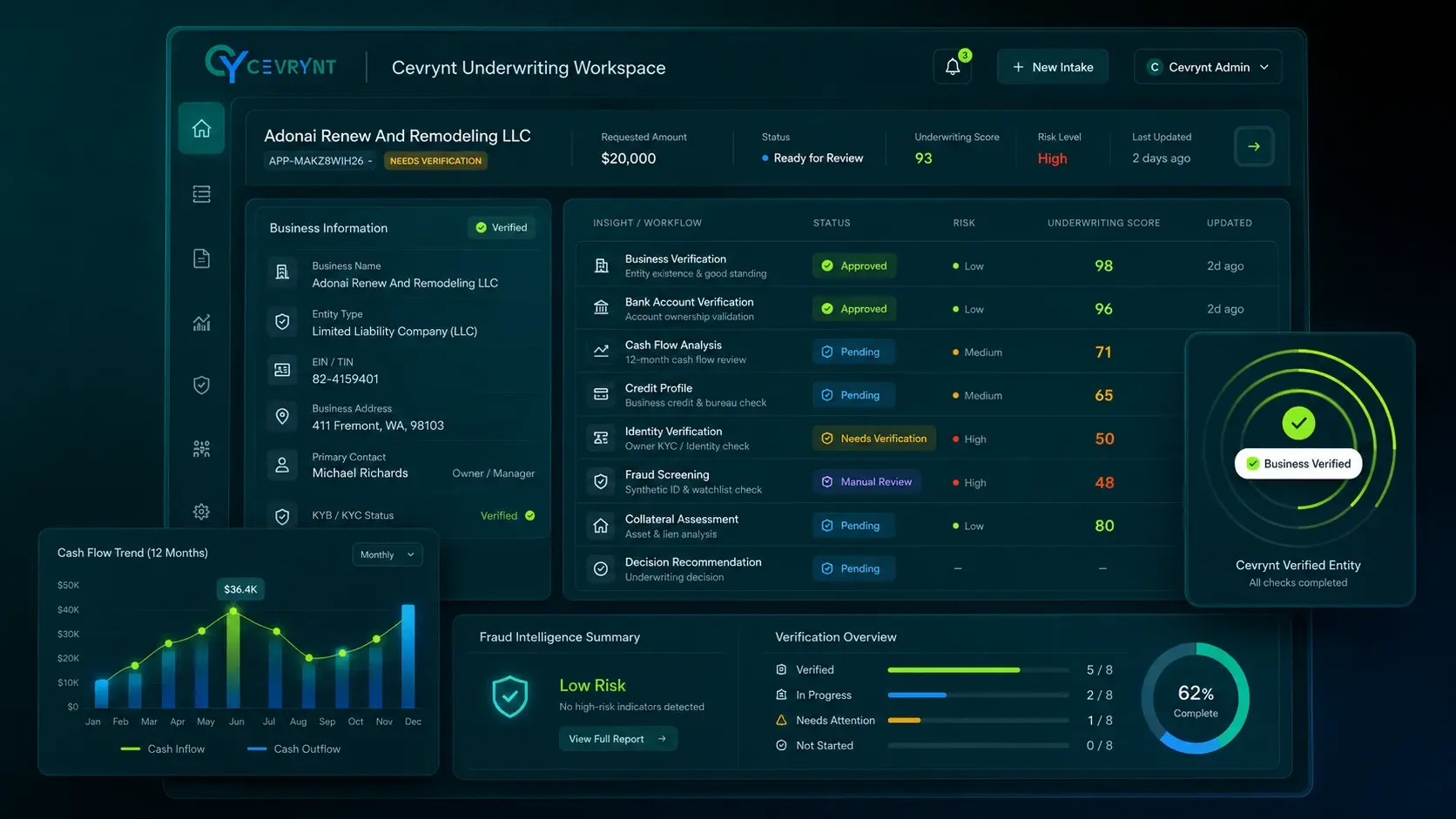
The market for merchant cash advance underwriting software has grown crowded enough that most funders and ISOs will sit through several vendor demos before making a decision. Most of those demos will look reasonably similar on the surface — a clean dashboard, a curated example deal, confident claims about speed and accuracy. The differences that actually matter for your operation tend to show up only when you push past the demo script, which is what this guide is meant to help you do.
Start with your own workflow, not the vendor's feature list
Before evaluating any specific product, map out your current underwriting workflow honestly — where document handling actually happens, how bank statement analysis gets done today, how verification and fraud checks fit in, and where the real bottlenecks are. Our piece on underwriting turnaround time offers a useful framework for this. Without this baseline, it's easy to be impressed by a feature that doesn't actually address your biggest pain point.
What to test in a vendor evaluation
Bring your own messy file
Demo files are curated to look good. Bring a real, representative file from your own pipeline — ideally one that was genuinely difficult to underwrite manually — and ask the vendor to show exactly how their system handles it, not a rehearsed walkthrough of a clean example.
Check document handling on mixed submissions
As covered in our document intelligence guide, classification and extraction quality on genuinely mixed, disorganized submissions is where document handling tools most often fall short of their marketing claims.
Test bank statement coverage against your actual lender mix
If your applicant pool skews toward smaller regional banks or credit unions, ask specifically how the tool handles formats outside the largest national institutions — coverage gaps here directly affect real-world usability.
Verify stacking and fraud detection with a known example
If you have a past file where stacking or fraud was identified manually, run it through the tool and see whether it surfaces the same signals. This is a far more useful test than any vendor's abstract accuracy claims. See our guide on detecting stacking for the specific signals worth checking.
Ask how the tool handles your specific credit policy
A generic policy template that doesn't reflect your actual underwriting criteria will require workarounds from day one. Ask to see your own policy rules configured directly, not adapted to fit the vendor's existing framework.
Questions to ask beyond the product demo
- Where does human review fit in the workflow, exactly? Get specific about which decisions, if any, the system makes without underwriter involvement.
- How are overrides and exceptions documented? See our guide to policy exceptions for what a good answer looks like.
- What does onboarding and data migration actually involve? Understand the real timeline and effort, not just the sales team's estimate.
- How is data security and access control handled? This deserves a dedicated conversation, not a single slide in a sales deck.
- What does pricing scale with? Deal volume, seat count, and feature tiers all affect total cost differently as your operation grows.
What good integration and implementation support actually looks like
Implementation is where the gap between a compelling demo and a functional deployment often becomes visible. A vendor who delivers a clean demo but provides shallow onboarding support will leave your team configuring a new tool while simultaneously running your existing underwriting volume — a combination that creates significant friction. During evaluation, push specifically on: What does the onboarding process look like, step by step? Who is responsible for configuring your specific credit policy rules? What testing is done before go-live, and against what files? Is the onboarding scope written into the contract, or described verbally?
The right answer varies by vendor and deal structure, but you should have a clear, written picture of what the implementation involves before signing. 'We'll figure out the details once you're a customer' is a flag worth taking seriously.
Evaluating data security and access control
Underwriting software handles some of the most sensitive financial documents a business produces — bank statements, tax returns, identity documents. The security and access control practices of any vendor you consider deserve explicit scrutiny, not just a single slide in a sales deck. Questions worth asking: How is data stored and for how long? Who within the vendor has access to your applicant data? Is access logged? How is data handled at contract end or termination? Is the vendor willing to share a security overview, SOC 2 report, or equivalent independent assessment?
Cevrynt's approach to data security is discussed on our dedicated Security page. For any vendor, the answers to these questions should be clear, specific, and available before you're a customer — not a post-sale conversation.
Build vs. buy: when to consider building internally
Some larger MCA funders and alternative lenders eventually consider building proprietary underwriting tooling rather than purchasing a vendor solution. The cases where this makes sense are narrower than they might appear. Building internally requires sustained engineering investment, specialized expertise in financial document processing and bank statement analysis, and ongoing maintenance as document formats, bank APIs, and fraud patterns evolve. The operational cost of keeping custom-built tooling current is frequently underestimated at the time the build decision is made.
The build-vs-buy question typically favors buying for underwriting functionality that isn't a direct source of competitive differentiation — classification, extraction, consistency checking, policy evaluation. It may favor building for functionality that is uniquely specific to the lender's own risk model and would be difficult to express through any vendor's configuration tools. Most lenders find that the core underwriting workflow falls into the former category, and the genuinely proprietary parts of their risk model can be expressed through a well-designed vendor's policy configuration layer rather than built from scratch.
Red flags worth taking seriously
- A vendor that can't clearly explain where automated findings end and human decisions begin.
- Reluctance to test the tool against your own messy, real-world files.
- Accuracy or approval-rate claims presented without any way to verify them against your own portfolio.
- A policy configuration process that requires ongoing vendor engineering involvement for basic changes.
- No clear answer on how evidence links back to source documents for audit purposes.
From here, this article is about Cevrynt
How Cevrynt fits this evaluation
Cevrynt is built specifically for merchant cash advance underwriting, connecting document handling, bank statement analysis, business verification, fraud signals, and policy evaluation into one evidence-linked workflow. Every finding traces back to its source, policy evaluation reflects your own credit criteria, and the underwriter makes the final call in every case — Cevrynt is not a lender and does not issue funding decisions.
If you're in the middle of an evaluation process, a qualified walkthrough using your own representative file is the most useful next step, and exactly the kind of test this guide recommends running with any vendor.