
"We need to move faster" is one of the most common goals underwriting leaders bring to a technology evaluation, and it's usually stated as if speed were a single dial that can simply be turned up. In practice, underwriting turnaround time is the sum of many smaller delays scattered across a workflow, and most attempts to improve it fail because they target the wrong stage — often the analysis itself, when the real time loss is happening in the handoffs between stages.
Where turnaround time actually goes
A useful exercise for any underwriting team trying to improve turnaround time is to break a typical file's lifecycle into discrete stages and time each one separately, rather than tracking only the total. Doing this consistently across several lenders tends to reveal the same pattern: the actual credit analysis — reviewing cash flow, checking policy fit — often takes less total time than the surrounding administrative and handoff work.
Intake and document sorting
As covered in our piece on the hidden cost of manual document review, organizing a mixed submission before any real analysis can start is a significant, often underestimated time sink on its own.
Waiting on missing information
Incomplete submissions require a request-and-wait cycle that adds calendar days regardless of how quickly the eventual analysis happens once everything is in hand. This is particularly common with broker and ISO submissions where quality varies by source.
Manual handoffs between review stages
When financial analysis, verification, and fraud review happen in separate tools or by separate people, the file itself often sits idle in a queue between stages, waiting for the next person's attention — time that doesn't show up as "analysis time" but very much counts toward total turnaround.
Reconciling disconnected findings before a decision
Before an underwriter can actually decide, they often need to manually assemble findings scattered across separate systems into one coherent picture — a step that takes real time but produces no new analytical insight, purely administrative reconciliation.
Why measuring only the total misleads
A lender tracking only overall turnaround time — submission to decision — sees a single number that obscures where the time actually goes. This makes it easy to misattribute slow turnaround to "underwriters need to work faster" or "we need a better scoring model," when the actual bottleneck is intake friction or handoff delay that no amount of underwriter effort or model sophistication would fix.
What to measure instead
- Time from submission to "file complete" — how long it takes before a file has everything needed to begin real analysis.
- Time in each review stage — document handling, financial analysis, verification, fraud review, policy evaluation — tracked separately.
- Queue time between stages, not just active work time — the gap between one stage finishing and the next starting.
- Resubmission rate, since files requiring follow-up requests add disproportionate calendar time relative to their share of total files.
Why fixing fragmentation beats fixing any single stage
Speeding up one stage in isolation — a faster bank statement parser, a quicker verification lookup — produces limited overall improvement if the file still has to wait in queues between disconnected systems and get manually reconciled before a decision. Real turnaround improvement tends to come from connecting the stages so information flows automatically from one to the next, which is the core idea behind our broader guide to building a connected underwriting workflow.
How turnaround time pressure differs by lender type
High-volume MCA funders
For funders processing a high volume of smaller merchant cash advance deals, turnaround time pressure is largely about throughput — how many files a fixed underwriting team can move through per week without quality degrading. Fragmentation costs compound quickly at this volume, since even a small amount of manual reconciliation per file adds up to a significant chunk of total team capacity.
Brokers and ISOs competing on speed
For brokers and ISOs, turnaround time is a direct competitive factor with their merchant clients, who often compare offers across multiple funding sources. A broker whose submissions consistently move faster through a funder's underwriting process — because they're complete and well organized — effectively offers their clients a better experience, independent of the underlying credit terms.
Larger, more complex commercial deals
For larger or more complex deals, turnaround time pressure is less about raw throughput and more about avoiding unnecessary delay on deals where the borrower has time-sensitive needs — a seasonal inventory purchase, an opportunity with a closing deadline. Here, fragmentation-driven delay can mean losing a deal entirely to a faster-moving lender, not just a productivity loss.
A practical starting point for measuring your own turnaround time
Teams that haven't previously broken down turnaround time by stage often find it useful to start small: pick ten recent files, and for each one, note the timestamp when the submission arrived, when it was confirmed complete, when financial analysis finished, when verification and fraud review finished, when policy evaluation finished, and when the final decision was made. Even this modest sample size, done honestly, usually reveals a clear pattern — a specific stage or handoff that consistently takes disproportionately long relative to the others. That pattern is a far more actionable starting point than a single average turnaround number.
From here, this article is about Cevrynt
How Cevrynt improves turnaround without cutting corners
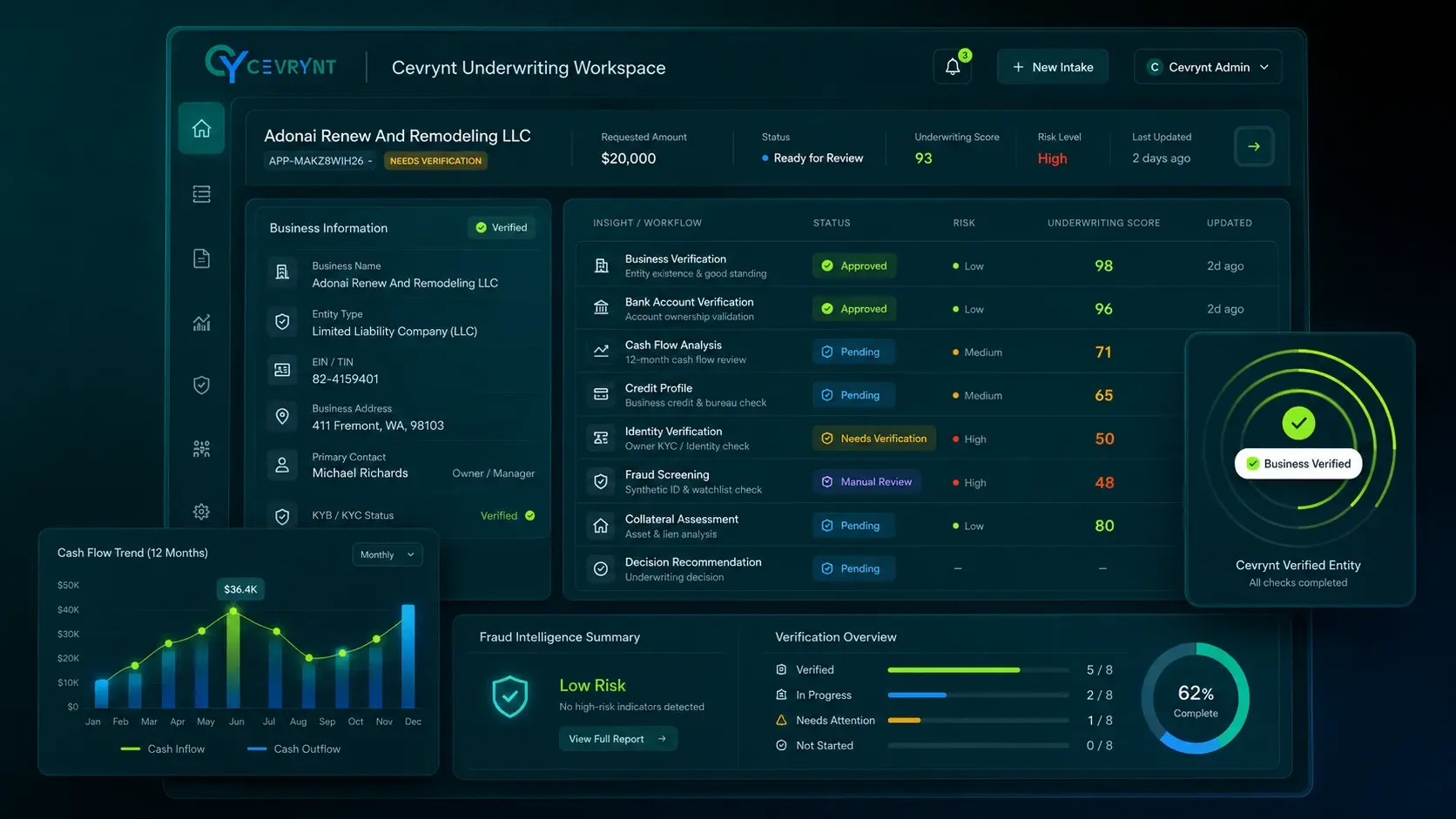
Cevrynt's platform connects intake, document handling, financial analysis, verification, fraud signals, and policy evaluation so findings flow automatically between stages instead of sitting in a queue waiting for manual handoff. This targets the handoff friction directly, rather than only speeding up any single stage in isolation — which is where most of the turnaround-time improvement actually comes from.
This is designed for alternative lenders trying to grow deal volume without proportionally growing headcount, while keeping the underwriter's final decision fully intact. A qualified walkthrough can walk through what this looks like against your own current turnaround metrics.