
A growing share of small business financing demand comes from merchants who operate primarily or entirely online — through Shopify, marketplace platforms, or a mix of commerce channels. Underwriting these businesses well requires adapting traditional SMB underwriting approaches to account for how e-commerce revenue actually behaves, which differs in real ways from a brick-and-mortar business's cash flow pattern.
This growth is not a niche trend. Shopify alone reported originating $1.4 billion in business loans and merchant cash advances in a single recent quarter, up substantially year over year, according to reporting from Let's Submit — underscoring how significant commerce-platform-originated financing has become for alternative lenders paying attention to this segment.
How e-commerce revenue differs from traditional SMB revenue
Payout timing versus sales timing
A brick-and-mortar business generally deposits revenue close to the time of sale. An e-commerce merchant often sees a delay between a sale and the corresponding payout landing in their bank account, since payment processors and platforms typically batch and remit funds on their own schedule. Bank statement analysis that doesn't account for this timing gap can misread genuinely healthy revenue as inconsistent.
Multi-channel revenue fragmentation
Many e-commerce sellers operate across several channels simultaneously — their own Shopify store, one or more marketplaces, sometimes wholesale — with revenue landing in the bank account from multiple distinct sources at different times. A complete underwriting picture needs to account for the full revenue picture across channels, not just what's visible from a single platform's data.
Seasonality tied to commerce cycles
E-commerce businesses often show pronounced seasonality tied to retail calendar events — holiday shopping periods, seasonal product categories — that can look like volatility in a naive analysis but reflects entirely normal, predictable patterns for the business model. Distinguishing this from genuine instability requires either enough historical data or category-specific context, similar to the seasonality challenge discussed in our broader guide to cash flow underwriting.
Platform and processor fees as a distinct expense category
Marketplace and payment processing fees represent a meaningful and fairly predictable expense category unique to e-commerce operations, worth categorizing distinctly rather than folding into generic operating expenses when assessing true margin and cash flow.
Reading processor payouts versus bank deposits correctly
When underwriting e-commerce merchants using bank statement analysis, one of the most consequential classification decisions is how to treat processor payouts — the regular remittances from Shopify Payments, Stripe, PayPal, Amazon Seller Central, and similar platforms. These are revenue-originating deposits, but they behave differently from a typical business-to-business payment: they come in at regular intervals set by the platform's remittance schedule, they often contain net-of-fee amounts (the gross sale minus the platform's take), and they may carry holding periods during which the platform retains funds before releasing.
Correctly identifying these deposits as revenue, calculating the gross-to-net relationship where relevant, and distinguishing remittance timing patterns from irregular revenue are all important steps in producing an accurate cash flow picture for e-commerce merchants. An underwriting approach that treats these deposits as routine business deposits without any category-specific handling risks both over- and under-stating revenue depending on the specific payout pattern.
The underwriting implications of platform-originated financing
A meaningful and growing share of e-commerce merchant financing originates directly through the platforms merchants sell on — Shopify Capital, Amazon Lending, similar programs. These are relevant to underwriting in two ways. First, as potential existing obligations: a merchant that already has platform-originated financing will show specific repayment deductions in their payout amounts or their bank activity, which represent existing debt service commitments an underwriter needs to account for. Second, as context for the merchant's relationship with the platform: a merchant who has previously received platform financing and repaid successfully has a demonstrated repayment history, even if it doesn't show up in traditional credit bureau data.
For alternative lenders providing additional financing alongside or after platform programs, understanding these dynamics — both the deductions and the prior repayment record — produces a more accurate picture of the merchant's financial situation than bank statement analysis alone would show.
Verification considerations specific to e-commerce merchants
E-commerce businesses sometimes have a lighter traditional footprint than brick-and-mortar operations — no physical storefront, potentially newer registration if the business started as an online-only venture. This doesn't make them inherently riskier, but it does mean verification approaches built primarily around physical business signals need to adapt, incorporating storefront and marketplace presence as additional legitimate verification signals alongside standard business verification checks.
What this means for underwriting workflow design
- Adjust cash flow analysis for payout timing lag, rather than treating a delayed deposit pattern as inconsistency.
- Look across multiple revenue channels when assessing total business revenue, not just what's visible in the primary bank account.
- Apply category-aware seasonality context for known e-commerce sales cycles.
- Categorize platform and processor fees distinctly from general operating expenses for a clearer margin picture.
- Adapt verification to account for lighter physical footprints without lowering the underlying verification standard.
From here, this article is about Cevrynt
How Cevrynt supports e-commerce merchant underwriting
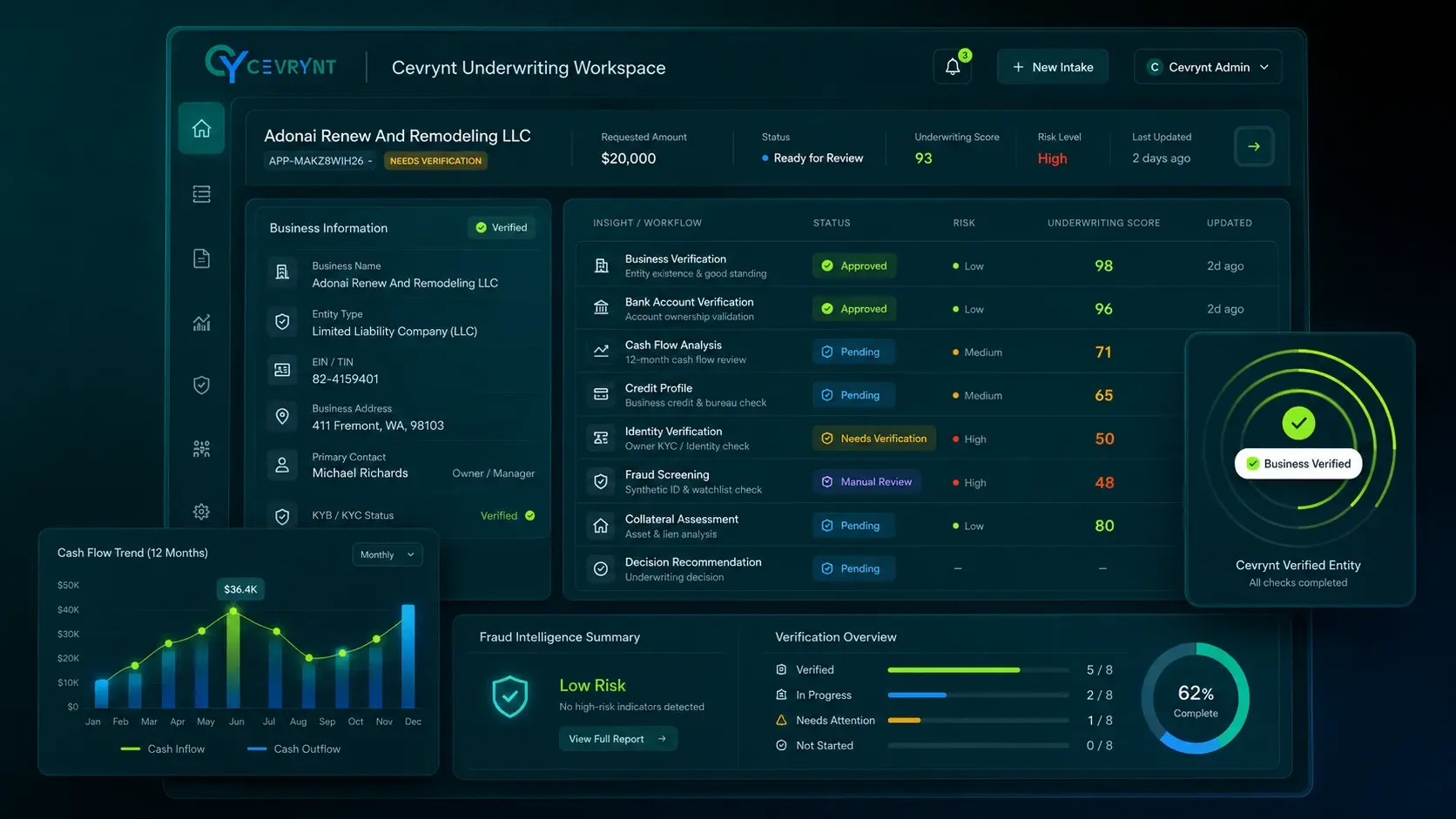
Cevrynt's e-commerce merchant underwriting solution brings commerce-context signals into the same evidence-backed workflow used across Cevrynt's platform, combining bank statement analysis with business verification adapted for online-first merchants. This is also the workflow context behind the Cevrynt × SHOPLINE partnership — a documented development and referral relationship exploring e-commerce merchant-underwriting workflows, not a live automatic-eligibility integration.
As with every Cevrynt workflow, lenders retain full decision authority — Cevrynt structures the evidence, the underwriter makes the call. A qualified walkthrough can go deeper into how this applies to your e-commerce merchant pipeline specifically.