
Revenue-based financing (RBF) has grown into a distinct category of alternative lending, sitting alongside merchant cash advances and traditional term loans as a way for businesses — particularly subscription and e-commerce businesses — to access capital without giving up equity or committing to a fixed repayment schedule unrelated to their actual revenue. Underwriting RBF deals well requires a somewhat different lens than traditional term loan underwriting, because the repayment mechanism itself is structurally different.
How RBF repayment structure changes the underwriting question
A traditional term loan has a fixed repayment schedule regardless of how the business performs — the underwriting question is largely "can this business reliably make this fixed payment every month." RBF repayment, by contrast, typically scales with revenue — a percentage of monthly top-line, meaning payments naturally rise and fall with the business's performance. This reframes the underwriting question toward "how predictable and durable is this business's revenue," since the financing itself is designed to flex with revenue rather than demand a fixed amount regardless of conditions.
What underwriters should weigh differently for RBF
Revenue durability over absolute level
Because repayment scales with revenue, the absolute revenue level matters less on its own than how durable and predictable that revenue is likely to be going forward. A business with strong current revenue but high customer concentration or churn risk presents a different RBF risk profile than one with more modest but highly recurring revenue.
Revenue composition and recurrence
For subscription businesses, the mix of recurring versus one-time revenue matters significantly, since recurring revenue provides a more predictable base for scaling repayment. For e-commerce sellers, understanding repeat-purchase behavior serves a similar function — see our related guide on e-commerce merchant underwriting for more on how commerce-specific revenue patterns get evaluated.
Growth trajectory, not just current snapshot
Since RBF repayment amounts naturally track revenue growth or decline, the trend direction carries more underwriting weight than it might for a fixed-payment product, where the business's ability to cover a flat payment matters more than its growth trend specifically.
Where cash flow underwriting principles still apply
Despite the structural differences, RBF underwriting still relies heavily on the core cash flow underwriting principles covered in our broader guide: understanding deposit patterns, existing obligations, and operating cushion. The difference is less about which data matters and more about how it gets weighted and interpreted against a repayment structure that flexes with performance rather than staying fixed.
How cap and term work in RBF and why they matter for underwriting
Revenue-based financing deals are typically structured with a repayment cap — the total amount the business will pay before the financing is fully retired — expressed as a multiple of the advance amount. A $100,000 advance with a 1.5x cap means the business repays $150,000 total, regardless of how long that takes. Because the monthly payment scales with revenue, the actual time to full repayment varies: higher-performing months retire the financing faster, lower-performing months extend it.
This structure has direct underwriting implications. The underwriting question isn't just whether the business can make payments — it will always make some payment as long as it's generating revenue — but whether the combined repayment burden (the periodic revenue percentage committed to this deal plus any other existing obligations) is sustainable at expected revenue levels without materially compressing the business's operating margins. A business where 12% of revenue is committed to RBF repayment on top of existing obligations may not have enough margin to fund operating costs at lower revenue points in their seasonal cycle.
Underwriting RBF for e-commerce versus SaaS businesses
RBF is used across multiple business types, but the specific revenue signals that matter most differ meaningfully between e-commerce merchants and SaaS or subscription businesses. For e-commerce merchants — a segment covered in depth in our guide to e-commerce merchant underwriting — the key revenue signals are repeat purchase rates, category-relevant seasonality patterns, and platform diversification (multi-channel revenue is more durable than single-channel dependence).
For subscription and SaaS businesses, the key signals are monthly or annual recurring revenue, churn rate, and expansion versus contraction in the customer base. A SaaS business with high gross revenue but a churn rate that implies significant near-term revenue decline is a different risk profile from one with identical revenue and low, stable churn — even though their bank statements in the current period might look nearly identical.
Common mistakes in RBF underwriting
Overweighting current revenue, underweighting trend
Because RBF repayment depends on future revenue, a business's current revenue matters less than where it's heading. A business with strong current revenue on a declining trajectory may look better at origination than it will perform over the financing term.
Treating all revenue types as equivalent
Recurring revenue and project-based or one-time revenue carry very different repayment reliability implications for RBF. A business whose revenue appears strong because of a large one-time contract that won't recur is a different risk than a business with equally strong but recurring subscription revenue.
Ignoring existing RBF or MCA positions
Just as with MCA underwriting, the presence of existing revenue-sharing or debt-service obligations needs to be identified and accounted for before underwriting a new deal. A business already committing 10% of revenue to an existing RBF deal has significantly less capacity for additional revenue-based commitments than its gross revenue level would suggest.
Policy considerations specific to RBF
Lenders offering RBF alongside other products — MCA, term loans — generally need distinct policy criteria for each, since the risk factors that matter most genuinely differ by structure. A policy engine that supports multiple distinct policy sets for different products, rather than forcing every deal type through the same generic criteria, is particularly valuable for lenders operating across these different structures.
From here, this article is about Cevrynt
How Cevrynt supports revenue-based financing underwriting

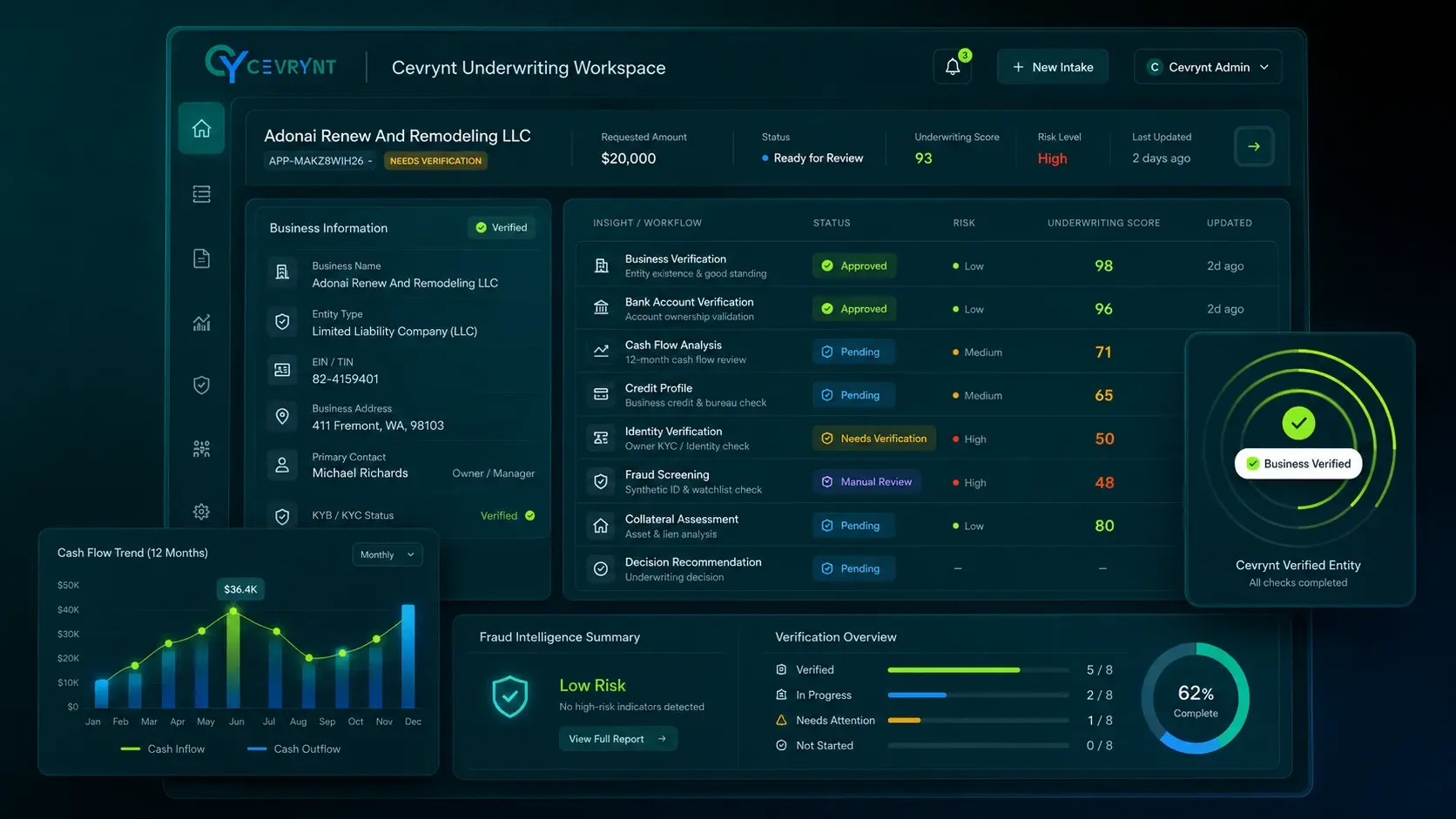
Cevrynt's Bank Statement Analysis and Policy Engine can be configured to reflect the specific criteria relevant to revenue-based financing, alongside other products an alternative lender may offer. Revenue trend, composition, and durability signals are surfaced alongside the same evidence-linked workflow used across Cevrynt's platform.
A qualified walkthrough is the best way to discuss how this applies to your specific RBF underwriting criteria, especially if you're evaluating this alongside other product lines.