
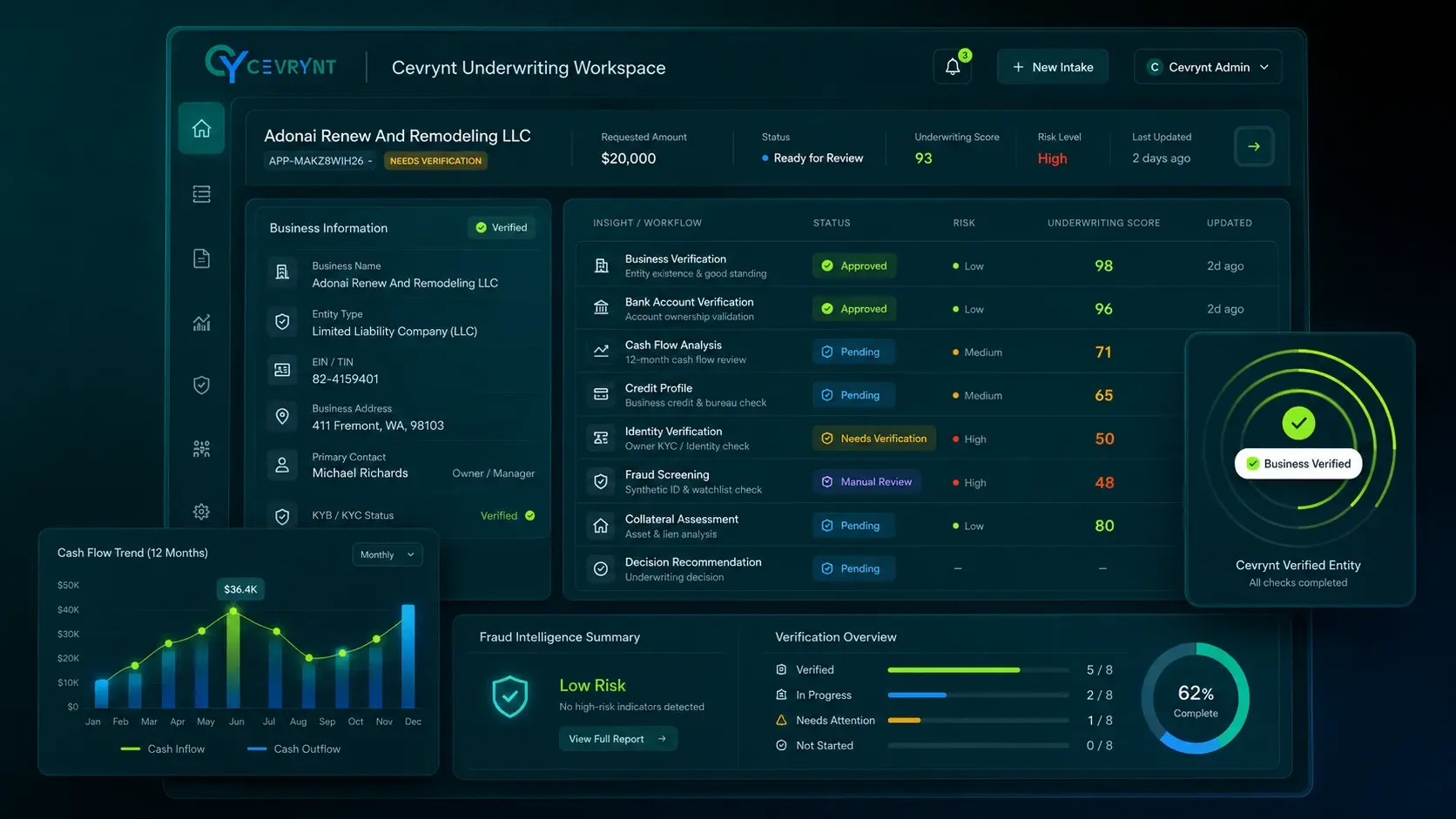
Traditional credit underwriting leans heavily on static numbers: a credit score, a debt-to-income ratio, a snapshot balance sheet. Cash flow underwriting takes a different approach, common across SMB and alternative lending, that looks at how money actually moves through a business over time — what comes in, what goes out, how consistently, and under what stress. For merchant cash advance and short-term working capital products, this is usually the more relevant lens, because repayment happens out of ongoing operating cash flow, not from a static asset base.
This piece lays out what cash flow underwriting actually involves for underwriting, credit, and risk teams evaluating SMB deals.
Why cash flow matters more than static financials for SMB lending
Small businesses are volatile by nature. A restaurant's revenue looks different in December than in February. A construction contractor might have irregular, lumpy deposits tied to project completion rather than smooth monthly revenue. Static financial snapshots — a single balance sheet date, a single credit score — miss this texture entirely. Cash flow underwriting, by contrast, looks at a rolling window of actual account activity, which captures both the level and the pattern of a business's financial life.
The building blocks of cash flow underwriting
Inflow analysis
This starts with identifying genuine revenue deposits and distinguishing them from transfers, loan proceeds, or other non-operating inflows that could otherwise inflate an apparent revenue picture. Getting this classification right is foundational — everything downstream depends on it. Our guide to bank statement analysis covers how this typically works.
Outflow analysis
Understanding recurring expenses — payroll, rent, existing debt service, supplier payments — shows how much of incoming cash is already committed before a new advance or loan payment would need to be serviced. This is where existing MCA positions and other debt obligations become visible.
Volatility and seasonality
A business with genuinely seasonal revenue (landscaping, holiday retail) needs to be evaluated differently than one with unexplained volatility that doesn't map to any obvious seasonal pattern. Distinguishing the two requires enough historical data and enough industry context to tell a normal cycle from a warning sign.
Buffer and resilience
Average daily balance and the frequency of low-balance or NSF events show how much cushion a business actually has. Two businesses with identical monthly revenue can have very different resilience if one consistently operates near zero balance and the other maintains a healthy buffer. See our piece on average daily balance and DSCR for how these get calculated in practice.
How cash flow underwriting differs by loan product
Merchant cash advances
For MCA specifically, the relationship between deposit volume and repayment capacity is tighter than for other products, since MCA advances typically take a fixed daily or weekly amount regardless of how well the business performs that particular week. This makes both the level and the consistency of deposits particularly important: a business whose deposits swing wildly from week to week may have adequate monthly totals while still struggling to maintain a consistently positive balance between debit dates.
Term loans
Traditional term loans have a fixed monthly payment that doesn't scale with revenue. Here, the underwriting question is narrower: can this business reliably cover this specific monthly payment amount, regardless of whether revenue is growing or flat? Average daily balance and the absence of stress signals like NSF patterns are still important inputs, but the threshold question is different — sufficiency versus durability.
Revenue-based financing
For revenue-based financing, where repayment scales as a percentage of revenue, the focus shifts toward revenue durability and trend direction more than absolute cash flow level. A declining revenue trend matters more for RBF risk than it would for a fixed-payment product, since declining revenue means declining repayments, which can extend the financing term indefinitely if the underlying trend doesn't recover. Our dedicated guide to revenue-based financing underwriting covers this in more depth.
The role of industry context in reading cash flow signals
Cash flow patterns that would be alarming in one industry are routine in another. A landscaping business with near-zero deposits in January and February isn't exhibiting distress — it's following a seasonal pattern common to the entire industry. A retail business with a sharp revenue spike in November and December isn't showing unusual growth — it's experiencing a predictable holiday pattern. Evaluating these patterns without industry context produces a misleading picture in both directions: penalizing healthy seasonal businesses and potentially missing genuine distress that's being masked by a recent good month.
This context doesn't have to come from a complex industry database. Even basic knowledge of a business's SIC code or self-reported industry, combined with a long enough lookback window to observe at least one seasonal cycle, is usually enough to distinguish normal patterns from genuine variance worth investigating further.
How to build a cash flow underwriting framework that holds up at scale
Cash flow underwriting done well in a small team — where one or two experienced underwriters apply nuanced judgment to every file — can work reliably. The challenge is maintaining that quality as volume grows. When a team goes from reviewing twenty files a week to two hundred, informal judgment-based approaches tend to break down: different underwriters interpret the same signals differently, thresholds drift, and the institutional knowledge behind good decisions becomes hard to transfer to newer team members.
A scalable cash flow underwriting framework generally has three properties. First, it defines explicitly which metrics are being calculated and how, so results are comparable across every file and every underwriter. Second, it documents which thresholds trigger which outcomes — not as a rigid rule that can never be overridden, but as a baseline that makes deviations visible and documented rather than invisible and informal. Third, it keeps evidence links intact so a reviewer looking at any decision can see the underlying data rather than having to reconstruct it.
Common pitfalls in cash flow underwriting
Averaging away important variance
A simple monthly average can mask meaningful swings. A business averaging $50,000 in monthly deposits might have had one $150,000 month and two months near zero — a very different risk profile than three consistent $50,000 months, even though the average is identical.
Missing existing obligations
Failing to identify recurring debits tied to existing MCA advances or loans is one of the more consequential gaps in cash flow analysis, because it directly overstates how much free cash flow is actually available to service a new obligation. This connects closely to the risk of stacking.
Treating a short lookback window as sufficient
A single month of statements rarely provides enough signal to distinguish a temporary dip from a structural decline. Most credible cash flow underwriting frameworks use a rolling window of at least three months, and often longer for larger or higher-risk requests.
From here, this article is about Cevrynt
How Cevrynt supports cash flow underwriting
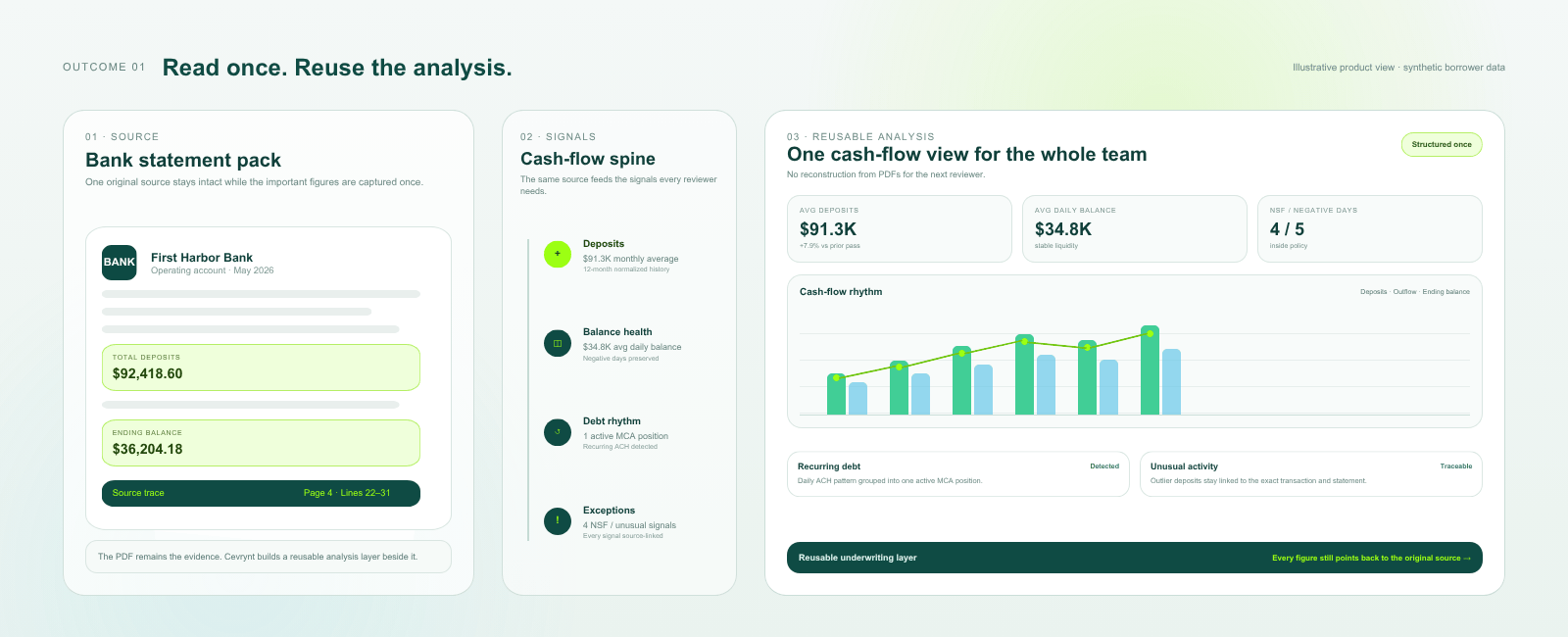
Cevrynt's Bank Statement Analysis structures inflows, outflows, volatility, and buffer metrics into a consistent view for every deal, with existing debt obligations and NSF patterns surfaced explicitly rather than buried in an aggregate score. This gives underwriters at alternative lenders the full texture of a business's cash flow, evaluated against their own credit policy.
As with every stage of Cevrynt's workflow, this analysis supports the underwriter's judgment rather than replacing it — findings are evidence for a human decision, not an automated verdict. Book a qualified walkthrough to see it against your own deal types.