
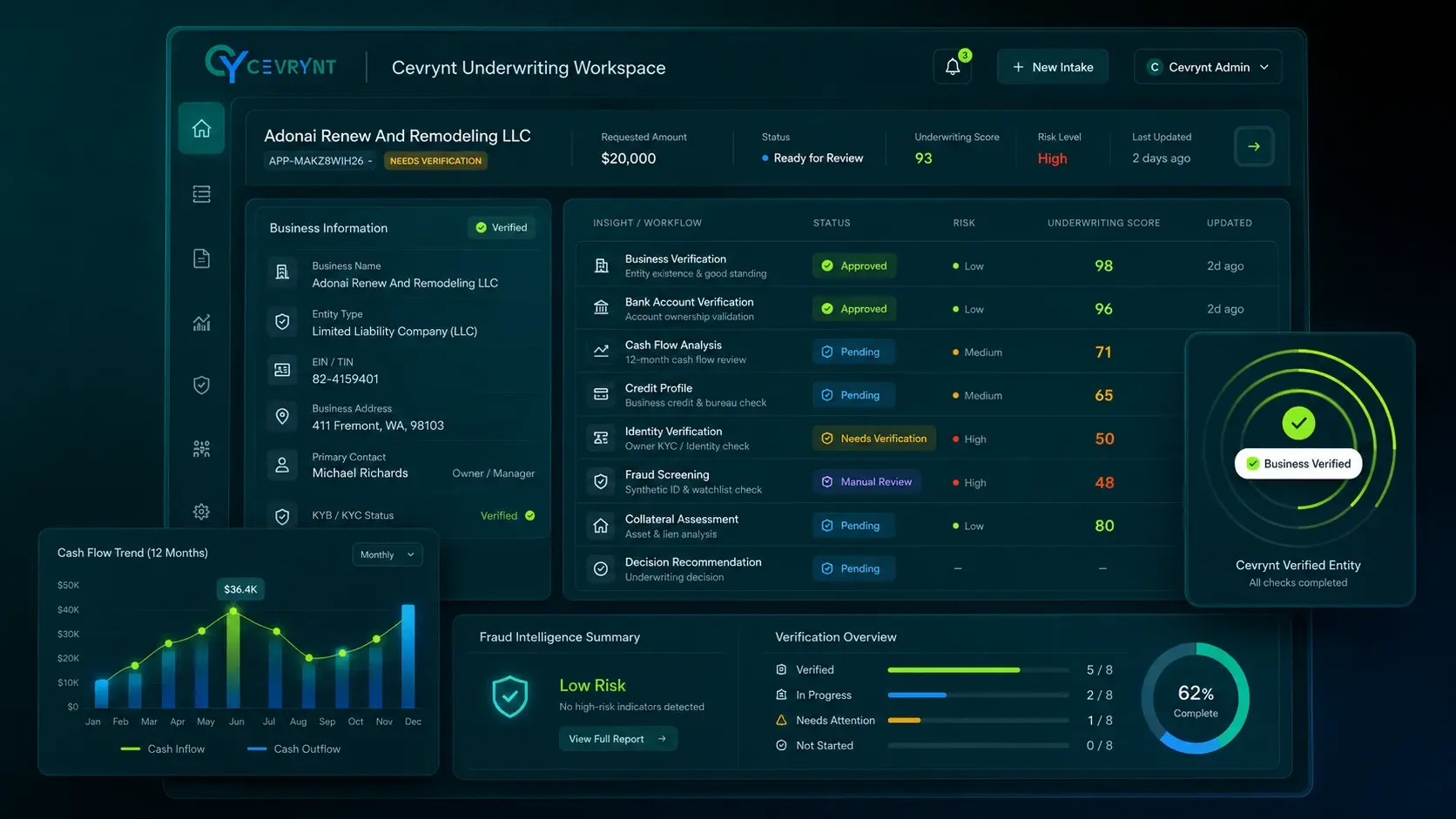
The credit memo has become the headline feature of AI underwriting. Upload a borrower package, and a few minutes later you receive a polished, committee-ready document. For small-business lenders and MCA funders that is a genuine change: memo writing has always been one of the slowest, least consistent parts of the underwriting job.
But a memo that reads well is not the same as a memo you can rely on. A fluent summary with no sources is harder to check than a messy spreadsheet, and a memo that quietly resolves every conflict hides exactly the things a credit committee most needs to see. This guide sets out what a decision-ready memo should contain, how to test whether an AI-generated one is trustworthy, and which parts must remain the underwriter's.
What a credit memo is for
A credit memo exists to let someone who did not work the file understand the deal, the risk and the recommendation in one sitting — and to let anyone reconstruct later why the decision was made. That second purpose is the one AI-generated memos most often fail. The memo is not just a summary for today's approver; it is the record an auditor, investor or collections team will open months from now.
The eight sections of a decision-ready memo
- Deal summary — the business, the request (amount, product, term or factor), the ISO or channel, and the recommendation.
- Business identity and verification — legal entity, ownership, formation and standing, address, and every mismatch against the application. See our guide to KYB for lenders.
- Cash flow — true revenue after removing transfers and loan proceeds, average daily balance, negative days, NSFs, seasonality and trend across the statement period.
- Existing obligations — every MCA and loan payment visible in the account, their cadence and the resulting burden. Stacking belongs here, not in a footnote.
- File integrity and fraud signals — document-tampering signs, missing or duplicate statements, conflicting names and numbers.
- Policy results — each lender-defined rule, the observed value, pass or fail, and which results need judgment.
- Open items and exceptions — what is unresolved, why it matters, and what would resolve it.
- Decision and rationale — the underwriter's call, conditions, pricing and structure, and any overrides with their reasons.
The first seven sections can be prepared by software. The eighth is where the lender's judgment and accountability live, and it should be written — or at least owned and signed — by a person.
Four tests for an AI-generated memo
1. Is every figure sourced?
Pick any number in the memo — monthly revenue, average daily balance, a daily MCA payment — and ask where it came from. A trustworthy memo lets you open the statement page and transaction behind it. If the answer is "the model calculated it", you are being asked to trust rather than verify. Our piece on source-linked extraction explains why this matters.
2. Whose policy does it reflect?
Generic memos judge a deal against generic standards. Yours should show results against your own thresholds and conditions, name the rule behind each result, and record the policy version in force. If the memo cannot tell you which rule a deal failed, it cannot support a consistent decision across underwriters. See what a loan policy engine does.
3. Does it keep conflicts open?
Real files disagree with themselves: the application states one revenue figure and the statements show another; the ownership on the application differs from the registry. A good memo shows both values and where each came from. A memo that silently picks one has made a credit judgment without telling you.
4. Is it honest about uncertainty?
Language models write confidently whether or not the evidence supports it. Look for memos that distinguish what was verified from what was inferred, flag low-quality or missing documents, and leave a section blank rather than filling it with plausible text.
Where the underwriter's judgment belongs
Automating the memo should move underwriters from assembling evidence to evaluating it — not remove them from the decision. The best division of labor is simple: software prepares sections one to seven consistently and completely; a person decides section eight, records the reasoning, and signs it. Overrides of policy should be possible, but never silent: each needs a reviewer, a reason and a timestamp, as covered in policy exceptions, overrides and audit trails.
From here, this article is about Cevrynt
How Cevrynt prepares the memo
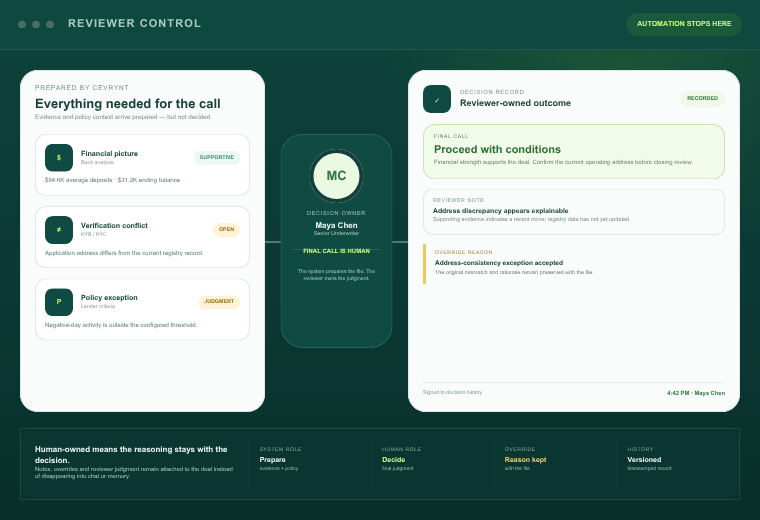
Cevrynt's underwriting report is built around these tests. It brings documents, bank analysis, business verification, fraud signals and your policy results into one evidence-linked record, keeps unresolved conflicts and exceptions visible, and records reviewer notes, overrides and the policy version in force. It does not write the decision: the approval, decline, pricing and structure remain with your underwriters, and Cevrynt is not a lender.
To see a memo prepared from one of your own files, book a walkthrough.