
A funder structures a merchant cash advance by buying a set amount of the merchant's future receivables at a discount. The MCA factor rate sets the purchased amount (purchase price times factor), the holdback percentage (the specified percentage) sets how much of each day's or week's receipts is remitted, and the estimated term falls out of those two numbers and the merchant's actual sales.
This guide is written for funders, underwriters and credit teams, not for merchants shopping for capital. It explains each structural term, shows how revenue volatility and existing positions limit sizing, works through an illustrative structure for Cedar & Stone LLC, covers reconciliation and renewals, and summarizes why New York and California require an estimated APR on sales-based financing. It closes with what merchant cash advance pricing software should and should not do.
How does a merchant cash advance work from the funder's side?
From the funder's side, an MCA is a purchase of a defined slice of future receipts, paid for up front, and collected as the merchant generates sales. The funder's return comes from the gap between what it pays and what it is entitled to collect, and its risk comes from how fast, and whether, those receipts arrive.
Three numbers anchor every deal. The purchase price is what the funder pays for the receivables, usually wired to the merchant's operating account less any fees the contract deducts at funding. The purchased amount (sometimes called the receivables purchased amount or the payback) is the total the funder is entitled to collect. The specified percentage is the share of receipts the merchant agrees to deliver until the purchased amount is collected.
Because the funder is buying receipts rather than lending a principal balance, a standard MCA contract usually has no interest rate and no fixed maturity date. The duration depends on sales. That is the structural difference from a term loan, and it is why underwriting an MCA is mostly about the size, consistency and composition of the merchant's receipts. Our guide to revenue-based financing versus term loans covers that contrast in more depth.
Whether a particular contract is treated as a true purchase of receivables or as a loan is a legal question that depends on the contract terms and the jurisdiction. Features such as reconciliation rights, how the contract treats a business that closes in the ordinary course, and recourse provisions are often part of that analysis. Funders settle it with counsel; underwriters need to know which provisions their contract actually contains, because those provisions change how a file should be sized and monitored.
What is an MCA factor rate and how is it calculated?
An MCA factor rate is the multiplier that converts the purchase price into the purchased amount. A purchase price of $32,000 at a factor of 1.30 gives a purchased amount of $41,600, so the funder's gross margin before fees and losses is $9,600.
The arithmetic is simple: purchased amount equals purchase price times factor rate, and the cost of capital equals purchased amount minus purchase price. What takes judgment is choosing the factor. Funders usually set it from a pricing grid in their credit policy, keyed to the risk tier the file lands in, the position (first position or a later one), the requested term, the industry, and the funder's own cost of funds and loss experience. Syndication arrangements and broker commissions also enter the economics, which is why two funders can price the same file differently and both be internally consistent.
Factor rate versus interest rate
A factor rate is not an interest rate, and it does not accrue. The $9,600 in the example is the same whether collection takes six months or twelve. An interest rate is a price per unit of time; a factor rate is a price per deal. That is the source of most confusion about MCA cost, and it is the reason regulators in some states require an annualized estimate alongside the dollar cost, covered later in this guide.
Why the same factor rate costs differently over different terms
Because the cost is fixed per deal, the time it takes to collect drives the annualized cost. If Cedar & Stone's receipts rise and the purchased amount is collected in seven months, the merchant paid $9,600 for seven months of capital. If receipts fall and collection stretches to eleven months, the dollar cost is unchanged but the annualized cost is much lower. For a funder, the reverse is the point: a slower collection lowers the annualized return on the same deal and ties up capital longer. Pricing that ignores the realistic term range for a given merchant misreads the deal from both sides.
Fees complicate the picture. Origination, underwriting or ACH program fees deducted at funding reduce what the merchant actually receives without changing the purchased amount. If Cedar & Stone's contract deducted an illustrative $640 fee, the merchant would receive $31,360 while owing $41,600. Disclosure rules in states that require them define which charges count toward the finance charge, so the treatment of each fee should be confirmed against the applicable regulation rather than assumed.
What is the holdback percentage, or specified percentage, in an MCA?
The holdback percentage, called the specified percentage in many contracts, is the share of the merchant's receipts the funder is entitled to until the purchased amount is collected. At 8% of $65,000 in monthly receipts, the remittance is about $5,200 a month.
The specified percentage is the main lever on affordability. The factor rate decides how much is owed; the percentage decides how hard the remittance presses on the merchant's operating cash every week. A higher percentage collects faster and shortens the funder's exposure, but it takes a larger bite out of the cash the business needs for payroll, inventory and rent, and it raises the chance of NSF events and default. A lower percentage protects operating cash and lengthens the term. Underwriters should evaluate the percentage against the merchant's margin structure, not just its gross deposits: a restaurant and a staffing firm with the same deposits can tolerate very different percentages.
Split remittance versus fixed ACH estimates
There are two common mechanics for collecting the specified percentage. In a split, the card processor or payment channel sends the specified percentage of each settlement directly to the funder, so remittance tracks actual card sales automatically. In an ACH structure, the funder debits a pre-set daily or weekly amount from the merchant's bank account. That amount is an estimate of the specified percentage of expected receipts, which is why contracts with fixed debits often include a reconciliation provision so the total collected can be brought back in line with the percentage.
Splits suit businesses that take most of their revenue by card. ACH structures cover merchants with mixed revenue such as checks, transfers and platform payouts, which is most of the SMB market outside retail and hospitality. The underwriting consequence is that ACH structures depend more heavily on how well the funder estimated receipts, and on the merchant's ability to request an adjustment when sales fall.
Daily or weekly remittance
For Cedar & Stone, $5,200 a month is about $248 per business day, assuming roughly 21 business days a month, or $1,200 a week (5,200 x 12 / 52). Daily debits match the rhythm of a card-heavy business and surface trouble quickly, because a missed debit shows up the next day. Weekly debits suit businesses with lumpy deposits, such as a contractor paid on invoices, where a daily debit could land on a day with no inflow and trigger an NSF that says more about timing than about credit. The choice should follow the deposit pattern visible in the bank statements, not habit.
How is the estimated term of an MCA calculated?
The estimated term is the purchased amount divided by the expected remittance per period. For Cedar & Stone, $41,600 divided by $5,200 a month is about 8 months, or roughly 168 business days at $248 a day.
The estimate is only as good as the receipts projection behind it. Most funders project from a historical average of qualifying receipts over a fixed lookback, often three to six months of statements, adjusted for items that are not sales: transfers between the merchant's own accounts, loan or advance proceeds, refunds and reversals, and one-time credits such as an insurance payout. A projection built on gross deposits will understate the term and overstate affordability whenever non-sales credits are material.
Term also interacts with policy. Many credit policies cap the estimated term, both to limit exposure to a single merchant's future and because longer terms at a fixed factor dilute the annualized return. When a requested amount only fits by stretching the term past the cap, that is a signal to reduce the purchase price or lower the percentage, not to quietly extend the estimate. The metrics guide on average daily balance and DSCR explains how lookback choice changes every cash-flow metric that feeds this estimate.
How do revenue volatility and existing positions affect MCA sizing?
Sizing starts from qualifying receipts, subtracts what existing advances already take, and applies the funder's own caps on total remittance burden and term. Volatile revenue and stacked positions both shrink the headroom, and the result should be a range the policy supports, not a single number pulled from the request.
Start from qualifying receipts, not gross deposits
Gross deposits include money that is not revenue. Classifying credits correctly is the first sizing step, and it is where most bank-statement analysis work happens: separating card settlements, ACH customer payments and checks from internal transfers, advance proceeds and returned items. Our bank statement analysis page describes how that classification is organized for review.
Measure volatility, not just the average
Two merchants averaging $65,000 a month are not the same risk if one ranges from $60,000 to $70,000 and the other from $40,000 to $90,000. Volatility matters for an MCA in two ways. With a fixed ACH estimate, a low month means the debit takes a far larger share of receipts than the specified percentage, which pressures operating cash and raises NSF risk. With a split or a reconciled structure, a low month slows collection and lengthens the term. Useful measures include the lowest month in the lookback, the month-to-month swing, the trend across the window, and whether a dip has a seasonal explanation that recurs in prior years. Sizing against a conservative month rather than the average is a common policy choice.
Subtract existing positions before adding a new one
Every existing advance already takes a share of the same receipts. A new position does not get the merchant's full cash flow; it gets what is left after earlier funders collect. Identifying those positions from recurring debits, and confirming whether any are being paid off by the new funding, is a core step. Missing one is the classic way a sized deal turns into a stacked one. Our guide to detecting stacking covers the debit patterns that reveal undisclosed positions, so this guide only uses the total.
Worked example: structuring an illustrative advance for Cedar & Stone LLC
Cedar & Stone LLC is the illustrative deal used throughout Cevrynt's examples: a small general contractor with three months of statements averaging $68,000 a month in deposits and an existing advance remitting about $17,000 a month. Every figure below is illustrative. None is a recommendation, a market rate or an offer, and the policy settings are examples a funder would replace with its own.
- Classify receipts. Of $68,000 average monthly deposits, $3,000 is transfers from the owner's other account and a small insurance credit. Qualifying receipts: $65,000.
- Apply the burden cap. The example policy limits total remittances across all positions to 35% of qualifying receipts: $22,750 a month.
- Subtract existing positions. The current advance takes about $17,000 a month, leaving $5,750 of monthly headroom for a new position.
- Apply the term cap. The example policy limits estimated term to 8 months, so the purchased amount can be at most $46,000.
- Apply the pricing grid. The file's tier maps to an example factor of 1.30, so the purchase price can be at most about $35,400.
- Choose a structure inside the range. A purchase price of $32,000 at 1.30 gives a purchased amount of $41,600. At an 8% specified percentage the remittance is $5,200 a month, under the $5,750 headroom, and the estimated term is 8 months.
- Check the result against the merchant's worst month. In the lowest month of the lookback, receipts were $58,000. Total remittances of $22,200 would be about 38% of that month, above the 35% cap, which the reviewer notes as a condition or a reason to trim the amount.
Gross deposits (3-mo avg)        $68,000 / month
Non-sales credits removed         -$3,000
Qualifying receipts              $65,000 / month

Policy cap on total remittance   35% x 65,000 = $22,750
Existing positions               -$17,000
Headroom for new position         $5,750 / month

Term limit (policy)              8 months
Max purchased amount             5,750 x 8 = $46,000
Factor (pricing grid tier)       1.30
Max purchase price               46,000 / 1.30 = ~$35,400

Chosen structure (illustrative)
  Purchase price                 $32,000
  Purchased amount               32,000 x 1.30 = $41,600
  Specified percentage           8% of receipts
  Expected remittance            8% x 65,000 = $5,200 / month
                                 ~ $248 / business day or $1,200 / week
  Estimated term                 41,600 / 5,200 = ~8 months
  Total burden, all positions    17,000 + 5,200 = $22,200 (34.2%)
  Burden in lowest month ($58k)  22,200 / 58,000 = ~38.3%  -> reviewer note
Two points are worth drawing out. First, the funnel produces a range, from zero up to about $35,400 in purchase price, and the structure chosen inside it reflects judgment about volatility, industry and the existing position. Second, the worst-month check is what turns a tidy average into a credit conversation. That last step is exactly where an underwriter's notes belong in the file, so the next reviewer can see why the deal was trimmed, conditioned or approved as requested.
What is reconciliation in a merchant cash advance?
Reconciliation is a contract provision, where the contract includes one, that lets the merchant request, or the funder initiate, an adjustment so that what the merchant actually remits matches the specified percentage of actual receipts rather than the pre-set estimate. When sales fall, a reconciliation can reduce the debit or credit back the excess.
Regulators use similar language. New York's commercial finance disclosure regulation defines a true-up mechanism for sales-based financing as an arrangement where the funder collects pre-set periodic payments and the contract allows adjustments after signing so that the total paid more closely reflects the split rate stated in the contract (23 NYCRR Part 600). California's regulation defines a true-up mechanism in comparable terms (10 CCR section 900).
For Cedar & Stone, suppose receipts run $65,000 and $66,000 in the first two months, then drop to $45,000 in month three. The pre-set debit still collects about $5,200, but 8% of $45,000 is $3,600. Under a reconciliation provision, the merchant can document the lower receipts and the funder adjusts: by crediting the $1,600 difference, by lowering the debit going forward, or both, according to the contract's terms. Collection slows and the estimated term extends; the purchased amount does not change.
What underwriters should check about reconciliation
- Whether the contract has one. Size and monitor the deal according to the actual provision, not a generic assumption.
- What documentation it requires. Most provisions ask for bank statements or processor reports for the period; know which, and how quickly the funder must respond.
- How often it can be requested. Monthly windows are common in practice, but the contract governs.
- How minimum payments interact with it. A contract with a minimum payment behaves differently from one where remittance can fall all the way to the percentage. Disclosure rules in New York ask providers to state minimum payment terms explicitly.
- How the term estimate changes after an adjustment. Servicing and portfolio reporting should update the expected collection curve, not keep the original 8-month assumption.
From a portfolio view, reconciliation requests are also an early-warning signal. A cluster of requests from merchants in one industry or region says something about receipts before defaults do. Treating reconciliation data as underwriting feedback, rather than only a servicing task, improves the next round of pricing grids.
How do MCA renewals work and what should underwriters check?
A renewal is a new advance to an existing merchant, usually offered once a portion of the current purchased amount has been collected, with part of the new purchase price used to pay off the remaining balance. The merchant receives the new purchase price minus the payoff and any fees.
Renewals are attractive because the funder has observed real remittance behavior. They are risky for the same reason stacking is: the merchant's need for more capital may itself be a signal. A renewal file should answer a few specific questions. How did the merchant perform on the current advance, including NSF events, reconciliation requests and missed debits? Has qualifying revenue held, grown or declined since the original file? How much of the new purchase price is going to pay off the old balance rather than reaching the merchant's operating account? And have any new positions appeared since the original funding?
The payoff question matters for disclosure as well as credit. New York's regulation requires a renewal disclosure stating whether any amount of the new financing is used to pay unpaid finance charges or fees from the prior financing, which the rule calls double dipping, and it describes how to treat a fixed finance fee on a pro rata basis (23 NYCRR Part 600). Even outside states with such rules, a renewal in which most of the purchase price goes to payoff is worth a second look: it extends the funder's exposure without giving the business much new working capital.
Renewal files should be re-underwritten on current statements, not priced from the original file. Our article on NSF patterns and overdrafts covers how to read the payment-behavior evidence a renewal depends on.
Why do some states require an estimated APR for merchant cash advances?
Some states require commercial financing providers, including providers of sales-based financing such as MCAs, to give standardized disclosures that include an estimated annual percentage rate, a finance charge, an estimated payment and an estimated term. The aim is to let a business compare products priced in different ways. Rules vary by state and change over time, so compliance teams should work from the current text.
New York. The New York Department of Financial Services' regulation at 23 NYCRR Part 600 implements the state's Commercial Finance Disclosure Law. It requires covered providers to give disclosures when a specific offer is extended, for offers up to $2,500,000. For sales-based financing it prescribes a table that includes the estimated APR, finance charge, estimated total payment amount, estimated payment, payment terms, estimated term, prepayment and collateral, and it adds an estimated monthly cost row when payments are not monthly. Where no part of the finance charge is interest, the disclosure must state that APR is not an interest rate (23 NYCRR Part 600).
The New York rule offers two ways to project receipts. Under the historical method, a provider fixes a lookback between four and twelve months and uses the merchant's historical average through the relevant payment channel, with limited permitted exclusions such as a month depressed by a cause unlikely to recur. Under the opt-in method, a provider uses an internal estimated sales projection, audits its paid-off sales-based financings every twelve months by computing the retrospective APR, and reports the comparison to DFS. DFS states that those annual reports are due by April 30 each year beginning in 2025 (DFS, small business financing providers).
California. California's commercial financing disclosure regulations, administered by the Department of Financial Protection and Innovation, sit in Title 10 of the California Code of Regulations. Section 914 sets the formatting and contents for sales-based financing disclosures, including estimated APR, finance charge, estimated total payment amount, estimated payment, estimated term and prepayment, and requires the statement that APR is not an interest rate where applicable (10 CCR section 914). Section 930 sets out a historical method for estimating sales and requires that any disclosure based on an estimate be labelled as one (10 CCR section 930). Coverage thresholds and exemptions are set in the statute and regulations and should be checked directly.
Elsewhere. Other states have adopted or proposed commercial financing disclosure laws with their own scopes, thresholds and formats, and some regulate brokers separately. Requirements can change after publication of any guide, including this one. Treat this section as orientation, not legal advice.
What estimated APR disclosure means for underwriting
The disclosure rules reach into underwriting more than their name suggests. The estimated APR depends on the same receipts projection the underwriter used to size the deal, so the projection method, the lookback, the exclusions and the treatment of fees need to be consistent and documented. New York's historical method requires a provider to record its fixed lookback period in an internal document with an effective date and keep each version. A file in which the underwriter used one average and the disclosure used another is a compliance problem waiting to be found. The practical answer is a single, evidence-linked calculation of qualifying receipts that both the credit decision and the disclosure draw from.
What should merchant cash advance pricing software actually do?
Good merchant cash advance pricing software applies the funder's own rules, consistently, to evidence the underwriter can verify. It should compute qualifying receipts, existing burden, headroom, a policy-bounded range of structures and the worst-month check, and show the source of every number. It should not invent a price or make the decision.
When evaluating MCA lending software for structuring work, the questions that separate useful tools from spreadsheets with a login are concrete:
- Does every receipts figure trace back to statement lines? If a reviewer cannot click from the $65,000 to the deposits behind it, the number cannot be defended to a credit committee or a regulator.
- Are your rules configurable and versioned? Burden caps, term limits, factor grids and position rules change. The software should record which version of the policy produced a given range. See what a loan policy engine is for how that separation works.
- Does it flag rather than decide? A worst-month breach, an unidentified recurring debit or a renewal mostly consumed by payoff should become a reviewer flag, not an automatic decline or approval.
- Does it keep overrides and notes? When an underwriter trims an amount or accepts an exception, the reason should live with the file. Our guide to policy exceptions and audit trails covers what good records look like.
- Can disclosure and underwriting share one projection? In states with estimated APR rules, the calculation behind the credit decision and the one behind the disclosure should not drift apart.
For a wider view of the software categories involved, from bank-statement analyzers to full underwriting platforms, see our merchant cash advance software guide and the buyer's guide to MCA underwriting software.
Common mistakes when structuring an MCA
Most structuring errors come from sizing against the wrong revenue figure, ignoring what is already being collected, or treating the estimated term as a promise. Each one is avoidable with a documented, repeatable calculation.
- Sizing on gross deposits. Transfers, advance proceeds and refunds inflate capacity. The error compounds when the merchant has recently received another advance, because its proceeds look like revenue.
- Pricing from the request, not the evidence. Starting with the amount the broker asked for and adjusting the percentage until it fits produces deals that only work on paper.
- Averaging away volatility. A healthy average with one deep trough month behaves badly under fixed ACH debits. Check the worst month and the trend, not only the mean.
- Missing or misreading existing positions. An unidentified recurring debit can be the difference between a 34% and a 45% total burden.
- Mismatching remittance frequency and deposit rhythm. Daily debits against invoice-driven weekly deposits create NSFs that are timing artifacts but still damage the merchant.
- Assuming reconciliation works the same in every contract. Size and monitor according to the provision your contract actually has.
- Letting the disclosure projection diverge from the underwriting projection. In disclosure states, inconsistent averages are both a credit and a compliance problem.
- Leaving no record of judgment. A trimmed amount or an exception with no note forces the next reviewer, auditor or examiner to guess.
Many of these failures trace to the same root: numbers re-keyed by hand from PDFs into a spreadsheet, with no link back to the source. Our article on cash flow underwriting for SMB loans covers the broader discipline of reading statements before the structuring step begins.
From here, this article is about Cevrynt
How Cevrynt supports MCA structuring decisions
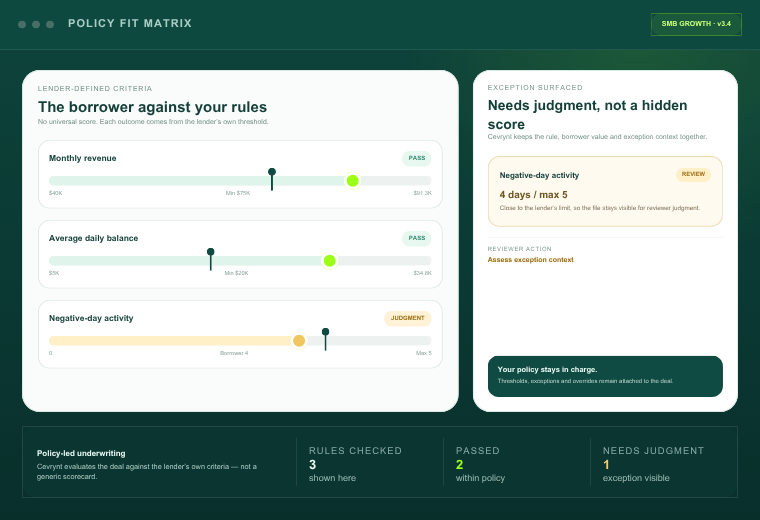
Cevrynt is AI-assisted underwriting infrastructure for MCA funders and alternative lenders. It does not price deals, make offers or fund anything. It structures the evidence a structuring decision depends on: bank statement analysis that separates qualifying receipts from transfers and other non-sales credits, recurring-debit detection that surfaces existing positions, and source links from every figure back to the statement line it came from.
The Policy Engine then evaluates the file against the lender's own rules, such as burden caps, term limits and pricing tiers, and returns a range from your rules, not an offer. Breaches such as a worst-month burden above the cap appear as flags for the underwriter, alongside reviewer notes and overrides, in an evidence-linked underwriting report. The decision, and the structure, remain the underwriter's.
To see how this fits an MCA workflow, visit the merchant cash advance solution page or book a walkthrough with our team.