
MCA syndication is an arrangement in which one funder, the lead or syndicator, contracts a merchant cash advance with a business and other funders, the participants, put up a fixed percentage of the money. Each participant then receives that same percentage of every remittance collected and bears that percentage of fees, costs and losses, under a participation agreement with the lead.
This guide is for funders who syndicate deals and for the participants who join them. It explains the roles, works through the math of a participation on an illustrative Cedar & Stone LLC advance (contributions, daily splits, fees, rounding, a returned payment and a default), sets out what the lead funder services and reports, describes the data and audit records participants expect, and closes with the securities-law questions syndication raises. For the wider software stack around an MCA book, see the companion merchant cash advance software guide.
What is MCA syndication?
MCA syndication spreads one advance across several funders: the lead contracts and services the deal, and participants buy a percentage interest in its economics. It lets a lead fund larger or more numerous deals than its own capital allows, and lets participants take exposure to deals they did not originate.
A merchant cash advance is usually structured as the purchase of a share of a business's future receivables: the funder pays a purchase price now, and the business remits an agreed purchased amount over time, often through daily or weekly ACH debits. In a syndicated deal the merchant normally sees only the lead funder. The merchant's contract, its debit authorization and its point of contact all sit with the lead. The participants' rights run against the lead, through the participation agreement, not against the merchant.
That structure explains almost every operational question in this article. Because participants have no direct relationship with the merchant, everything they know about the deal comes from the lead: the underwriting basis at the start, the cash collected each day, every change to the payment schedule and every collection action. A syndication program is only as good as the records and reports behind it.
Why funders syndicate
- Capacity: a lead with more approved deals than capital can fund them by bringing in participants for part of each one.
- Concentration: spreading each deal across several funders limits how much any one funder loses if a single merchant stops paying.
- Deal flow for participants: a participant without an ISO network or an underwriting team can take exposure to deals sourced and underwritten by someone else.
- Fee income for the lead: many participation agreements pay the lead a servicing or management fee on collections, so the lead earns on capital it did not provide.
Lead funder vs syndication participants: who does what?
The lead funder originates, underwrites, contracts, funds, services and collects the advance; participants fund their share, receive their share, and rely on the lead's reporting. The participation agreement allocates every other right and duty between them.
In practice the lead does almost all of the work. It receives the submission from the ISO or the merchant, underwrites the file, decides whether to fund and at what terms, signs the contract, wires the purchase price, debits the remittances, handles returned payments and reconciliation requests, agrees any modification, and pursues collections if the merchant stops paying. Participants are mostly passive. Their leverage sits in three places: the decision to join a deal at all, the terms of the participation agreement, and the information and audit rights that agreement gives them.
What a participation agreement typically covers
Agreements vary widely, and the terms below are a checklist of what to look for rather than a description of any standard form. Have counsel draft and review the actual document.
- Participation share: the percentage of the deal the participant funds and receives, and whether it can ever change after funding.
- Contribution: what the share applies to, usually the purchase price plus the same share of the ISO commission and any upfront costs.
- Distributions: whether participants are paid on settled funds or scheduled debits, how often, and how returned payments are clawed back.
- Fees: the lead's servicing or management fee (rate, base and timing), and which costs, such as collections or legal fees, are shared.
- Lead discretion and consent: which decisions the lead can make alone (payment reductions, reconciliations, settlements, renewals) and which need participant consent or notice.
- Defaults and recoveries: how losses, recovery costs and recovered amounts are allocated, and when a deal is written off for reporting.
- Reporting: what statements participants receive, how often, and in what format.
- Information and audit rights: what underwriting and servicing records participants may inspect, with what notice, and for how long after the deal closes.
- Renewals and stacking: whether a participant has a right to join a renewal, and how a renewal that pays off the old balance is reported.
How does a participation percentage work in an MCA deal?
The participation percentage is the single number that drives the economics: a participant with 25% of a deal funds 25% of the cost and is entitled to 25% of the collections, subject to the fees and terms in its agreement. Get the share and its base right at funding and most later arithmetic follows.
Take an illustrative advance to Cedar & Stone LLC. The lead buys $135,000 of future receivables for a purchase price of $100,000, a factor of 1.35, with an estimated daily remittance of $1,125. If every debit settles on schedule, the purchased amount is collected in 120 business days. The ISO commission is $9,000. The lead keeps 40% and syndicates 35% to Participant A and 25% to Participant B. In this illustration each party's contribution covers its share of both the purchase price and the commission.
- Lead funder, 40%: $40,000 of purchase price plus $3,600 of commission, so $43,600 in total.
- Participant A, 35%: $35,000 plus $3,150, so $38,150.
- Participant B, 25%: $25,000 plus $2,250, so $27,250.
- Total deal cost: $109,000, against a purchased amount of $135,000.
If the deal performs in full, Participant A's gross collections are 35% of $135,000, or $47,250. With an illustrative 2% servicing fee on collections paid to the lead, A pays $945 and keeps $46,305, a profit of $8,155 on $38,150 contributed. Participant B collects $33,750 gross, pays $675 and keeps $33,075, a profit of $5,825 on $27,250. These are illustrative numbers only; real deals differ in factor, commission, fee base and term, and performance is never guaranteed.
Two details cause most later disputes. First, the base of the share: if one participant's agreement applies its share to the purchase price only while another's includes commission, their effective returns differ and the lead's allocation logic needs both rules. Second, changes after funding: a share sold on to another participant, or a lead that buys out a participant mid-deal, must be recorded with an effective date, or historical statements stop reconciling.
How are MCA remittances split between syndicate participants?
Each remittance that settles in the lead's account is split by participation share, the lead deducts any servicing fee the agreement allows, and the net amounts are distributed on the agreed schedule. The safe default is to distribute only settled funds, and to have a written rule for returned payments that were already distributed.
On a daily debit of $1,125.00 the gross split is $450.00 to the lead, $393.75 to A and $281.25 to B. The 2% fee is $7.875 for A and $5.625 for B, and neither is a whole number of cents. Whether those round to $7.88 and $5.63, or truncate to $7.87 and $5.62, looks trivial. Across 120 payments and dozens of deals it is not: rounding that is not written down produces statements that differ from the lead's ledger by small, persistent amounts, and small unexplained differences are what make participants ask for an audit.
A sound allocation routine works in integer cents, applies one stated rounding rule, assigns leftover cents deterministically, and checks that the total paid out equals the cash that settled. The sketch below shows the idea; it is an illustration of the control, not production code.
// Illustrative only: split one settled remittance by participation share,
// charge the lead's servicing fee, and keep every cent accounted for.
// Amounts are integer cents to avoid floating-point drift.

const deal = {
  remittanceCents: 112500, // $1,125.00 settled for Cedar & Stone LLC
  feeRate: 0.02, // servicing fee charged to participants (from the agreement)
  parties: [
    { id: "lead", shareBps: 4000, paysFee: false },
    { id: "participant-a", shareBps: 3500, paysFee: true },
    { id: "participant-b", shareBps: 2500, paysFee: true },
  ],
};

function allocate({ remittanceCents, feeRate, parties }) {
  // 1. Gross split, rounded down; leftover cents go to the largest remainders.
  const raw = parties.map((p) => (remittanceCents * p.shareBps) / 10000);
  const gross = raw.map(Math.floor);
  let left = remittanceCents - gross.reduce((a, b) => a + b, 0);
  raw
    .map((r, i) => ({ i, rem: r - Math.floor(r) }))
    .sort((a, b) => b.rem - a.rem)
    .forEach(({ i }) => { if (left > 0) { gross[i] += 1; left -= 1; } });

  // 2. Fees: round half up per party, credited to the lead.
  const lines = parties.map((p, i) => {
    const fee = p.paysFee ? Math.round(gross[i] * feeRate) : 0;
    return { id: p.id, gross: gross[i], fee, net: gross[i] - fee };
  });
  const feeIncome = lines.reduce((n, l) => n + l.fee, 0);
  lines.find((l) => l.id === "lead").net += feeIncome;

  // 3. Control total: what goes out must equal what settled.
  const out = lines.reduce((n, l) => n + l.net, 0);
  if (out !== remittanceCents) throw new Error("Allocation does not tie to cash");
  return lines;
}

console.log(allocate(deal));
// lead:          gross 45000, fee 0,   net 46351 (450.00 + 13.51 fees)
// participant-a: gross 39375, fee 788, net 38587
// participant-b: gross 28125, fee 563, net 27562
Settled funds vs scheduled debits
ACH debits are not final when they are sent. Nacha, which governs the network, notes that ACH payments can settle the same business day or one to two business days later, and a debit can still be returned after it settles, for example for insufficient funds. A lead that distributes on scheduled debits will sometimes pay participants money it never kept. The cleaner options are to distribute only after a holding period the agreement defines, or to distribute promptly and net any returned amounts against the next distribution, with each clawback shown as its own line on the statement.
Illustration: on day 31 the Cedar & Stone LLC debit of $1,125 is returned for insufficient funds after the lead distributed it. Under a netting rule, the next distribution shows a reversal of $450.00 for the lead, $393.75 gross (and the $7.88 fee) for A, and $281.25 gross (and the $5.63 fee) for B. The statement should show the original payment, the return, the return reason and the reversal, not one silently reduced net figure. Repeated returns are also a performance signal participants care about; see NSF patterns as an underwriting risk signal.
How are fees, commissions and defaults allocated in MCA syndication?
Commissions and upfront costs are usually funded in proportion to the participation share; the lead's servicing fee is usually charged on participants' collections; and losses, recovery costs and recoveries are normally shared in proportion too. The agreement decides each point, so the reporting must show which rule was applied.
Fees and commissions
Common structures include a servicing or management fee charged as a percentage of each participant's gross collections, a flat underwriting or administration fee at funding, and a share of the ISO commission built into the contribution. Some agreements also allocate any fees the merchant pays, such as a returned-payment fee, by share; others let the lead keep them. Whatever the structure, each fee should appear on the participant's statement as its own line with its base and rate, so a participant can recompute it.
Commission clawbacks
Some ISO agreements require the broker to return part of the commission if the merchant defaults early. If the participants funded their share of that commission, they are usually entitled to their share of anything clawed back. That only works if the commission funded by each party and any later clawback are both recorded against the deal, not in a separate ISO ledger nobody joins back.
Defaults, recoveries and write-offs
Suppose Cedar & Stone LLC stops paying after 48 settled debits, so $54,000 of the $135,000 purchased amount has been collected. Before fees, the lead has received $21,600, Participant A $18,900 and Participant B $13,500. The lead pursues collections and recovers $12,000, against an illustrative 25% contingency cost, leaving $9,000 net to distribute: $3,600, $3,150 and $2,250. Each party has now recovered 57.8% of what it put in, and the unrecovered amounts are $18,400, $16,100 and $11,500.
Proportional loss sharing is simple on paper. In practice the disputes come from what happens around the default: whether the lead agreed a payment reduction before the merchant stopped paying, whether it consulted participants before settling for less than the balance, which costs it charged to the deal, and whether a renewal or a second position taken by another funder changed the merchant's ability to pay. Participants need the event history, not just the final number. Stacking in particular is worth understanding from the underwriting side; see detecting stacking in MCA underwriting.
What does MCA servicing software need to handle for syndicated deals?
For a syndicated book, MCA servicing software must do everything it does for a single-funder deal and also hold participation shares per deal, allocate every settled payment, return, fee and recovery by share, and produce statements that tie back to cash. The servicing record is the source every participant report is built from.
The general servicing layer (funding, ACH, payment application, collections) is covered in the MCA software guide. What syndication adds is a second ledger: for every deal, who owns what share from what date, and what each owner has been paid. The lead's servicing responsibilities to participants usually include the following.
- Payment application: every settled debit recorded against the right deal on the right date, with the running balance of the purchased amount.
- Return handling: return codes captured, reversals allocated by share, and patterns escalated rather than discovered at month end.
- Reconciliation requests: where the contract lets the merchant ask for the remittance to be adjusted to actual receivables, the request, the supporting documents and the outcome recorded and reported.
- Modifications: any change to the remittance amount, frequency or schedule recorded with its reason, approver, effective date and, where the agreement requires it, participant consent.
- Collections: status changes, contacts, demand letters, settlements and recovery costs logged against the deal.
- Distributions: net amounts paid to each participant, with the calculation behind them.
Per-merchant reporting
Participants usually hold small slices of many deals, so a merchant reporting tool view matters as much as portfolio totals: for each merchant, the original terms, the share held, the payments made and missed, the current status and every event. Portfolio dashboards answer how the book is doing; per-merchant views answer why a number changed, which is the question participants actually ask.
What data do syndication participants expect?
Participants expect two things: enough of the underwriting record at funding to judge the deal they are joining, and ongoing performance and event reporting until the deal pays off or is written off. Both should come from systems of record, not from documents rebuilt for the purpose.
At funding: the underwriting basis
A participant deciding whether to join a deal needs more than a merchant name and a factor rate. A useful underwriting summary states the decision and its terms, the policy version applied, any exceptions to that policy and who approved them, and the evidence behind the key numbers: average daily balance, deposit totals and trends, existing positions and returned items, verification results and any fraud or risk flags that were reviewed and how they were resolved. Each figure should trace back to the page of the source document it came from. What a report like that contains is covered in evidence-backed underwriting reports, and why source links matter in source-linked extraction.
Two cautions. First, the package should not overstate certainty: a fraud check that raised no flag is not a guarantee that the documents are genuine, and the summary should say what was checked rather than imply the deal is safe. Second, share the minimum personal information the participant needs. Owner identity documents, full account numbers and personal credit reports rarely need to leave the lead; a summary of what was verified, with the evidence available on audit under the agreement, usually serves the purpose.
During the deal: performance and events
- Performance updates: settled payments, returns, fees, net distributions and remaining balance, on the schedule the agreement sets.
- Modifications: notice of any change to the payment schedule, with the reason and supporting documents, and a record of consent where consent is required.
- Reconciliation outcomes: what the merchant asked for, what was provided and what was decided.
- Collections: the date a deal moved to default, the actions taken, the costs charged and the amounts recovered.
- Renewals and payoffs: whether the balance was paid from a renewal, and how that payoff was allocated.
How should participant statements and reconciliation work?
A participant statement should let the participant recompute every number on it from the deal terms and the payment history, and the sum of all participants' statements should tie to the cash the lead actually received and paid out. If either test fails, the statement is a summary, not a statement.
What a participant statement should show
- Deal identifier, merchant name, funding date and the participant's share and contribution.
- Opening balance of the participant's share of the purchased amount for the period.
- Each settled payment in the period, with date and amount, and the participant's gross share.
- Each return or reversal, with the original payment date and the return reason.
- Each fee, with its base and rate, and any shared costs with their description.
- Net amount distributed, with the distribution date and reference.
- Closing balance, current status (performing, modified, in default, paid off, written off) and any event in the period.
Reconciliation checks the lead should run before statements go out
- Cash to ledger: settled remittances in the bank account equal settled payments recorded in servicing for the period.
- Ledger to allocation: for every deal, the sum of participants' gross shares equals the settled amount, to the cent.
- Allocation to payout: net distributions sent equal net amounts on the statements, and fee income equals the fees charged.
- Shares to agreements: participation shares in the servicing system match the signed participation agreements, including any transfers.
- Status to events: every deal marked modified or in default has a dated event record explaining why.
Failures to watch for: distributions paid on debits that later returned, shares changed after funding with no record, statements built in a spreadsheet from a servicing export that breaks when a column moves, and balances that differ between the servicing system and the participant report. Each one is cheap to prevent with a control and expensive to explain after the fact.
What audit rights do participants have, and how should investor audit record retrieval work?
Audit rights are whatever the participation agreement grants, typically the right to inspect the lead's underwriting and servicing records for deals the participant joined, on notice. Investor audit record retrieval works when the lead can produce those records for a given deal quickly, complete and unchanged since the date they were made.
Participants use audit rights in a few predictable situations: a deal defaults early and the participant wants to know what the underwriter saw; statements do not reconcile; the participant is doing its own diligence or reporting to its own investors; or there is a dispute over a modification or settlement. In each case the questions are concrete. What documents were in the file when the decision was made? Which figures did the underwriter rely on? Which flags came up and how were they cleared? Who approved the exception? What did the lead agree with the merchant, and when?
An investment audit trail that can answer those questions has a few properties. Records are tied to a deal identifier shared across underwriting, servicing and syndication. Each record carries a timestamp and the person or system that created it. Decisions are stored as they were made, with the policy version and evidence at that time, not regenerated from current data. Changes are appended, not overwritten. The general principles are covered in underwriting audit trails and, for exceptions, policy exceptions and overrides; what syndication adds is that the audience is outside the company and has a contractual right to see the record.
How do you keep the underwriting record retrievable for participants?
Freeze the underwriting record at the decision, store it against the same deal identifier the servicing and syndication systems use, and share it through permissions rather than copies. A record that has to be reassembled from email and shared drives months later is not reliably the record the underwriter used.
- Snapshot at decision: when the deal is approved, store the report, the evidence it cites and the policy version as an immutable version. Later notes are added as new entries.
- One deal identifier: use the same identifier in the CRM, the underwriting record, the contract, servicing and the participation ledger, so a request for one deal pulls everything.
- Role-based sharing: give each participant access to the deals it joined, at the level of detail the agreement allows, with an access log.
- Redaction by default: share summaries and verification outcomes rather than raw identity documents unless the agreement and privacy obligations call for more.
- Exportable format: keep a human-readable report and a structured export, so a participant's own team or auditor can review it without your systems.
- Retention: set retention for underwriting and servicing records with counsel, at least covering the audit window in your agreements.
This is also where underwriting quality and syndication quality meet. A participant who can see which flags were raised and how a person resolved them can judge the lead's discipline, not just one deal. Keeping a person accountable for each decision, with AI assistance documented as assistance, makes that review possible; see human-in-the-loop AI underwriting.
Is MCA syndication regulated as a securities offering?
It can raise securities-law questions, and the answer depends on the facts of each program and on federal and state law. Whether a particular participation interest is a security is a legal question for qualified counsel; this section only points to the sources that show why the question matters.
The SEC's guidance for small businesses states that every offer and sale of securities must either be registered under the Securities Act of 1933 or qualify for an exemption, such as those under Regulation D. Syndication arrangements range from participations negotiated between professional funders to programs marketed to individual investors with promised returns, and regulators have treated some MCA investment programs as securities offerings.
Two SEC litigation releases show the kind of conduct that has drawn enforcement. In one, the SEC alleged that promoters sold investors purchase agreements in a purported MCA venture that never made any advances, and that returns were paid mainly from other investors' money; the complaint charges violations of the antifraud provisions. In another, the SEC charged a former chief financial officer and a former business development director of a Florida MCA company over monthly investor account statements that allegedly contained false rates of return. These are allegations in specific cases, not findings about syndication generally, but the second one is a direct reminder that investor statements are themselves a compliance matter.
States act too. In 2018 the New Jersey Bureau of Securities issued an emergency cease and desist order against a Pennsylvania-based cash-advance funder, finding that it had sold unregistered securities to raise money for small-business cash advances and had used unregistered individuals paid through finder's fee agreements to sell them. State securities laws, registration requirements for people who sell interests, and exemptions differ from state to state and change over time.
Practical steps that do not depend on any legal conclusion: have securities counsel review how participations are offered, to whom, and through whom, before you raise from anyone new; do not let ISOs or finders solicit participants without that review; keep offering materials consistent with what the deals actually are; and make statements accurate, reconcilable and supported by records, because inaccurate statements are a problem under any structure. Commercial-financing disclosure rules for merchants are a separate question that varies by state and also belongs with counsel.
Which tools do syndicators and participants actually need?
A syndication program needs a system of record for participations and distributions, a servicing ledger that tracks settled payments and events, and an underwriting record that can be shared with participants. These can be one platform or several, as long as they share a deal identifier and reconcile.
When evaluating MCA syndication software or a lending platform for MCA, ask concrete questions. Does it store participation shares per deal with effective dates? Does it allocate on settled funds, and how does it handle returns already distributed? Can the rounding rule and fee base be configured to match each agreement? Does it produce statements a participant can recompute? Can it give a participant access to the underwriting record for its deals without a manual export? Is every change logged with a user and a time? For the broader buying criteria across the stack, see the MCA software guide and the merchant cash advance solution page.
Many funders run a mix of a lending platform, a servicing tool, spreadsheets and email. The gaps between them, such as participant statements rebuilt by hand, distribution files typed into a bank portal, or underwriting files copied into shared folders, are usually where errors and audit trouble start. Closing those gaps is often an integration and automation problem rather than a reason to replace every system; Cevrynt's engineering team takes on that kind of back-office work through Lending Ops Automation.
From here, this article is about Cevrynt
How Cevrynt fits into a syndicated MCA deal
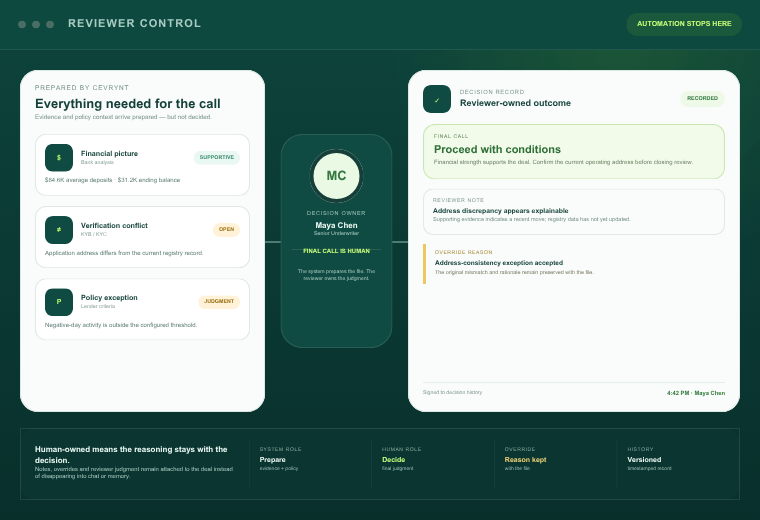
Cevrynt is an MCA platform for funders and alternative lenders: AI-assisted underwriting from intake to an evidence-linked memo, plus a built-in MCA CRM for the deal pipeline, ISO and broker management, offers and contracts, and funding and servicing, including daily remittances, collections and renewals. It is not a lender, and syndication and participant reporting are not part of Cevrynt today. The lender keeps final authority over every decision; fraud and policy results are flags for a person to review, not automatic declines.
Its output is the underwriting report: financial findings, verification results, fraud and risk signals and policy outcomes, each linked to the page of the source document behind it, together with reviewer notes, overrides and audit history. For a syndicated deal, that report is a natural part of the participant package: the underwriting basis a participant asks for at funding, and the record the lead can retrieve when a participant exercises audit rights. How it fits an MCA workflow is described on the merchant cash advance solution page.
Because remittances and collections for the deal are tracked in the same platform as its underwriting record, the lead has one deal identifier to reconcile against. Participant ledgers and distributions stay in whatever syndication tool or process you use today. If you want to see how an evidence-linked report would look for your files, book a walkthrough or email sales@cevrynt.com.